Bitcoin CPU Mining: History, Feasibility, and Alternatives
Bitcoin CPU mining is technically possible, but it's economically negligible because modern ASICs are roughly 50 million times faster and about a million times more energy efficient than early CPUs. For a beginner today, the realistic purpose of mining with a processor is education and experimentation, not earning Bitcoin.
That distinction matters. Bitcoin began as a network that welcomed ordinary desktop computers, but its mining economics changed as specialized hardware took over the work. A CPU can still demonstrate hashing, pool communication, wallet configuration, and proof-of-work mechanics, yet it won't compete meaningfully with the industrial machines securing the network.
The practical question, then, is not whether your computer can mine Bitcoin. It can. The better question is what you want to learn, what electricity and hardware you're willing to use, and whether another CPU-friendly network offers a more useful hands-on experience.
Table of Contents
- The Origins of Bitcoin CPU Mining
- The Hardware Evolution That Ended CPU Era
- Understanding the Technical Gap Between CPUs and ASICs
- How to Experiment with CPU Mining for Education
- Exploring Energy-Efficient Mining Alternatives
- Why Hobbyists Should Consider Alternative Coins
- Conclusion and Future Perspectives on CPU Mining
The Origins of Bitcoin CPU Mining
On January 3, 2009, Satoshi Nakamoto mined Bitcoin's genesis block with a standard CPU. At launch, network difficulty was 1.0, and that low starting point allowed ordinary desktop processors to compete effectively for blocks through much of 2009, as documented in this history of Bitcoin mining.
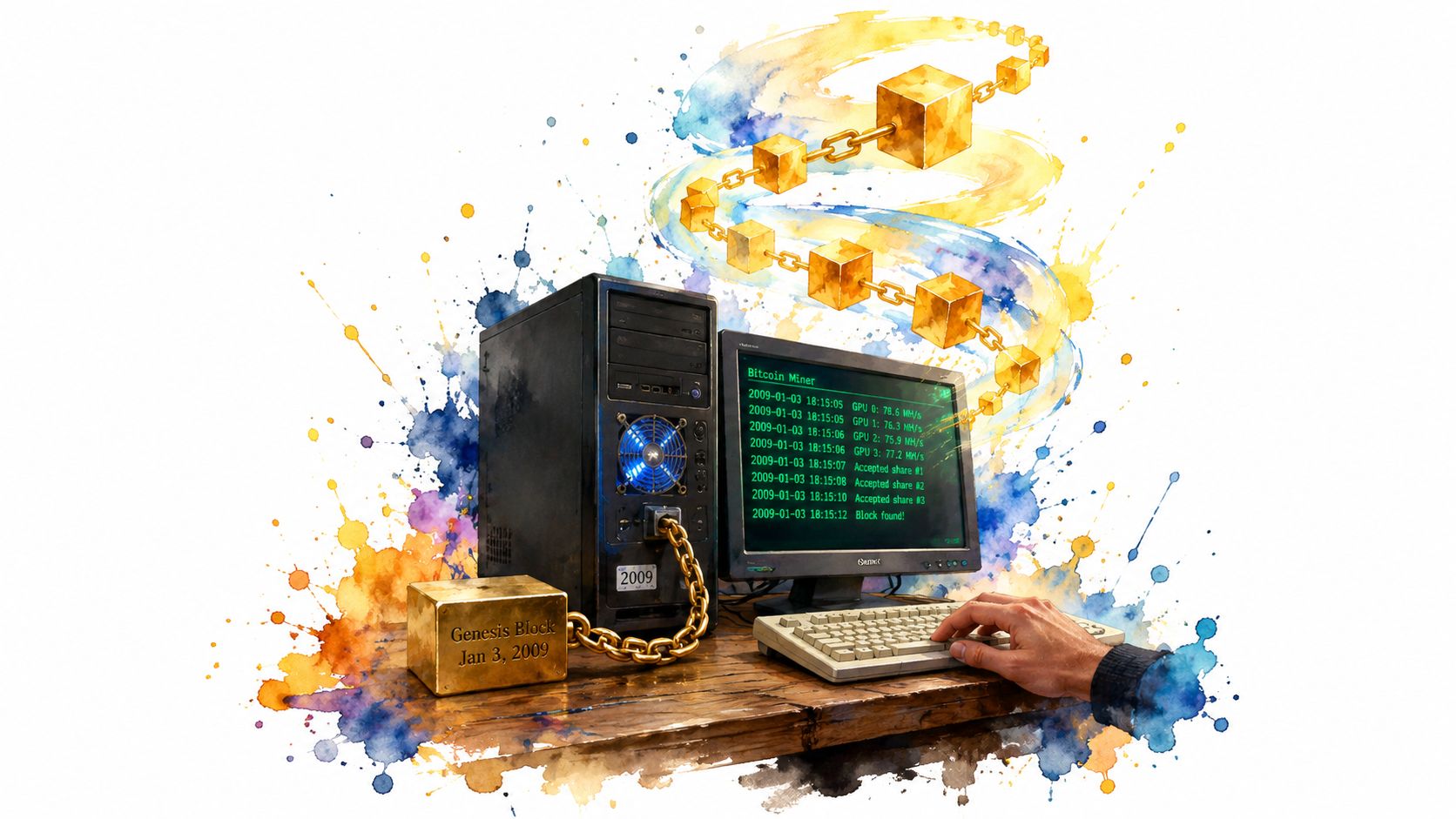
A miner in that environment didn't need a warehouse, custom cooling, or a purpose-built SHA-256 machine. A desktop processor could perform the required calculations and have a meaningful chance of finding a block because relatively little competing hashpower was connected to the network. One industry history describes the early phase as relying on roughly 4.7 MH/s on a single CPU, a useful illustration of how different the network was from today's industrial system.
The important point isn't that early miners discovered a secret way to make Bitcoin easy. They participated during a period when the network was small and the difficulty target was low. Mining software used the general-purpose hardware already available in a home computer, so CPU mining wasn't a compromise. It was the normal method.
Why the early model worked
Bitcoin's proof-of-work process has always required miners to search for valid hashes. The process itself hasn't become conceptually inaccessible, but the amount of competition around it has changed dramatically. As more participants joined, miners looked for hardware that could perform more hashes with less energy.
Early CPU mining also had a different opportunity cost. A desktop might run mining software in the background while its owner used the machine for ordinary tasks. That setup made experimentation approachable, and it helped establish mining as a visible part of Bitcoin's culture. Readers interested in how the industry developed can also explore this blog for crypto talent seekers, which provides broader context on work across the blockchain sector.
For a beginner, the historical lesson is straightforward: Bitcoin CPU mining was once practical because the network was young, not because CPUs are naturally suited to SHA-256. A broader explanation of how mining works, including the relationship between hardware, hashes, and network security, is available in this cryptocurrency mining guide.
The Hardware Evolution That Ended CPU Era
CPU mining lost its position because miners optimize for two connected variables, hashrate and energy consumed per hash. General-purpose processors can run SHA-256, but they perform many other computing tasks too. An ASIC, by contrast, is designed around a specific hashing algorithm and removes much of the flexibility that makes CPUs useful for everyday computing.
The transition moved through increasingly specialized hardware. GPUs brought parallel processing, FPGAs introduced programmable logic designed around mining workloads, and ASICs eventually hardwired the required operations into dedicated silicon. Each step made it harder for a desktop processor to justify its electricity use.
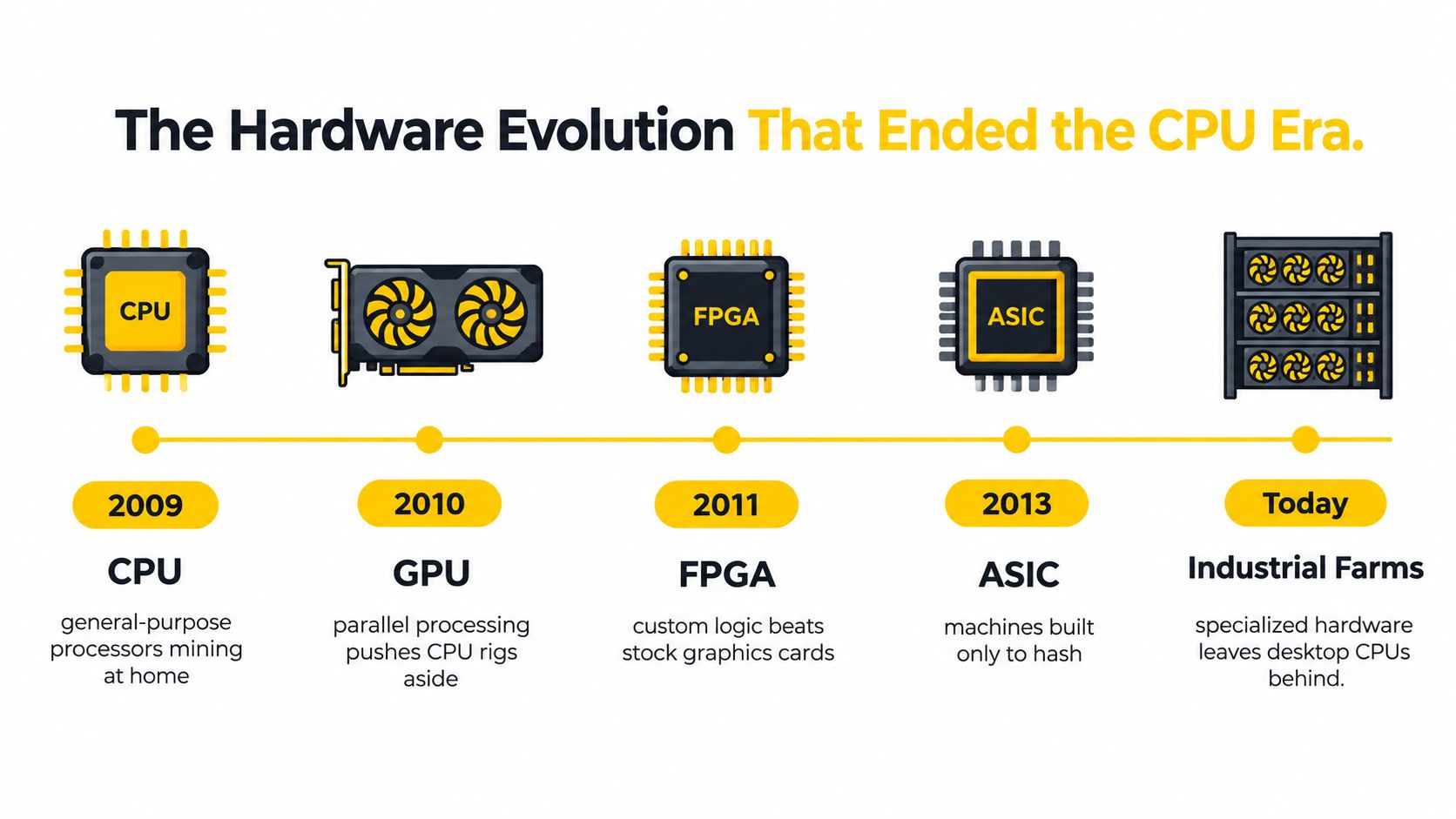
A particularly clear milestone arrived in mid-2013, when ASICMiner's Block Erupter USB shipped with 336 MH/s of hashing power while consuming only 2.5 watts. The same historical timeline calculates its efficiency at about 7,440,000 J/TH and reports that SHA-256 mining hardware became about 827,000 times more efficient over 13 years. Those figures are summarized in this Bitcoin mining hardware history.
Why specialization changed the economics
A CPU has to balance mining against operating-system tasks, memory management, graphics, applications, and many other workloads. An ASIC doesn't need that flexibility. Its circuitry can focus on the transformations required by SHA-256, allowing the manufacturer to arrange the chip around throughput and power efficiency.
That advantage compounds at network scale. If one class of hardware produces far more hashes while using less electricity, miners using weaker equipment face two problems at once. They contribute fewer attempts toward a block, and they spend more energy for every attempt they make.
Practical rule: If your goal is to mine Bitcoin economically, evaluate SHA-256 hardware by joules per terahash and total operating cost, not by whether a CPU can run the algorithm.
The difference also explains why small USB ASICs became historically important even though they were quickly outgrown. A device built only for Bitcoin hashing could outperform a general-purpose computer in the one task that mattered to the network. A technical look at compact dedicated devices is available in this USB ASIC Bitcoin miner guide.
The hardware race didn't make CPU mining impossible. It made it financially irrational. Once specialized machines dominated the available block probability, desktop processors became useful mainly for learning, testing, or mining algorithms designed to resist that kind of specialization.
The following video offers a visual introduction to the changing hardware:
Understanding the Technical Gap Between CPUs and ASICs
The clearest way to assess Bitcoin CPU mining is to compare a processor and an ASIC using the same units. A practical benchmark places a CPU at about 0.01 GH/s and approximately 9000 J/GH, while ASIC-based devices reach roughly 44,000 GH/s at about 0.05 J/GH. The benchmark, discussed by the International Energy Agency, gives the ASIC about 4.4 million times more throughput and vastly lower energy use per hash.
| Hardware | Approximate hashrate | Energy figure |
|---|---|---|
| CPU benchmark | 0.01 GH/s | 9000 J/GH |
| ASIC benchmark | 44,000 GH/s | 0.05 J/GH |
The table isn't a shopping comparison. It shows why the question “Can my CPU mine Bitcoin?” needs a second sentence. The processor can execute the algorithm, but its contribution is vanishingly small beside dedicated hardware.
Hashrate is only half the problem
A beginner may look at hashrate first and overlook electricity. That creates a misleading picture because mining is a continuous search process. A machine that generates fewer hashes per second has fewer opportunities to find a valid result, and a machine that uses more energy per hash increases the cost of every opportunity.
ASICs also benefit from purpose-built deployment. Operators can install many machines in facilities designed around power delivery, ventilation, monitoring, and maintenance. A home CPU doesn't receive the same operational advantages, even before its lower hashrate enters the calculation.
Independent analysis describes the underlying cause as hardware specialization. SHA-256 can be hardwired into dedicated silicon, reducing energy per hash and increasing throughput. The same analysis reports roughly 300,000-fold improvement in semiconductor conversion efficiency from CPU through GPU to ASIC mining since Bitcoin's inception, a change that helps explain why the network moved away from desktop participation.
What a CPU contributes today
A CPU still contributes valid hashes if mining software connects it to a Bitcoin pool or node. The issue is expected share. Against network-scale ASIC competition, a normal desktop processor's probability of influencing a block outcome is effectively zero in practical terms.
That doesn't make the experiment useless. Running a miner lets you observe work submission, accepted shares, rejected shares, local hashrate, processor load, thermal behavior, and wallet accounting. It changes the success criterion from earning Bitcoin to understanding how a proof-of-work system operates.
How to Experiment with CPU Mining for Education
Treat a CPU mining setup as a small laboratory. The safest starting point is an alternative algorithm or test environment where the purpose is to observe the process rather than compete for Bitcoin's block rewards. A beginner-focused resource on understanding cryptocurrency mining can help clarify the basic terminology before you install software.
A practical learning path
Define the experiment. Decide whether you want to study wallet creation, pool communication, algorithm behavior, operating-system performance, or blockchain records. Write down the goal before launching a miner.
Use a separate wallet. Create a wallet intended for experimentation, verify that you control the recovery information, and avoid entering sensitive wallet details into unverified mining software. A test wallet keeps the exercise separate from funds you may hold elsewhere.
Choose the algorithm first. Don't assume a Bitcoin miner is suitable for every network. Match the software to the algorithm, and confirm that the download comes from a legitimate project source. CPU-friendly algorithms are generally more appropriate for a home demonstration than SHA-256.
Connect to a reputable pool or test network. A pool provides visible shares and regular feedback, which is useful when you're learning. A testnet or local setup can be even better if your objective is to explore transactions and block production without treating the activity as income.
Start conservatively. Limit CPU threads, watch temperature and fan behavior, and check whether the computer remains responsive. Mining software should never compromise the machine's normal use or cause sustained thermal stress.
Record what happens. Note hashrate, accepted shares, rejected shares, processor utilization, power behavior, and wallet updates. The record is more valuable than an unverified promise of earnings.
A useful experiment produces observations, not expectations. If the software teaches you how work moves from a miner to a pool and how rewards are recorded, it has done its job.
Don't download a program just because a website claims that your laptop can earn Bitcoin. Search for the project's documentation, inspect the software's provenance, and understand what permissions it requests. CPU mining applications are also a common disguise for unwanted software, so security checks matter as much as technical configuration.
After the first run, compare the result with the network's actual purpose. If the machine is producing tiny amounts of work while consuming noticeable power, stop treating it as a financial project. Keep the setup for learning, move to a more suitable algorithm, or shut it down.
Exploring Energy-Efficient Mining Alternatives
The more useful alternative to Bitcoin CPU mining isn't necessarily another attempt to maximize hashes on the same algorithm. It may be a network that treats participation, experimentation, and lower-power hardware as legitimate design goals.
Cascoin is one example. Its open-source model uses Labyrinth Mining, where lightweight client software simulates mice navigating a virtual maze to collect virtual cheese. The project also provides MinotaurX, a CPU-friendly option intended for low-power participation, alongside SHA-256 for operators who already work with specialized hardware.

This kind of design changes the learning experience. Instead of pretending that a desktop CPU can compete with Bitcoin's ASIC network, it gives the user a visible task, a lightweight client, and a network where low-power participation is part of the intended model. The code is publicly available, and users can inspect activity through the Casplorer block explorer.
What to evaluate in a CPU-friendly project
Look beyond a claim that a coin is “easy to mine.” Check whether the software is open source, whether the algorithm is documented, whether the network has a working explorer, and whether wallet and pool instructions are clear. A project should also explain its risks without presenting mining as guaranteed income.
Power use deserves attention even when a project is designed for CPUs. Run only the resources you can afford, monitor heat, and compare the experience with your original learning goal. Lower consumption is helpful, but it doesn't remove hardware wear, market volatility, software risk, or the possibility that a small network may change over time.
For readers interested in the environmental side of proof-of-work systems, this cryptocurrency environmental impact overview provides a useful starting point. The broader principle is simple: choose a network and mining method that match your hardware instead of forcing a general-purpose processor into an industrial SHA-256 competition.
Why Hobbyists Should Consider Alternative Coins
Bitcoin is the wrong training ground if your main objective is to see meaningful feedback from a home CPU. Its security model is valuable precisely because miners compete at enormous scale, but that scale removes the beginner from the practical outcome. You can observe the process, yet your machine won't have a meaningful economic role.
A smaller, CPU-oriented project can offer a better connection between action and result. You can configure a wallet, launch a miner, inspect submitted work, watch the explorer, and discuss changes with a community. Those activities teach transferable skills without requiring you to pretend that a desktop is an industrial mining rig.
Choose according to your goal
- For Bitcoin history: Run a controlled demonstration and study how the genesis block and early difficulty made desktop mining possible.
- For mining mechanics: Use a CPU-friendly algorithm or test environment where shares and local performance are easy to observe.
- For open-source research: Prefer projects with public repositories, documented clients, and verifiable on-chain activity.
- For low-power participation: Compare CPU load, heat, and runtime before committing to continuous operation.
- For financial returns: Don't assume any CPU project is profitable. Calculate energy costs and treat rewards as uncertain.
The appeal of an alternative coin isn't that it guarantees earnings. It's that the network may give a hobbyist a more direct role. That can make the learning loop more rewarding: configure, test, measure, review, and improve.
Cascoin's CPU-friendly MinotaurX option fits that educational category, while its Labyrinth Mining approach offers a different way to think about participation. It should be assessed like any other open-source project, by examining its software, documentation, network activity, and community rather than relying on promotional claims.
Conclusion and Future Perspectives on CPU Mining
Bitcoin CPU mining has a clear two-part answer. Technically, a CPU can run Bitcoin's hashing algorithm. Economically, it cannot compete with modern ASIC infrastructure. The hardware transition from general-purpose processors to dedicated silicon made desktop mining historically important but commercially negligible for Bitcoin.
That doesn't make a CPU irrelevant. A carefully controlled experiment can teach wallet handling, pool communication, proof-of-work, performance monitoring, and the relationship between hardware and network difficulty. Those lessons are often more valuable to a beginner than running a machine continuously while expecting a reward that won't arrive.
The best roadmap is therefore practical:
- Learn how Bitcoin mining worked at launch.
- Run a safe, limited CPU experiment.
- Measure hashrate, heat, power behavior, and accepted work.
- Move to a CPU-friendly algorithm if participation matters more than Bitcoin specifically.
- Inspect open-source code and on-chain activity before trusting a project.
- Treat every reward as uncertain and every electricity cost as real.
CPU mining may continue to matter in networks that value accessibility, experimentation, or resistance to specialized hardware. It may also remain useful in classrooms, developer environments, and home laboratories. The opportunity isn't to recreate Bitcoin's early economics. It's to use today's tools to understand how decentralized networks work and to choose projects whose design matches the equipment you have.
Cascoin offers CPU-friendly MinotaurX mining, lightweight Labyrinth Mining, public documentation, and verifiable network activity for people who want to explore a lower-power alternative to Bitcoin CPU mining. Visit Cascoin to review the available mining options and decide whether its open-source ecosystem fits your learning project.