Crypto Community Building: The Complete Playbook for Cascoin
You've opened a Discord server, published an announcement, and watched the member count climb. Then the questions slow down, newcomers disappear after their first campaign, and the same small group carries every conversation. That pattern is common in crypto community building because attention is easy to acquire, while reasons to return must be designed into the product.
For a mining project, the difference is especially clear. A social feed can announce a new pool or software release, but it can't create durable participation by itself. Members stay when they can learn, contribute, verify what's happening, and experience useful activity inside the network. Cascoin's Labyrinth Mining model offers a practical example of that product-linked approach, where participation can connect community interaction with an underlying mining experience rather than relying only on hype.
Table of Contents
- The Reality of Crypto Community Building
- Defining Mission and Core Values
- Onboarding Different Miner Archetypes
- Building Trust Through Transparency
- Shifting Metrics to Retention Engineering
- Executing Your Community Strategy
The Reality of Crypto Community Building
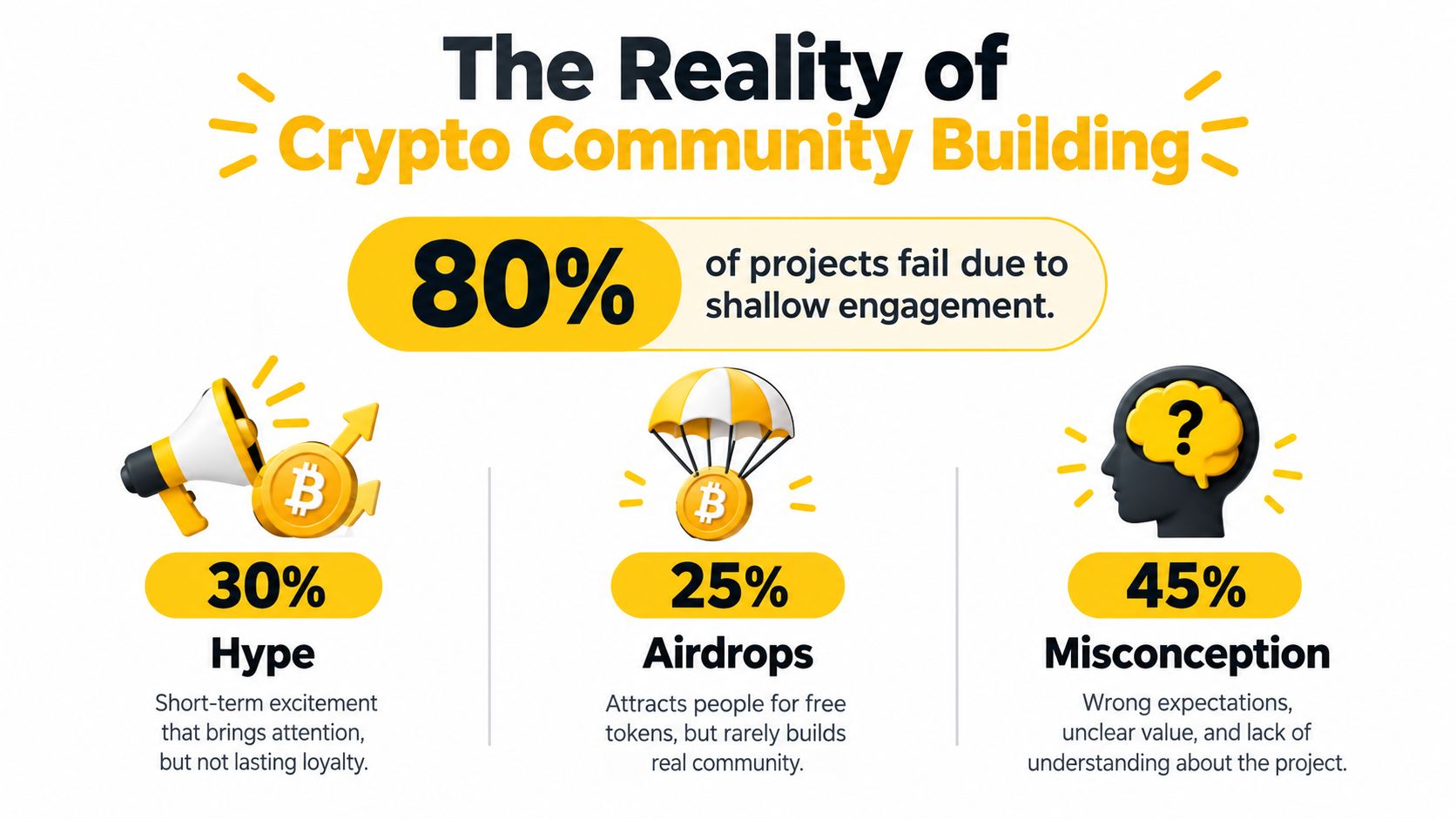
A crypto project can look active while failing to build participation. Thousands of accounts, launch-day reactions, and busy moderator logs show reach. They do not show whether newcomers finish onboarding, contribute to discussions, mine, test software, or return to take part in governance.
Community growth works better as a lifecycle with four phases: acquisition, activation, engagement, and retention. The crypto community management lifecycle connects durable participation with structured onboarding, recurring events such as weekly AMAs, and mechanics that link Discord activity with on-chain rewards. If acquisition runs ahead of activation and retention, the project collects attention without building a functioning member base.
Why member counts mislead
A membership total cannot show whether people understand the project or have a reason to participate. Someone joining for an airdrop may never read the documentation. A miner may enter the server, fail to find the correct software path, and leave without asking for help. A developer may want to inspect the repository but see only promotional announcements.
The operating question should be: what action should a new member complete next, and what value follows that action? For a miner, the path might run from an introduction channel to wallet setup, a mining guide, a support role, and a visible contribution. For a developer, it could move from technical documentation to an issue tracker and a public discussion.
Platform selection should support these behaviors. This community platform choice advice compares community formats, moderation needs, and participation workflows. Choose the platform that makes the intended next action obvious, rather than the one with the loudest audience.
Attention must connect to utility
Short-term return behavior and durable retention are different outcomes. Industry analysis describes the crypto vertical's stickiness as roughly 31% DAU/MAU, while about 60% of members churn inside 90 days and one-year on-chain retention is reported at 15.1% in the same analysis. A person can return frequently for a short period without becoming a lasting participant.
For Cascoin, Discord should help members use and understand the network. It should not replace the network's own reasons to return. Labyrinth Mining, accessible mining paths, transparent code, and verifiable on-chain activity give members concrete tasks and evidence to discuss. Product-linked features create intrinsic participation, so community activity leads back to the mining experience instead of depending only on campaigns or hype.
Defining Mission and Core Values
Before recruiting miners, write the sentence that explains why the network should exist. A vague mission such as “building the future of finance” attracts almost anyone and gives almost nobody a clear reason to stay. A useful mission names the problem, the participant, and the behavior the project wants to make possible.
For a project built around efficient, playful mining, the message could connect lower-power participation, open development, and gamified discovery. That framing speaks differently to an eco-conscious miner, an open-source contributor, and someone looking for an approachable way to explore cryptocurrency. The audience can overlap, but the reasons for joining aren't identical.
Turn technical goals into community promises
Use a short workshop before opening recruitment:
- Name the participant. Decide whether the first priority is a beginner with a CPU, an experienced ASIC operator, an engineer, or a governance-minded contributor.
- Describe the useful behavior. Specify what members should do after joining, such as running a client, testing a release, reporting an issue, or reviewing a proposal.
- Choose core values. Transparency, ecological efficiency, accessibility, experimentation, and respectful technical debate can become operating standards rather than decorative language.
- Define evidence. For every value, identify something members can inspect. Public code supports openness. Mining documentation supports accessibility. A block explorer supports verifiability.
- Remove incompatible incentives. If the project wants thoughtful participation, it shouldn't reward only message volume or referral spikes.
The project's technical philosophy should remain understandable without stripping away its substance. The white paper on cryptocurrency can serve as a reference point for explaining how the network's purpose, mechanics, and participant expectations fit together.

Build values into everyday decisions
Values become credible when they change what the team publishes and rewards. If transparency matters, publish release notes, explain known limitations, and keep technical questions visible. If accessibility matters, offer a beginner path without treating basic questions as noise. If experimentation matters, label experimental features clearly and invite feedback that can improve them.
A concise value proposition might read like this: “Join an open, community-built network where participants can explore efficient mining, inspect the code, and help shape the tools around it.” That sentence doesn't promise a price outcome. It tells the right audience what kind of participation is available.
Write separate versions for each audience, but keep the central promise consistent. A CPU miner needs a clear starting point. An ASIC operator wants accurate pool and software information. A developer wants repositories, issue tracking, and a clear contribution process. Mission gives those paths a shared purpose, while values determine how the project behaves when the community faces disagreement or uncertainty.
Onboarding Different Miner Archetypes
A single onboarding funnel creates avoidable friction because miners arrive with different hardware, knowledge, and expectations. The first screen should help a newcomer identify their path rather than forcing everyone through the same technical explanation.
Cascoin's three mining options provide a useful structure: Labyrinth Mining, MinotaurX, and SHA-256. Each path needs its own language, proof points, and support route.
The Labyrinth Mining participant
Labyrinth Mining is the product-led entry point for people attracted to a lighter, more playful mining experience. The onboarding should explain the maze concept in plain language, show how the client works, and make the first successful action visible. New users need a wallet guide, client installation instructions, an explanation of the mining loop, and a place to ask basic questions without embarrassment.
Don't lead with dense algorithmic terminology. Lead with the experience, then provide technical depth for users who want to inspect how the system operates. A short tutorial can direct newcomers to a test or demonstration environment, followed by a checklist that confirms wallet creation, client configuration, and first participation.
The CPU-friendly MinotaurX user
MinotaurX serves people who want accessible, low-power participation without specialized equipment. Their biggest risks are uncertainty and comparison anxiety. They may ask whether their computer is suitable, how to monitor activity, what normal behavior looks like, and how to troubleshoot a failed connection.
Give this group a dedicated role and channel. Pin a minimal setup guide, a troubleshooting decision tree, and a request template that asks for the information moderators need. The community should celebrate learning milestones, not just output. A newcomer who successfully configures a client and helps another beginner is already contributing to network health.
The SHA-256 operator
Experienced ASIC operators need a different experience. They're looking for direct documentation on pool integration, configuration, monitoring, operational requirements, and profitability variables. Promotional language weakens trust with this audience because operators make decisions from technical and economic details.
Use a specialist channel with clear documentation and release notices. Separate confirmed facts from community observations, and avoid implying that mining returns are guaranteed. Operators can still become community leaders when the project gives them a place to compare configurations, report operational issues, and discuss infrastructure without burying the conversation under general chat.
Route people by intent
Role-based onboarding prevents the server from becoming a single stream where every message competes for attention. Ask one early question, then route members to the path that matches their goal.
| Member type | First useful action | Best support format |
|---|---|---|
| Labyrinth Mining newcomer | Complete the guided maze and wallet setup | Tutorial, visual walkthrough, beginner chat |
| MinotaurX participant | Configure a CPU-friendly client | Checklist, troubleshooting channel, peer help |
| SHA-256 operator | Connect hardware to the relevant pool workflow | Technical documentation, operator discussion |
| Developer or researcher | Inspect code and identify a contribution path | Repository, issues, technical calls |
The goal isn't to create isolated groups. It's to make the first success attainable, then give members opportunities to cross paths through AMAs, release discussions, governance, and shared experiments. Product-linked onboarding works when each persona can do something meaningful quickly and understand where deeper participation begins.
Building Trust Through Transparency
Trust isn't created by repeating that a project is transparent. Members trust systems they can inspect, question, and verify. That requires a visible connection between community claims and technical evidence.
For an open-source cryptocurrency, the repository is part of the community infrastructure. A public, MIT-licensed codebase lets developers review implementation details, propose changes, and audit the assumptions behind the product. The open-source code repository should be treated as a participation surface, not a legal footnote.
Make verification a normal habit
Every important claim needs a route to independent confirmation. If the team announces a release, publish the relevant code and documentation. If a network event occurs, point members to the block explorer. If a bug is known, record it and explain its status instead of allowing moderators to answer the same question privately.
A practical transparency stack includes:
- Public code: Keep repositories organized, explain contribution expectations, and distinguish stable releases from experimental work.
- Verifiable chain data: Use a public explorer such as Casplorer so members can inspect transactions and network activity without relying on screenshots.
- Visible decisions: Record proposals, objections, and outcomes where the broader community can review them.
- Honest risk language: Explain volatility, technical uncertainty, operational failure modes, and the absence of guaranteed outcomes.
This approach also improves moderation. When a question has a public technical answer, moderators can link to the evidence and keep the discussion open. When the answer is uncertain, the team can label it as unresolved and invite investigation.
Product-linked engagement beats announcement cycles
Gamification works best when it reinforces genuine product behavior. Labyrinth Mining can create an intrinsic reason to return because the activity itself gives members something to learn, discuss, and improve. The maze isn't merely a theme layered over a marketing campaign. It can become a shared language for tutorials, challenges, user feedback, and software development.
That distinction matters. A reward campaign can attract attention, but it may end when the reward ends. A product-linked loop gives people recurring reasons to open the client, compare experiences, ask questions, and help others. Community managers should measure whether those actions lead to better product understanding and sustained participation, not just whether an announcement produced reactions.
Transparency also means resisting exaggerated expectations. Cryptocurrency markets are volatile, and mining outcomes depend on changing technical and economic conditions. A mature community can discuss potential openly while refusing price promises, artificial urgency, or claims that cannot be checked.
Practical rule: If members can't verify a claim, label it as an opinion, a hypothesis, or an open question.
Shifting Metrics to Retention Engineering
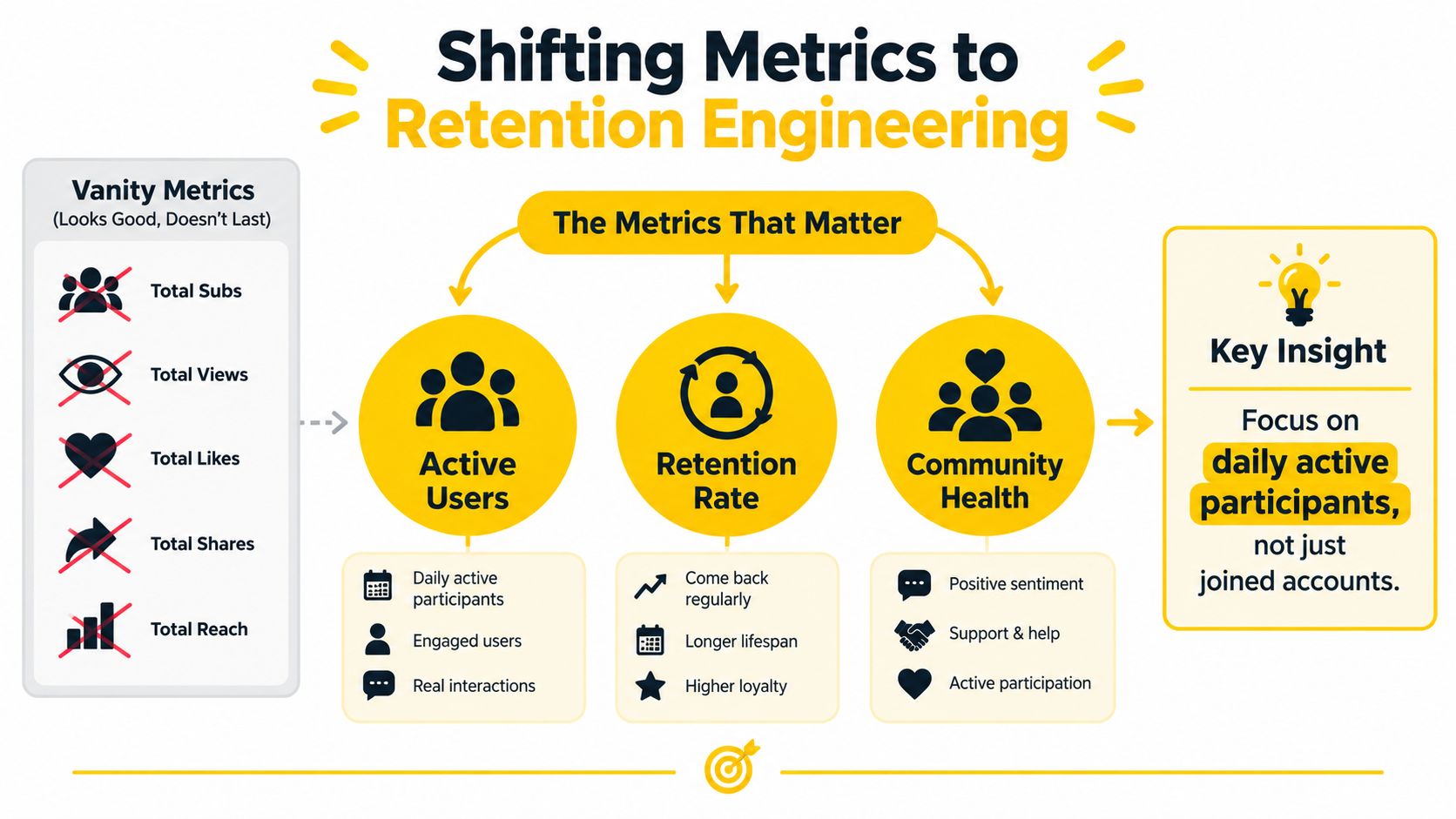
A community can grow while the product experience remains weak. Retention engineering examines what members do after joining, where participation stops, and which actions predict continued involvement. For Cascoin, the dashboard should connect community behavior to product use rather than treating activity as an end in itself.
The crypto community management benchmark analysis separates behavioral measures such as WAM, DAU/MAU, and governance turnout from lifecycle measures such as 30-day and 90-day retention. It also warns that frequent same-day returns do not necessarily indicate durable participation. The distinction helps the team assess whether members are building lasting habits or merely reacting to announcements.
Use benchmarks as diagnostic signals
A practical crypto community lifecycle framework recommends DAU/MAU above 40% as a sign of habit formation, weekly active rates above 50% as evidence of utility-driven engagement, and governance participation above 30% as a marker of meaningful decentralization. These figures are directional targets, not proof of a healthy community by themselves, and come from the four-phase community management framework.
Raw member counts can rise without improving participation, especially when newcomers are routed into channels that do not match their goals. Use each metric to identify a specific product or operating question:
- DAU/MAU: Do members return often enough to suggest a habit?
- Weekly active rate: Does the product offer practical utility between launch moments?
- Governance turnout: Are decisions attracting broad participation rather than only large holders?
- 30-day and 90-day retention: Which onboarding cohorts remain active after initial curiosity fades?
- Active contributors: Who mines, tests, documents, moderates, reports bugs, or helps newcomers?
Instrument the journey, not just the channel
Assign an event to every meaningful step. Record when a user joins, selects a mining role, downloads a wallet, completes setup, enters a pool, asks for help, submits feedback, or participates in governance. Compare cohorts by entry path, role, and first product action instead of relying on total membership.
A drop between joining and role selection points to unclear routing. A drop between setup and a first successful mining session may indicate documentation gaps or technical friction. Strong chat activity alongside weak product actions shows that conversation has not yet become utility.
Labyrinth Mining gives retention measurement a product-linked dimension. Track whether maze-related activity leads members to open the client, compare results, solve problems, contribute feedback, or return for another session. The objective is to identify recurring product value, not to reward announcement reactions alone.
A useful dashboard prioritizes retention, governance participation, returning users, active contributors, and treasury spend over vanity signals. If a metric does not change a decision, it should not receive top billing.
Executing Your Community Strategy
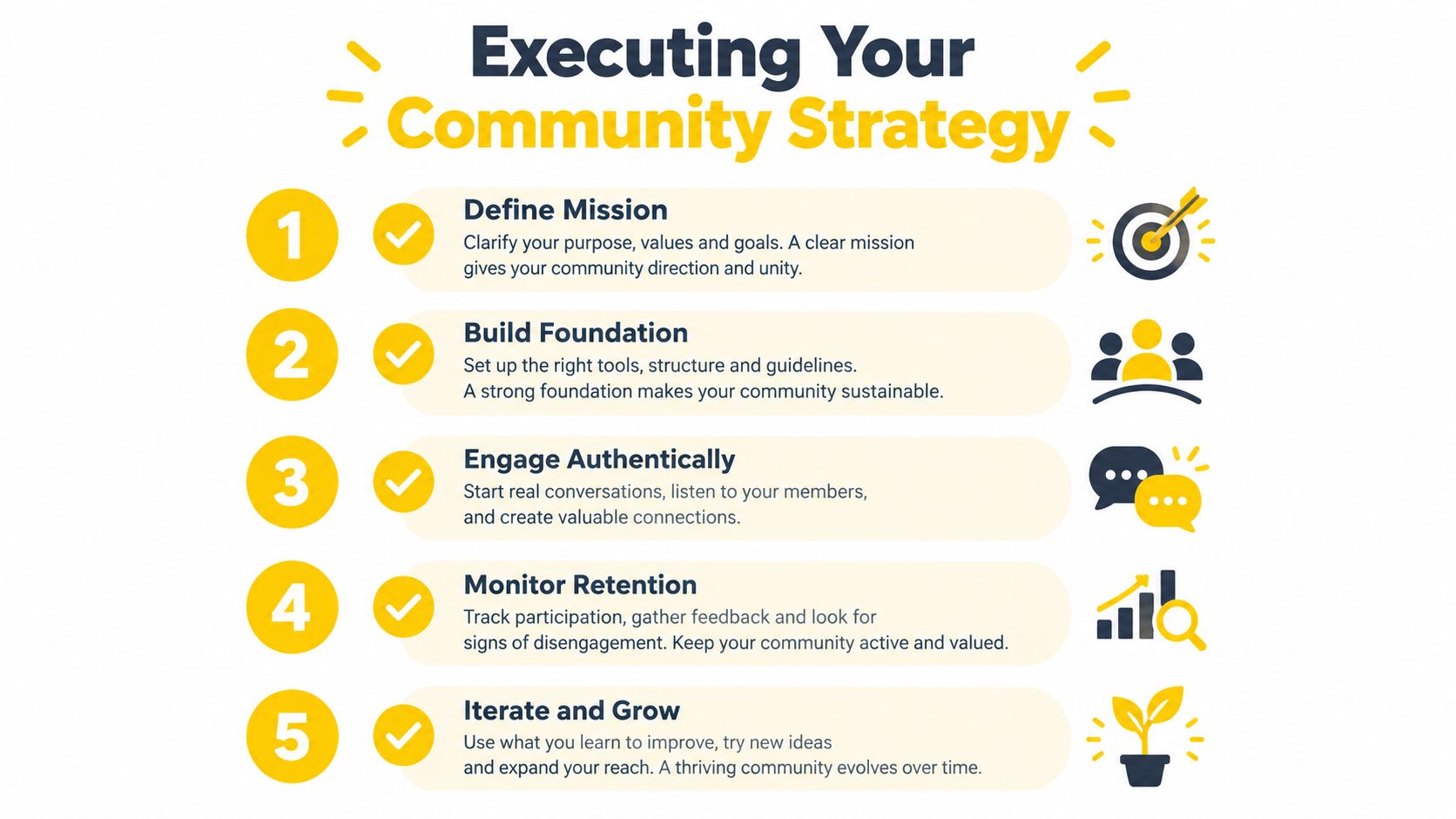
Execution becomes manageable when each community action has a product outcome. Start with a small operating system that connects documentation, conversation, code, and measurement.
- Define the mission. Publish the participant promise, core values, risk language, and the behaviors that count as meaningful contribution.
- Build the foundation. Organize Discord roles around miner archetypes, maintain clear wallet and mining guides, and connect technical questions to the repository.
- Create recurring utility. Schedule AMAs, release discussions, onboarding sessions, mining walkthroughs, and governance conversations. Each event should produce a next action.
- Measure retention. Track activation, returning participation, 30-day and 90-day retention, contribution, and governance behavior by cohort.
- Iterate deliberately. Review drop-off points, update documentation, adjust role routing, and explain what changed based on member feedback.
Give every channel a job
Discord works well for real-time support and social coordination. GitHub or Codeberg works better for issues, pull requests, and durable technical decisions. A public explorer supports verification. Documentation should answer repeat questions before they consume moderator time. The project's Telegram community guidance can help teams decide how an additional messaging channel fits into that ecosystem without duplicating every conversation.
Use a simple weekly rhythm:
- Monday: Publish one product or documentation update.
- Midweek: Hold an onboarding or technical session.
- Later in the week: Run an AMA, mining discussion, or governance prompt.
- End of week: Review retention signals, unanswered questions, and recurring friction.
The founder playbook for community growth is useful for thinking through ownership, cadence, and early operating discipline. Still, templates only work when the team connects them to a real product loop.
For Cascoin, that loop can connect Labyrinth Mining, CPU-friendly participation, SHA-256 operations, open-source contribution, and verifiable network activity. The community team should review the path from first visit to first useful action, then remove one source of friction each cycle. That is how crypto community building becomes an operating practice rather than a sequence of promotional bursts.
Cascoin offers an open-source cryptocurrency with Labyrinth Mining, MinotaurX, and SHA-256 participation paths, alongside public code, mining resources, and verifiable on-chain activity. Visit Cascoin to explore the network, choose the path that fits your hardware or interests, and join a community built around practical participation.