How to Setup Your Own Mining Pool for Cascoin

A rack of GPUs is humming, the upstream connection is stable, and the third-party pool dashboard still shows another payout threshold to reach. That's the point where many Cascoin miners start asking how to setup your own mining pool, not because pool software looks simple, but because they want control over the path between their hardware, the node, the shares, and the wallet.
Running the service yourself can remove a pool fee from the operation and give you control over payout timing and worker accounting. It also makes every outage your problem. A synchronized node, a reachable Stratum endpoint, accurate share validation, sensible payout logic, and fast block propagation all have to work together. A pool that looks healthy in a dashboard can still lose value through stale shares, delayed jobs, orphaned blocks, or payout errors.
Table of Contents
- Why Run Your Own Cascoin Mining Pool
- Server and Network Prerequisites
- Choosing Pool Software for a Cascoin Deployment
- Installing the Node, Pool, and Stratum Endpoint
- Connecting Labyrinth, MinotaurX, and SHA-256 Miners
- Monitoring Hashrate, Shares, and Propagation
- Backups, Security, and Long-Term Operations
Why Run Your Own Cascoin Mining Pool
The decision often starts with a practical irritation. A miner has several machines pointed at a public pool, but the account view gives limited control over payout timing, worker policy, and incident response. When the pool has a regional networking problem, the miner can only wait for the operator to fix it. Hosting a private pool changes that relationship. You decide where the node runs, how miners authenticate, when payouts are processed, and how quickly you respond when shares turn stale.
That control comes with a cost. A public pool spreads operations across a larger infrastructure team and a wider miner base. A private operator carries the burden of keeping the node synchronized, protecting the payout wallet, maintaining the database, and providing a fallback endpoint. The relevant question isn't whether self-hosting removes all pool problems. It's whether the extra control is worth taking responsibility for the problems yourself.
The real reasons operators make the switch
Fee retention is an obvious motivation, but it shouldn't be the only one. A small fee difference can disappear if your endpoint produces stale shares, goes offline, or pays incorrectly. Guides on pool selection caution that server distance, downtime, payout thresholds, and reporting quality can matter more than the advertised fee, which is why testing a pool with part of a fleet is safer than moving everything at once. See this practical mining-pool selection guidance before treating fee retention as a guaranteed saving.
Payout control matters when miners have different owners or when you need a particular accounting policy. You can choose how workers are grouped, how balances are recorded, and when the payout process runs. You can also inspect the code that handles those decisions instead of trusting an opaque service.
Network control is the less obvious benefit. A pool operator can place the node close to miners and peers, maintain a backup path, and react to propagation problems directly. The history of pooled mining shows why decentralization and protocol support matter. Slush's Pool launched in November 2010, and Deepbit reportedly controlled over 50% of the Bitcoin network hashrate at its peak between 2011 and 2013, a concentration that highlighted the operational importance of redundancy and decentralization. The historical context is summarized by P2Pool's mining-pool history resource.
For readers evaluating the wider business side of mining infrastructure, Blocsys Technologies' discussion of mining capital provides useful context around how mining operations can think about funding and infrastructure ownership. It isn't a substitute for a pool design, but it helps frame the difference between owning equipment and operating the systems that make that equipment productive.
A private Cascoin pool succeeds when miners submit valid work promptly, the node builds correct jobs, and rewards reach the intended wallets. The headline hashrate is only part of that result. Share efficiency and propagation latency decide whether the server earns its keep.
For a plain-language explanation of the components involved, start with what a mining pool does. Then treat the project as an operations service, not as a one-time installation.
Server and Network Prerequisites
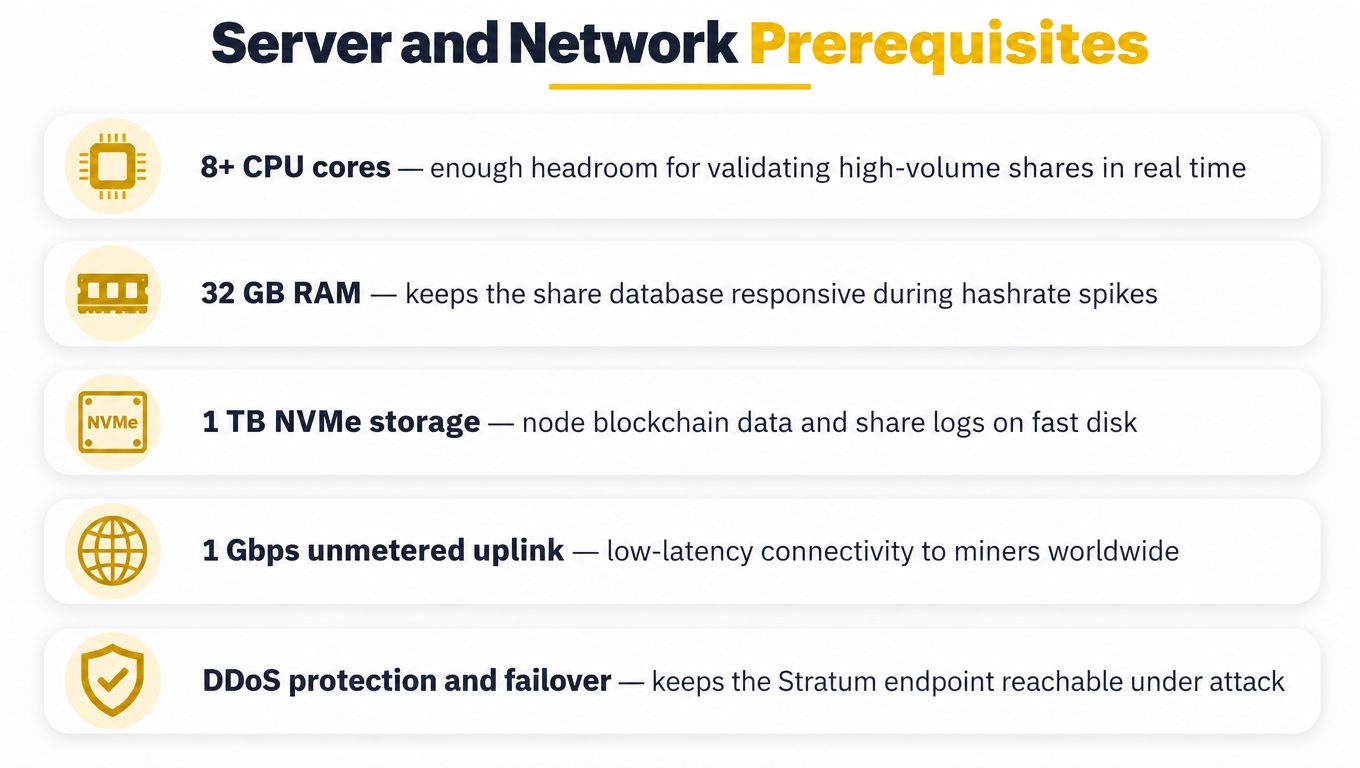
Start with the node and network path, not the pool dashboard. The pool daemon validates shares, requests jobs from the node, writes accounting data, and reacts when the chain tip changes. If the machine has no headroom, a burst of submissions can delay validation or database writes at the exact moment miners need a fresh job.
For a serious deployment, choose a current Ubuntu LTS or Debian installation on dedicated hardware or a properly isolated virtual server. CPU capacity matters because share validation is time-sensitive. RAM protects the share database and application processes from competing for memory. Fast NVMe storage keeps blockchain data, logs, and database writes from queueing behind slow disks.
The infographic below captures the baseline checklist. Its values are a planning reference, not a universal sizing guarantee. Actual requirements depend on the algorithm mix, miner count, share difficulty, retention policy, and node configuration.
Harden the machine before miners connect
Use a dedicated service account for the node and another for the pool where the software supports it. Apply unattended security updates, keep system time synchronized with NTP, and configure a firewall that exposes only the Stratum service publicly. The node's RPC interface should remain bound to localhost or a private management network. SSH should use key-only authentication and should not permit routine administration as root.
A dedicated public address with a clean reputation is preferable to an address that has previously attracted abuse reports or mining-related blocks. Stratum traffic itself is lightweight, but the connection between the node and its peers must be responsive. A sluggish upstream path can delay block reception and increase the chance that miners continue working on an outdated job.
Before installing pool software, verify the following:
- Chain access: The full node can communicate with peers and expose the RPC methods required by the pool.
- Storage health: The disk has enough headroom for chain data, logs, indexes, and the share database.
- Time accuracy: The system clock remains synchronized after reboot.
- Firewall scope: RPC isn't exposed to the public internet, while the intended Stratum service is reachable.
- Recovery access: You can reach the server through a tested administrative path if the pool process fails.
The decision between managing this environment yourself and paying for operational assistance deserves careful thought. A comparison of DIY versus managed server support can help clarify which tasks your team can own and which need an external service.
A node isn't just another background process. It is the source of block templates and chain state, so learn what a node is in a network before treating the RPC connection as a simple plug-in.
Choosing Pool Software for a Cascoin Deployment
Pool software choices look similar in a repository list, but they behave differently once miners submit work continuously. A Node.js-based fork can be quick to install and easy to modify, while a C-family daemon may use fewer resources for Stratum handling. A Cascoin-aware fork adds a more important capability, it understands the chain's job construction and algorithm requirements without forcing you to wrap generic RPC calls by hand.
The right choice depends on the algorithm path you intend to serve. Labyrinth Mining and MinotaurX need software that understands their job and share semantics. A pure SHA-256 deployment gives you more room to use mature generic pool code, provided you're prepared to inspect and patch the integration when consensus or RPC behavior differs from the assumptions in the upstream project.
| Software Type | Deployment Effort | Share Throughput | Cascoin/Algo Awareness | Operator Pain Points |
|---|---|---|---|---|
| Node.js-based pool fork | Lower to moderate | Adequate when tuned, but sensitive to runtime and database design | Depends on the fork | Dependency drift, event-loop pressure, and immature payout modules |
| C-family Stratum daemon | Moderate to high | Strong when validation is implemented efficiently | Usually limited without custom work | More complex builds, fewer ready-made Cascoin integrations |
| Cascoin-specific fork | Moderate | Designed around the supported chain and share flow | Strongest option for Labyrinth Mining and MinotaurX | Smaller maintenance community and possible lag behind upstream fixes |
| Generic SHA-256 pool software | Moderate | Mature for the algorithm it supports | Useful mainly for pure SHA-256 | Manual RPC adaptation, payout edge cases, and block-template assumptions |
What changes under real load
The first pain point is usually not the listener. It's the database. Every accepted, stale, and invalid share becomes accounting data, and a poor write pattern can make the dashboard lag while the Stratum process continues accepting work. The second pain point is node lag. If the pool keeps issuing jobs from an old tip, miners can submit technically valid work that no longer contributes to the current chain.
Payout maturity matters just as much. Check how the software records balances, handles minimum payouts, retries failed transactions, and reconciles wallet responses. A pool that validates shares correctly but misstates balances is not operationally sound.
My recommendation is direct. Choose a Cascoin-aware fork when serving Labyrinth Mining or MinotaurX. Consider generic software only for a pure SHA-256 path, and only if you're comfortable reviewing the code, testing block changes, and maintaining the integration yourself.
Installing the Node, Pool, and Stratum Endpoint
Bring the services online in a strict order. First compile or install the Cascoin full node and let it synchronize and validate the chain. Then create restricted RPC credentials for the pool daemon. Only after the node answers the required calls reliably should you install the pool layer and expose Stratum to miners.
Create a non-root service user, store configuration files outside public web directories, and protect credentials with file permissions. The pool configuration normally needs the node RPC endpoint, authentication credentials, the payout address or wallet integration, listening ports, worker rules, fee policy, minimum payout behavior, and the selected accounting scheme.
Set the payout policy before launch
PROP, PPLNS, and SOLO produce different operational and financial behavior.
PROP calculates rewards from submitted work over the relevant round. It's easy for miners to understand, but a short or unlucky round can produce noticeable payout variation.
PPLNS limits accounting to a defined recent work window. It can discourage short-term pool hopping, but the implementation must explain exactly which shares qualify and how a block boundary affects balances.
SOLO sends the reward outcome to the miner that finds a block rather than distributing ordinary block rewards across participants. That makes it a different product from shared mining, not merely another switch in the configuration file.
Choose the scheme only after reviewing Cascoin's block behavior, orphan exposure, and the expectations of the people pointing hardware at you. Don't advertise predictable payouts if the infrastructure can't support them.
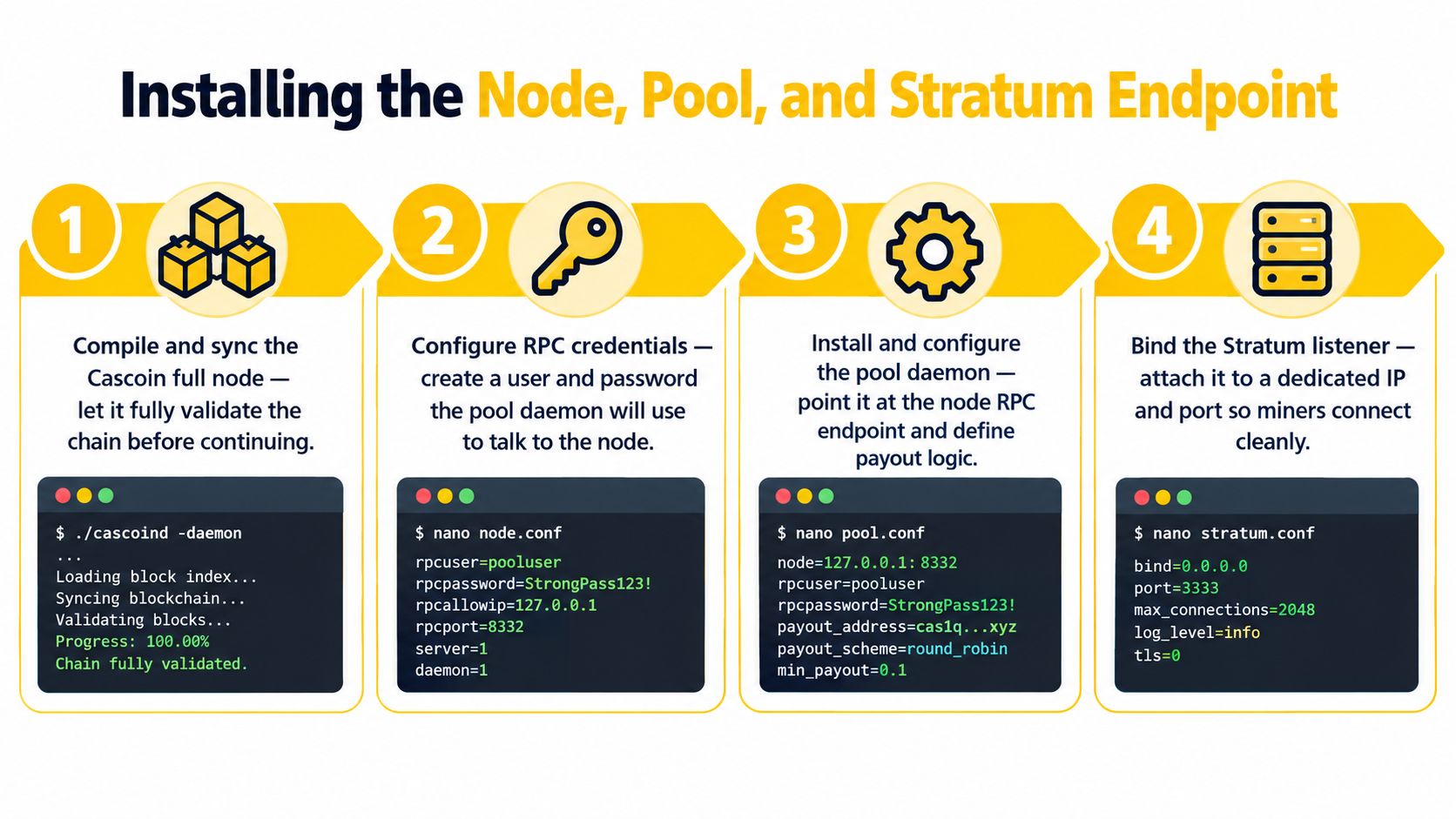
Configure the node RPC to accept requests only from the pool process or its private network. Permit public access to the Stratum listener, but keep administrative APIs and statistics endpoints authenticated and rate-limited. TLS can protect miner-to-pool traffic where the client software supports it, although certificate handling should be tested before making it mandatory for every worker.
Start the node, confirm synchronization and RPC responses, start the pool daemon, confirm that it can request a current template, and then start the Stratum listener. Connect one test miner before inviting the rest. The first job should arrive cleanly, the worker should submit an accepted share, and the logs should show no RPC timeout or stale-job loop.
Modern pooled mining moved away from the older getwork model because high-speed miners made repeated header-template transmission impractical. Stratum v1 lets a pool send a header template and coinbase transaction, often under 200 bytes, while shares use a secondary target below the network target to measure each miner's contribution proportionally, as described in this Stratum and pooled-mining implementation reference.
Connecting Labyrinth, MinotaurX, and SHA-256 Miners
Treat each algorithm as a separate production path, even if the pool uses one public hostname. A worker connecting with the wrong algorithm can look like a network failure when the underlying problem is job incompatibility. Give every miner a stable worker name such as rack-a01, rack-a02, or labyrinth-gpu03, and use a naming pattern that identifies location, owner, and algorithm without exposing wallet secrets.
Use a primary Stratum endpoint and a backup endpoint in the miner configuration. The backup should lead to an independently monitored service or a separate region, not another port on the same failing process. A fallback only helps if the miner switches when the primary stops delivering jobs.
The following examples use placeholders rather than real hostnames or addresses. Replace them with the endpoint, worker format, and flags supported by your selected miner.
| Algorithm | Miner | Stratum URL | Key Flags | Verify |
|---|---|---|---|---|
| Labyrinth Mining | Cascoin-compatible Labyrinth miner | stratum+tcp://pool.example:port |
Select Labyrinth, set the worker, begin with the miner's recommended intensity, and allow pool difficulty adjustment | Confirm the dashboard labels the worker as Labyrinth and accepts shares without wrong-algorithm errors |
| MinotaurX | MinotaurX-compatible CPU miner | stratum+tcp://pool.example:port |
Select MinotaurX, assign a distinct worker, avoid aggressive thread settings until share timing is stable | Check accepted shares, CPU utilization, and whether the pool reports the expected algorithm |
| SHA-256 | ASIC firmware with SHA-256 support | stratum+tcp://pool.example:port |
Select SHA-256, enter the worker and password, and use fixed difficulty only when the pool software supports it safely | Confirm the ASIC receives current jobs and rejects aren't caused by a stale endpoint |
Validate the first connection immediately
Create the worker entry, copy the Stratum URL, and enter the URL, worker, and password in the miner's web dashboard. Save the settings and restart the miner. This workflow is consistent with practical pool setup guidance, which also recommends clear worker naming and backup Stratum URLs for failover, as outlined in this ASIC pool connection guide.
Watch the first accepted shares rather than assuming a green “connected” status means the configuration works. A connection can remain open while the miner submits the wrong algorithm, uses an invalid credential, or continues hashing an obsolete job.
Read the reject reason instead of deleting and recreating the worker. Wrong algorithm points to the miner path or pool port. Bad password points to authentication or worker formatting. Stale share points toward job age, node updates, or propagation. Invalid share usually requires checking the algorithm implementation, difficulty handling, and miner firmware.
The password field often acts only as a routing or authentication value, but don't assume that behavior without checking the selected pool software. Keep worker names stable so a later payout or outage investigation can connect shares to a physical machine.
Monitoring Hashrate, Shares, and Propagation
A pool operator needs two views of health. The first shows whether miners are connected and submitting work. The second shows whether that work has a realistic chance of contributing to a reward before the network moves on. The second view catches the expensive failures.
Track short-window and long-window hashrate together. A sudden short-window drop with a stable long-window average usually indicates a recent connectivity or process problem. A falling long-window average suggests a persistent miner, power, or endpoint issue. Don't use the dashboard's headline hashrate as proof that payouts are healthy.
Read shares as network evidence
Separate accepted, stale, and invalid shares in both logs and metrics. Accepted shares indicate that the pool validated work at its assigned target. Stale shares indicate that the miner completed work after the job was no longer useful. Invalid shares indicate a protocol, algorithm, credential, or implementation problem.
Vardiff should produce a manageable submission pattern for each worker. If difficulty changes constantly, miners may be reconnecting, the pool may be overreacting to noisy measurements, or the configuration may be poorly matched to the hardware. If shares arrive too rarely to diagnose a failing connection, the assigned difficulty may be too high for that worker.
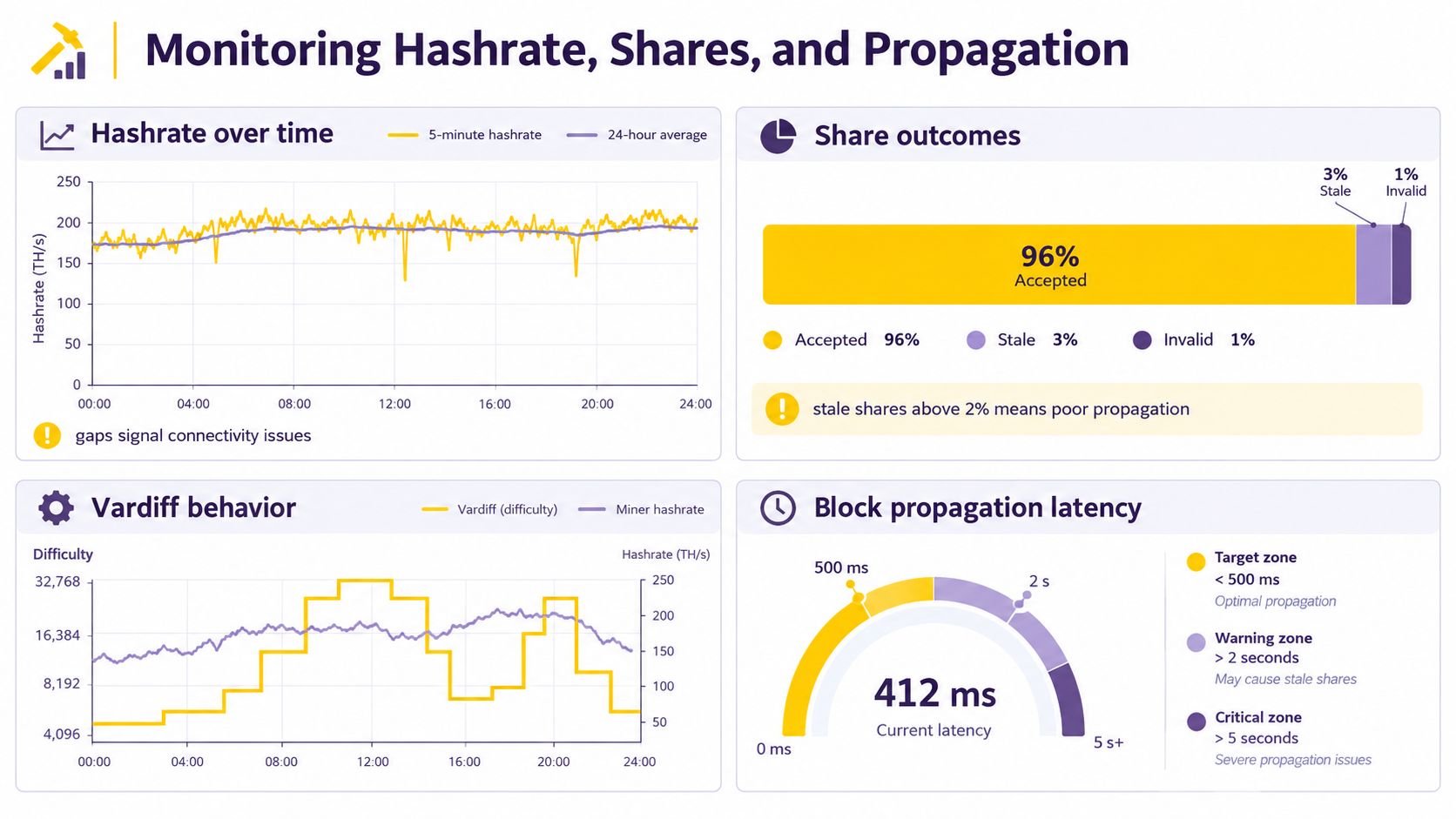
Prometheus or another metrics system should collect pool process state, RPC latency, node tip height, worker connection count, share outcomes, payout queue state, and disk usage. Grafana panels are useful only when every panel has an associated action. A stale-share alert should tell you to inspect the miner route, Stratum process, and node job updates. An RPC-latency alert should tell you to inspect peer connectivity and disk contention.
Operational rule: When stale shares rise across many workers at once, investigate the shared path first. Don't blame individual miners until the endpoint, node, and upstream route are clean.
Block propagation deserves its own measurement. Record when your node learns about a new block, when the pool creates a replacement job, and when miners receive that job. Compare the result with your normal network behavior. A node that is distant from useful peers or struggles to relay blocks can lose rewards through orphan risk even when its Stratum service remains reachable.
This is why pool performance depends on more than server installation. Braiins' mining basics material discusses the relationship between propagation, stale shares, and orphan risk. If the node path is slow, move the node, improve peering, reduce disk contention, or fail over before the dashboard turns the problem into a payout surprise.
Backups, Security, and Long-Term Operations
A pool isn't finished when the first worker submits an accepted share. Back up the node's chain data or recovery configuration, the pool database, service configuration, and wallet state. Keep copies offsite, protect them from the production server, and test restoration. A backup that has never been loaded is an assumption, not a recovery plan.
Run the pool under a non-root account. Keep SSH key-only, restrict the firewall to the services miners need, and rate-limit public APIs and statistics endpoints. The payout wallet deserves separate treatment. Keep only the operational balance in the hot wallet, and store the larger reserve with a cold signing key on a machine that never accepts public connections.
Use Cascoin's mining security guidance as a starting point, then adapt the controls to your own threat model. Rotate API tokens, review rejected-share and RPC-error logs, watch node disk growth, and remove unused accounts. Keep a written failover procedure with tested credentials and endpoint details, because an outage is the worst time to discover that nobody knows how to promote the backup.
A practical maintenance rhythm includes checking worker status and share outcomes daily, reviewing payout reconciliation regularly, testing restores on a planned schedule, and rehearsing failover before production depends on it. Pool operators also need to monitor software dependencies and chain updates. A compatibility problem discovered during an upgrade is manageable. The same problem discovered after miners have been hashing stale jobs is expensive.
Reliable operation requires more than a single server. Current pool guidance increasingly emphasizes multi-server failover, node monitoring, payout integrity, and infrastructure hardening because miners need backup endpoints and a pool can lose rewards when its own blocks become orphaned. That operational cost is the trade-off behind self-hosting, and it should be included in the decision before the first miner is redirected.
Cascoin offers an open-source network with Labyrinth Mining, MinotaurX, and SHA-256 paths, so you can design a pool around the hardware and operating model you run. Review the code, test a Cascoin-compatible deployment with one miner, and visit Cascoin for the wallet, mining, and network resources before putting the full fleet on your endpoint.