Mining Difficulty Explained: How It Works and What It Means
Mining difficulty is a network feedback mechanism that adjusts how hard it is to find blocks so the average block time stays near the target, regardless of total hashrate. Bitcoin retargets difficulty every 2,016 blocks, normally about 14 days, to keep block production near 10 minutes.
You may be looking at a mining dashboard, seeing difficulty rise or fall, and wondering what it means for your own machine. Does higher difficulty make your hardware slower? Does lower difficulty guarantee more coins? The answer becomes much clearer when you stop treating difficulty as a permanent property of a coin and start treating it as a moving competition indicator.
Table of Contents
- What Mining Difficulty Actually Means
- How Block Difficulty Is Calculated and Retargeted
- Comparing SHA-256 Difficulty with Cascoin Labyrinth Mining
- Real-World Bitcoin Difficulty Milestones and Adjustments
- How Miners Can Monitor and Respond to Difficulty Changes
- Why Lower Difficulty Does Not Always Mean Higher Rewards
- What Difficulty Means for Security and Network Health
- Frequently Asked Questions About Mining Difficulty
What Mining Difficulty Actually Means
Your mining dashboard shows difficulty rising while your ASIC produces the same number of hashes per second. The machine has not slowed down. The network has changed how selective it is about proof-of-work results, so your share of the competition may change.
Miners repeatedly alter input data and calculate hashes. A block is valid only when its hash meets the current network target. A higher difficulty sets a stricter target, meaning miners across the network generally need more attempts before one finds an acceptable result. Difficulty therefore measures the intensity of the race, not the physical speed of your hardware.
A maze makes the relationship clear. Each miner searches for an exit by testing possible routes. If more searchers enter, the group may find an exit sooner while the maze stays unchanged. The network responds by making the acceptable exit harder to reach. If searchers leave, the challenge can later become less demanding. The maze changes for the competition, while each searcher's pace remains the same.
The useful mental model
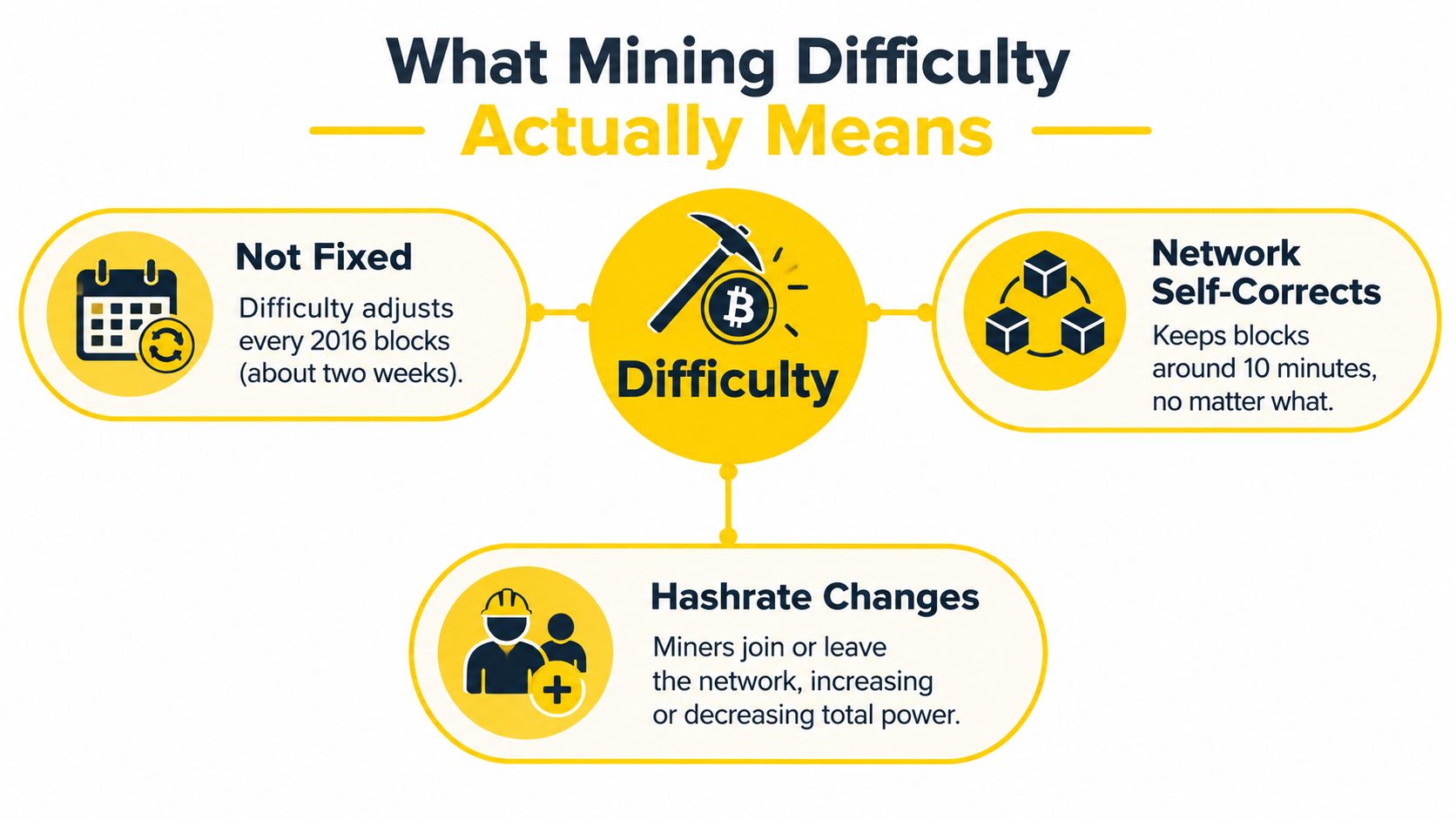
Difficulty is not a permanent hardness rating for an ASIC, CPU, or GPU. It is a moving competition indicator:
- More hash power joins: Blocks may arrive faster, and a later adjustment generally raises difficulty.
- Hash power leaves: Blocks may arrive more slowly, and a later adjustment generally lowers difficulty.
- Your hardware stays the same: Its expected share of network rewards changes because the competitive environment changes.
Bitcoin uses this moving setting to keep block production near its target rather than allowing new hardware to accelerate issuance indefinitely. The network compares observed block timing with its intended schedule and adjusts the target accordingly, as described in this Bitcoin difficulty explanation. A broader overview appears in this cryptocurrency mining guide.
Cascoin's gamified Labyrinth Mining presents the same concept in a different form. Participants compete within a maze-like mining experience, so the difficulty indicates how demanding the current competition is rather than defining a machine's permanent capability. In either system, a harder contest usually reduces the share a fixed-hashrate miner can expect, while an easier contest can improve that share.
Practical rule: Read difficulty as “how much competition is active now,” not “how powerful my machine is.”
Your hardware's hash rate sets how quickly it searches. Difficulty sets how that search compares with everyone else, which connects directly to what you can expect to earn.
How Block Difficulty Is Calculated and Retargeted
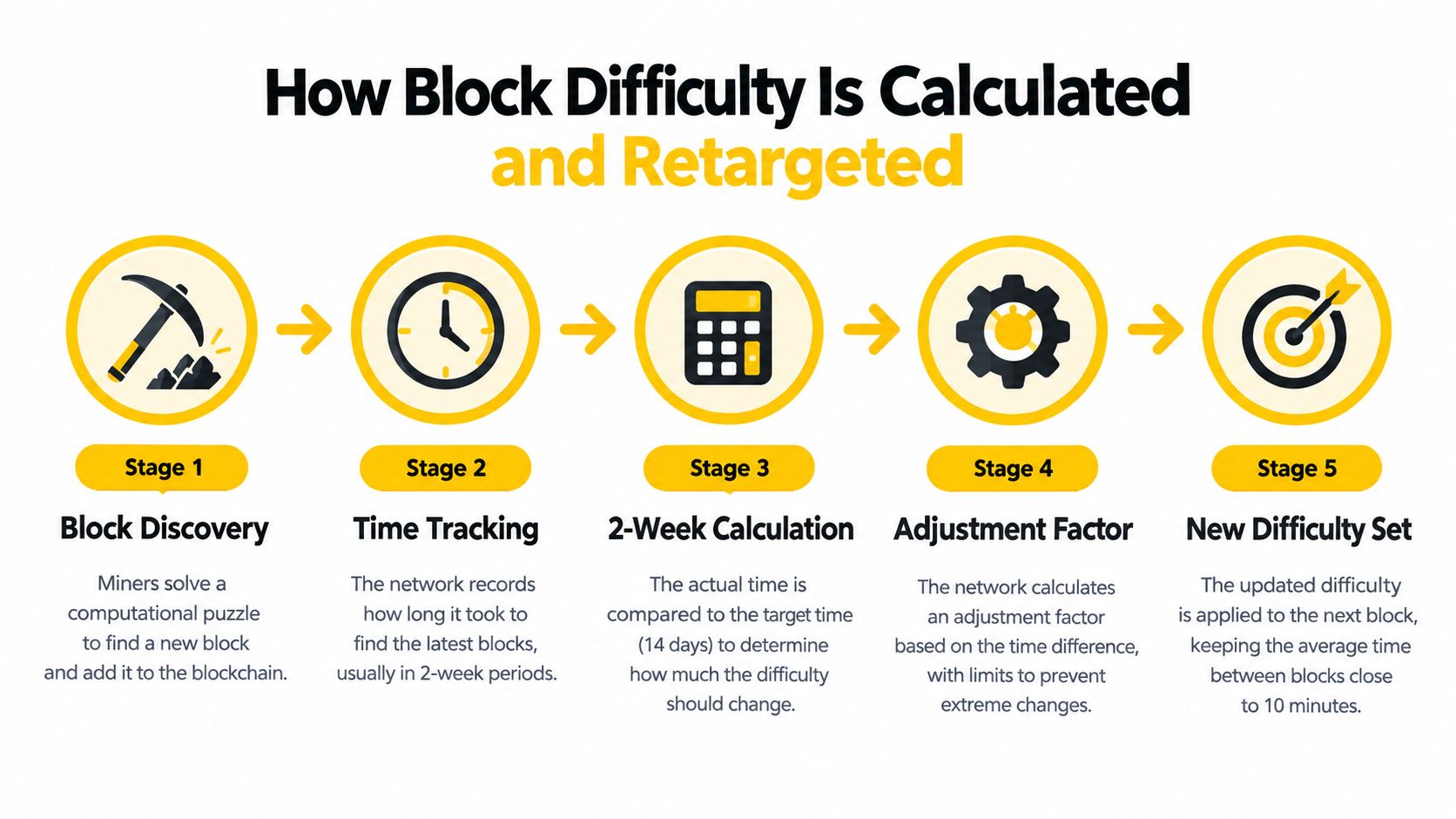
The adjustment works in five steps. A maze analogy makes the process easier to follow: miners keep trying paths, and the network changes how difficult it is to find an acceptable exit.
- The network records the starting point of the adjustment period.
- It records when the period ends and measures the elapsed time.
- It compares that time with the intended schedule.
- If blocks arrived too quickly, it raises the next difficulty.
- If blocks arrived too slowly, it lowers the next difficulty.
This creates a moving competition indicator. Difficulty does not describe whether one machine is permanently powerful or weak. It changes how selective the network is about an acceptable result, so the same hardware may earn a different share of rewards as total hash power changes.
A concrete timing example
Suppose new miners add substantial hash power and the adjustment period finishes faster than intended. The network treats that speed as evidence that more computational work is competing under the current setting. It then makes the target stricter. Every miner still performs the same number of hashes per second, but each attempt has a smaller chance of producing a valid block.
For an individual miner, that usually means more competition for the same block rewards. Unless the miner adds hash rate or operates more efficiently, its expected earnings can fall relative to the network total.
The reverse can happen after a large amount of hash power leaves. Blocks may slow until the next checkpoint, after which a lower setting makes valid results easier to find. Bitcoin's implementation limits a single retarget to a maximum fourfold decrease or fourfold increase, according to this technical overview of difficulty adjustment.
The delay between observed timing and the next change is deliberate. It prevents one unusually lucky or unlucky run from causing an immediate network reaction, while still responding to sustained changes in participation. The relationship between the target and block timing is also central to understanding Bitcoin block time.
The practical calculation matters less than the interpretation. Difficulty belongs to the network. Hash rate belongs to the miner. Expected earnings depend on the ratio between contributed hash rate and total network work, along with the rewards attached to successful blocks, rather than on difficulty alone.
Comparing SHA-256 Difficulty with Cascoin Labyrinth Mining
Bitcoin's SHA-256 model presents mining as a direct hash race. Specialized machines perform vast numbers of calculations, and the network accepts a block only when a result satisfies the current target. Difficulty governs how selective that target is, while a miner's revenue depends on its share of the work and the rewards attached to successful blocks.
A gamified design can use a different surface experience without abandoning the same underlying fairness problem. In Labyrinth Mining, software simulates navigation through a maze, turning the search into a coordinated path-finding activity rather than presenting it only as an abstract stream of hash calculations. MinotaurX offers another route for CPU-oriented participation, while SHA-256 remains relevant to operators using specialized hardware.
The important comparison is not whether one interface looks more playful. Ask what kind of resource each mode asks participants to provide, how the network measures valid work, and how rewards are distributed when many participants compete. A lower-power design may broaden access, but it still needs a network rule that prevents participants from claiming more than their verified contribution warrants.
| Mode | Competition Type | Energy Profile | Who It Suits |
|---|---|---|---|
| SHA-256 | Direct computational hash race | Hardware-intensive, depending on equipment and operating conditions | Experienced ASIC operators |
| Labyrinth Mining | Gamified maze-navigation work | Designed around lighter client participation | Users seeking an accessible, interactive mining model |
| MinotaurX | CPU-oriented proof-of-work participation | Lower-power participation than specialized hardware in suitable setups | Beginners and CPU miners |
Pools add another layer that often confuses newcomers. A pool can assign easier internal shares so miners receive frequent feedback and the pool can account for contributed work. Those shares aren't automatically network blocks. The actual chain still requires the full block difficulty for a participant or pool to win a block.
That distinction applies across designs. Difficulty remains a competition signal, but the work format, hardware requirements, and user experience can differ. Readers comparing approaches can also review this overview of proof-of-work coins before choosing a mining method.
Real-World Bitcoin Difficulty Milestones and Adjustments
A miner entering Bitcoin's maze does not face a permanently fixed wall. The maze changes as more or fewer competitors bring computing power into the race. Difficulty therefore works as a moving competition indicator. It shows how much work the network requires at a given point, while each miner's expected earnings still depend on hardware, electricity, rewards, fees, and market conditions.
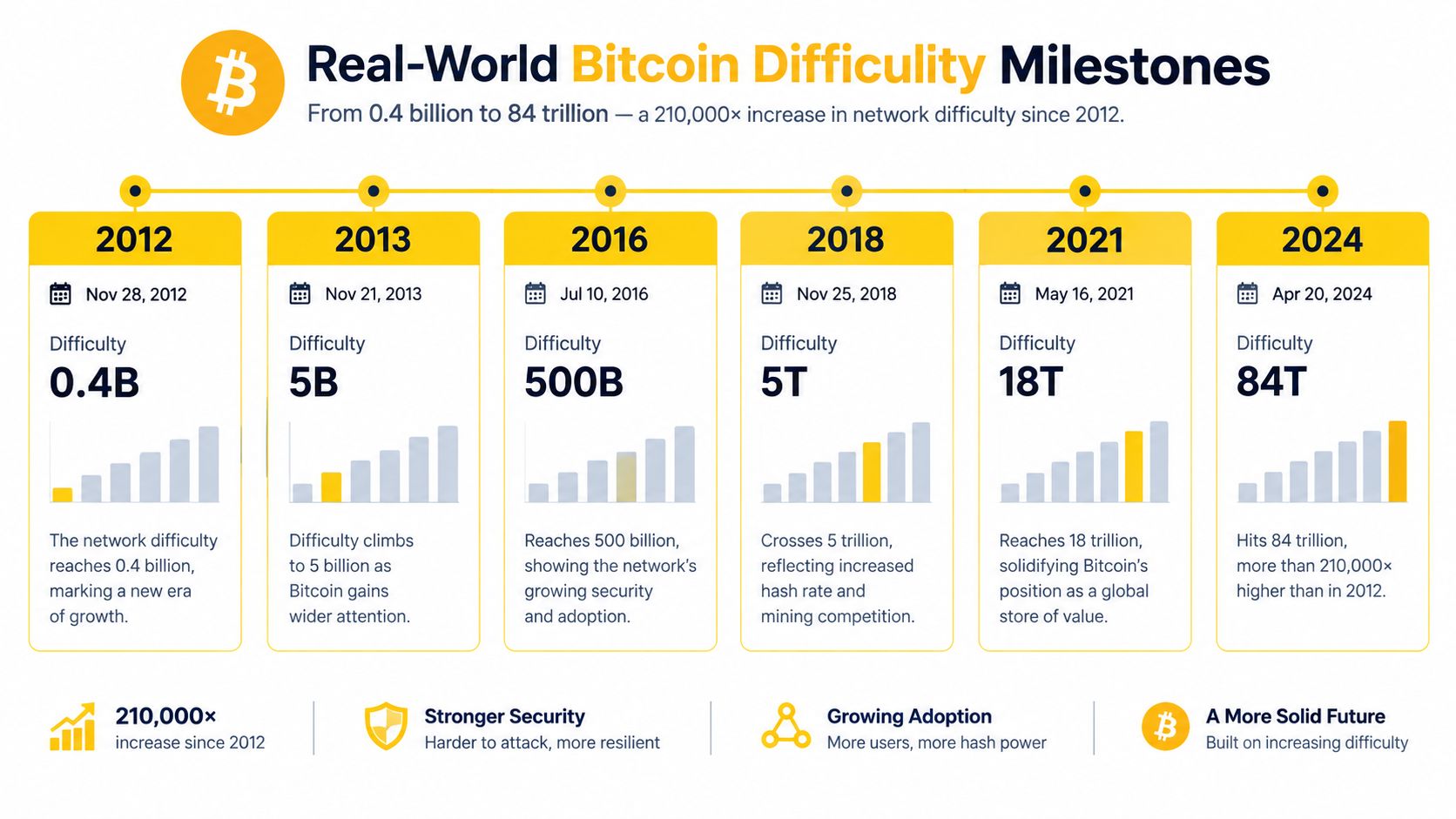
Bitcoin's history makes that change visible. Early blocks were mined with a difficulty baseline of 1.00 in January 2009. By block 855,766 in August 2024, difficulty had reached approximately 90,666,502,495,565.78, or about 90 trillion, according to this history of cryptocurrency mining difficulty.
That level was roughly 90 trillion times the early baseline. It does not mean one modern machine became 90 trillion times faster than an early computer. The increase reflects specialized hardware, more participating miners, and a worldwide hash race. Bitcoin difficulty first exceeded 1 trillion in September 2017, showing how far mining had moved beyond casual CPU experimentation.
When miners leave
China's 2021 mining crackdown showed the opposite movement. Many operations went offline or relocated, reducing the computing power competing in the maze. Block intervals became longer, and Bitcoin responded with a major downward difficulty adjustment in July.
Lower difficulty made it easier for the remaining machines to find valid blocks, helping production move back toward its intended cadence. It did not guarantee higher earnings for every miner. Revenue still had to exceed power and operating costs, and miners continued competing against the capacity that remained online.
Cascoin's gamified Labyrinth Mining presents the same idea in a different form. Its maze can make the competition easier or harder as participation changes, so difficulty describes the current contest rather than a permanent level of hardness. A participant may complete the work more easily after competitors leave, but actual rewards still depend on the network's reward rules and the participant's verified contribution.
How Miners Can Monitor and Respond to Difficulty Changes
A miner watching a maze needs two views: how crowded it is and how difficult the current route has become. The same applies to mining. Difficulty is a moving competition indicator, not a permanent measure of machine performance. Check the retarget countdown, recent network hashrate, and pool estimates before deciding whether expected earnings still justify operating.
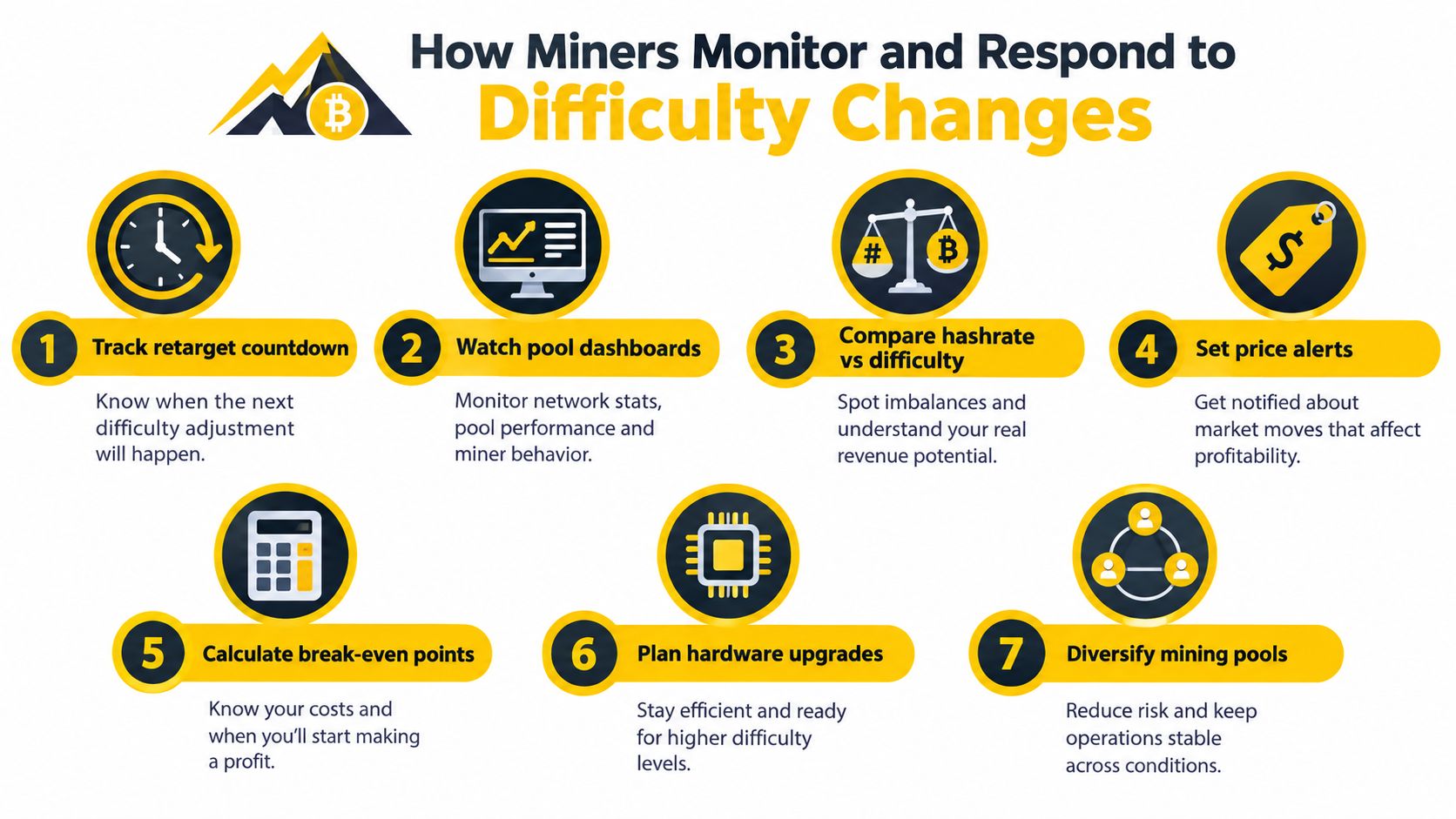
A practical monitoring routine
- Track the retarget countdown: Note when the next adjustment is due. A new setting can change expected output even if your hardware remains unchanged.
- Read pool dashboards: Compare reported hashrate, accepted shares, rejected shares, and payout estimates. These figures can show whether a change is network-wide or caused by your hardware, connection, or pool setup.
- Compare hashrate with difficulty: Difficulty describes the network's current target, while hashrate shows the computing power competing in the maze. Together, they reveal more than either measure alone.
- Watch market price: The coin's price changes the value of rewards, even when your machine finds shares at the same rate.
- Calculate operating break-even: Include electricity, cooling, maintenance, pool fees, hardware depreciation, and downtime. A friendlier difficulty setting does not erase those expenses.
- Review hardware efficiency: A newer, efficient machine may remain profitable when an older one does not. Compare expected rewards with power use instead of reacting to difficulty alone.
- Study several retargets: A series of adjustments can reveal a sustained trend. Short-term pool variance may make one miner's results look unusually strong or weak.
Difficulty is a forecast input, not a payout promise.
Use the results to choose among three actions. Stay online when expected rewards cover operating costs with a sensible margin. Scale when hardware and power economics support expansion. Pause when the complete operating model no longer works.
Cascoin's Labyrinth Mining follows the same logic in a gamified setting. As participation changes, the maze can become easier or harder. A participant may complete work more easily after competitors leave, yet actual rewards still depend on the network's reward rules and verified contribution. Difficulty changes the contest. It does not determine earnings by itself.
Why Lower Difficulty Does Not Always Mean Higher Rewards
A lower difficulty can improve a miner's expected share of network output, but it doesn't guarantee higher income. The result depends on what else changed at the same time. Network hashrate may continue moving, the block subsidy may differ, transaction fees may rise or fall, and the coin's market price may change before the miner receives or sells a reward.
Consider the recent decline from approximately 148.25 trillion to 125.81 trillion, a movement of roughly 15.1%, reported in this analysis of Bitcoin's difficulty decline. In a simplified world where hashrate, reward levels, fees, price, uptime, and costs remained unchanged, a miner's expected output could move in a similar direction. Real mining environments rarely hold all those variables steady.
Why the simple percentage fails
- Hashrate can return: A difficulty drop may follow machines leaving the network. If those machines come back, competition can increase again.
- Rewards have several components: Block subsidy and transaction fees both affect what a successful block represents.
- Operating costs don't follow difficulty: Electricity, cooling, rent, repairs, and financing continue regardless of the network setting.
- Pool variance changes experience: Expected rewards describe a long-run share, while actual payouts can arrive unevenly.
- Price changes alter revenue value: More coins are not automatically more valuable in financial terms.
Use lower difficulty as a reason to revisit your calculations, not as permission to assume a profit. The correct question is, “What does my machine earn under current network, market, and operating conditions?” That question forces difficulty into its proper role.
What Difficulty Means for Security and Network Health
A miner entering a maze faces a competition that can change while they are still searching. Mining difficulty works in a similar way. It is not a permanent measure of how hard a network is. It is a moving competition indicator that adjusts the amount of work required for a valid result.
In Bitcoin's hash race, difficulty helps keep new blocks arriving near the protocol's intended rhythm. If more machines begin searching, blocks may arrive faster during the current adjustment period. The next adjustment can then require more work, bringing the pace closer to its target. If miners shut down, blocks may slow temporarily before a lower difficulty makes successful discoveries more likely again.
That feedback protects the chain's issuance schedule. Wallets, exchanges, developers, and users can rely on a broadly stable rhythm without expecting every block to arrive at the same time. Mining is probabilistic, so one block may appear quickly and the next may take longer. Difficulty manages the average, not each individual outcome.
The same moving idea appears in Cascoin's gamified Labyrinth Mining. The maze provides an accessible way to see difficulty as a changing challenge rather than a permanent wall. As competition changes, a miner's chance of reaching a valid result, and therefore earning rewards, changes with it.
Difficulty also links security to real computational commitment. An attacker must produce work that meets the network's current requirement, while honest miners follow the same rule. A higher setting can indicate stronger participation and a more demanding hash race. For an individual miner, however, it usually means the same hardware finds valid blocks less often on average, so expected earnings depend on its share of network work and the available rewards.
The broader lesson is practical: difficulty helps Bitcoin absorb changing hardware and participation while preserving a steadier chain. It gives miners a live signal about competition, and it gives everyone else a predictable network to use.
Frequently Asked Questions About Mining Difficulty
Does a difficulty adjustment make my hardware faster?
No. A retarget does not change your machine's physical hashrate. It changes the network target, so your hardware's expected chance of finding a valid result changes relative to other miners. Your potential earnings change through that probability, not through faster equipment.
Why can my pool dashboard show easy shares?
A pool may assign lower share difficulty so your worker can submit results often enough for accounting and performance tracking. Those shares measure your contribution and help estimate payouts, but they are not necessarily valid blocks. The pool still needs a result that meets the network's full requirement before it earns a block reward.
Why did difficulty move in an unexpected direction?
The adjustment uses block-production timing across the completed adjustment period. It does not respond directly to headlines, price, or your personal profitability. Miners may have joined or left earlier, while the network applies the resulting change at its scheduled checkpoint.
Should a small miner react immediately?
Usually, wait and compare several adjustment cycles. Check your hashrate, electricity cost, uptime, pool performance, and expected reward. A difficulty change affects the calculation, but it does not by itself prove that your machine has become profitable or unprofitable.
What should beginners watch on a pool dashboard?
Check accepted hashrate, rejected work, estimated payout, recent luck, and network difficulty. Estimates are expectations, not guarantees. A network-wide change should appear across relevant dashboards. A problem affecting only your worker may indicate rejected shares, a connection issue, or another local fault.
Does a 15% difficulty decline mean 15% more rewards?
Only approximately, if other conditions stay unchanged. Network hashrate, block rewards, fees, price, uptime, electricity costs, and pool variance can change what you earn. Lower difficulty improves the odds for the same hardware, but it does not guarantee a larger payout.
Cascoin offers Labyrinth Mining, MinotaurX, and SHA-256 mining options. Its Labyrinth Mining maze presents proof-of-work competition in a different format, while the other options let participants compare approaches and power requirements. Review the Cascoin mining documentation, open-source project information, wallet options, and public pool resources before choosing an approach.