Mining Security Playbook: How to Protect Every Layer
You paste a payout address into your Cascoin wallet, press send, and watch the balance change. The address looks familiar because malware replaced it in the clipboard. Your mining client is running a fork downloaded from an unofficial repository, the pool endpoint in its configuration resolves somewhere unexpected, and the rig shares a network with your work laptop. Nothing appeared to fail, yet the whole payment path was compromised.
That scenario captures the central problem with mining security. A wallet alone can't protect rewards when the host, client, pool connection, network, or physical device is already under an attacker's control. A secure operation treats the entire stack as one system, from the seed phrase and payout address to firmware, remote access, telemetry, and supply-chain verification.
Table of Contents
- A Miner's Worst Afternoon and the Stack Behind It
- Threat Modeling the Full Mining Stack
- Hardening Wallets, Clients, and Pool Connections
- Choosing the Right Wallet Storage Strategy
- Detecting Cryptojacking and Host Intrusions
- Responding to a Security Incident Step by Step
- Open-Source Audit and Community Defense Habits
A Miner's Worst Afternoon and the Stack Behind It
The miner is running a solo GPU setup in a spare room. The dashboard shows normal performance, the fans are behaving, and the latest share has arrived. They open the Cascoin desktop wallet, copy a payout address from a note, paste it into the send form, enter 1.8 CSM, and click confirm.
The destination field contains a valid-looking address, but it isn't the one they copied. A clipboard hijacker installed alongside a pirated monitoring tool has watched for cryptocurrency address patterns and replaced the clipboard contents during the brief interval between copying and pasting. The wallet hasn't malfunctioned. It signs exactly what the user approved.
A second compromise sits in the mining configuration. The miner was downloaded from a fork that appeared to offer better performance, but its default failover points to a fake pool stratum URL. The operator's shares still appear to submit, yet the attacker can record worker names, IP data, and credentials, or redirect hashpower. When the miner later opens a wallet window, a wallet swap application presents a near-identical interface and encourages another payment.
The sixty seconds before the click contained several opportunities for defense:
- Clipboard integrity: The pasted address should have been compared with the source and verified on a separate trusted screen.
- Client provenance: The monitoring tool and miner should have come from a verifiable release rather than a pirated bundle.
- Pool authenticity: The configured stratum endpoint should have used authenticated encryption and a known certificate.
- Wallet separation: The operational wallet should have held only working funds, with reserves kept offline.
- Host isolation: The rig shouldn't have had broad access to personal devices or the home network.
Even apparently harmless hardware belongs in the threat model. A remote management board, smart PDU, USB device, or HDMI dummy plug can change how a rig boots, exposes consoles, or accepts peripherals. A useful starting point is understanding how a mining rig is assembled and operated, then treating every component as a possible trust boundary.
Mining security isn't a wallet feature. It is the combined reliability of the wallet, seed, client, pool, host OS, network path, supply chain, and physical environment. If one layer can rewrite an address without notice, execute altered code, or redirect traffic, the attacker doesn't need to defeat every other layer.
Threat Modeling the Full Mining Stack
Start by drawing the payout path and the control path separately. The payout path moves rewards from pool or node to wallet. The control path manages software, credentials, configuration, remote access, and power. Attackers target whichever path gives them the cheapest route to stolen funds, unpaid hashpower, electricity theft, or a foothold in the rest of the network.
Wallet and signing authority
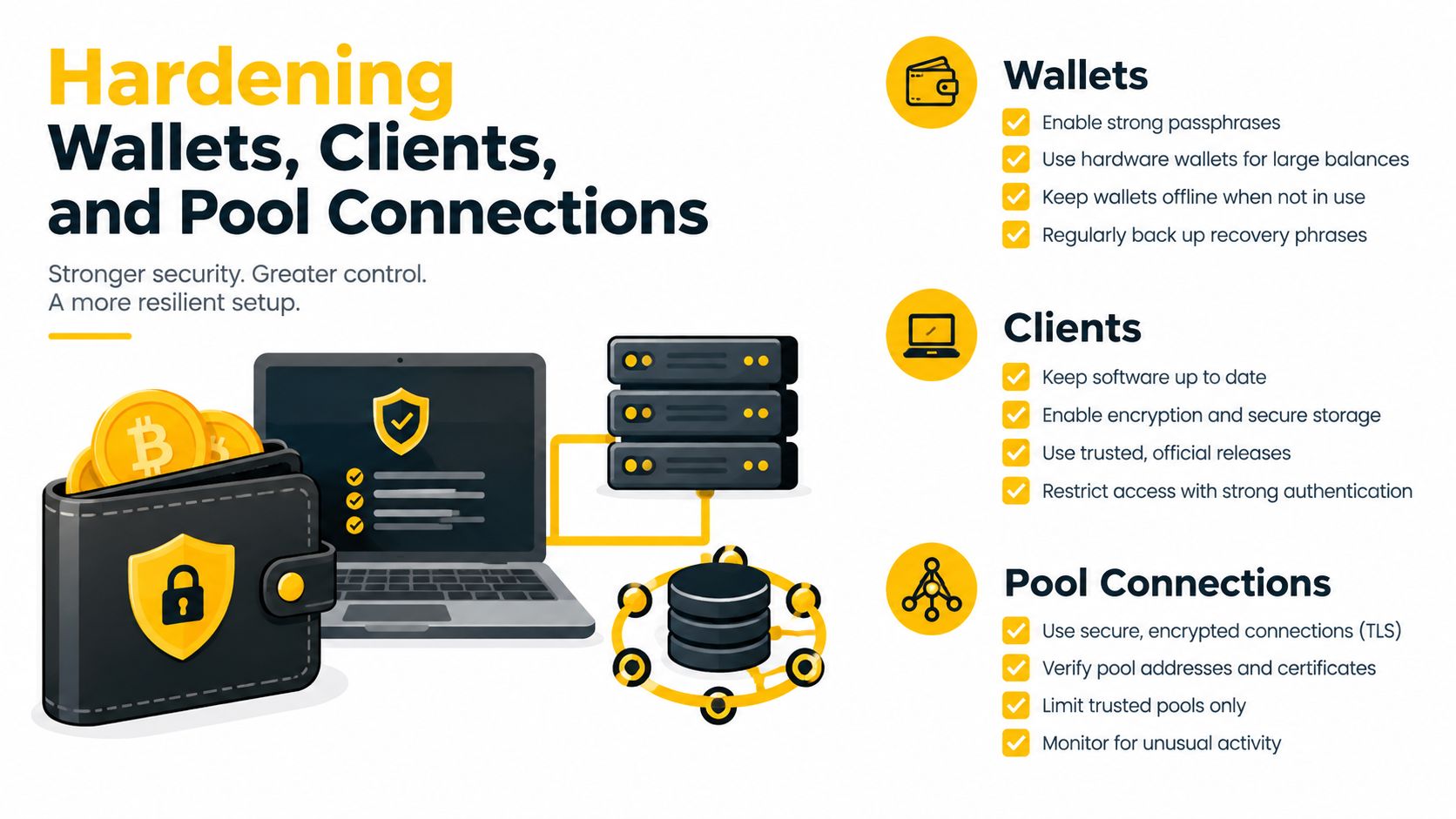
The wallet surface includes seed generation, address display, clipboard handling, backups, and transaction signing. Clipboard swap malware can replace a payout address, while a compromised desktop wallet can alter transaction details before signing. A seed copied into a pool dashboard or entered into a miner configuration gives an attacker direct signing authority.
Keep the seed off the mining host. Verify important addresses on a trusted display, and make the operational wallet disposable enough that a host compromise doesn't expose the full reserve.
Mining client and software supply chain
A trojaned miner fork on GitHub or an unsigned binary can steal credentials, modify payout settings, or install persistence. Even a legitimate client becomes risky when it runs as administrator, loads plugins from writable directories, or accepts configuration changes without review.
For Cascoin, the public source repository on Codeberg provides a way to compare your build and release artifacts with the canonical project code. That doesn't eliminate supply-chain risk, but it gives operators a practical route to detect client tampering instead of trusting an opaque executable.
Pool connection
A pool operator can observe worker metadata and connection details. A fake stratum URL can redirect shares, and a BGP hijack or compromised DNS path can send traffic to infrastructure that imitates the intended pool. Unencrypted stratum traffic also exposes configuration and authentication data to interception.
Use TLS where the pool supports it, verify the endpoint independently, and don't permit automatic failover to arbitrary hosts. A failover list is part of your trust boundary, not a convenience setting.
Host OS and remote administration
Rigs often run unattended, which makes exposed SSH especially attractive. An SSH service listening on the default port 22 isn't automatically vulnerable, but weak passwords, reused keys, excessive privileges, and unrestricted internet exposure turn it into a direct entry point. Once inside, an attacker can deploy a miner, steal wallet files, or pivot to other machines.
Run the miner under a dedicated low-privilege account. Restrict administrative access through a management network or VPN, disable password authentication, remove unused services, and log successful and failed access attempts.
Network path
A mining VLAN should have a narrow egress policy. The rig normally needs access to the pool, update sources, time synchronization, and approved management services. Broad outbound access lets a compromised process contact command-and-control servers, exfiltrate wallet data, or scan the home network.
Physical access and firmware
A second-hand GPU, smart PDU, motherboard controller, or bootable USB can carry altered firmware or configuration. Physical attackers may also reset credentials, replace storage, or attach a keyboard during boot. Lock the frame, restrict BIOS and boot-device changes, and record the hardware inventory before deployment.
Practical rule: Map every attacker goal to a surface. Hashrate theft points toward the client or host, payout theft toward the wallet and clipboard, electricity theft toward the host and cloud account, and lateral movement toward the network.
Hardening Wallets, Clients, and Pool Connections
A Saturday hardening session should produce a repeatable build, a restricted runtime, and a wallet process that never depends on the miner for signing. Work from a clean machine, record what you verified, and keep the configuration under version control.
Establish wallet integrity first
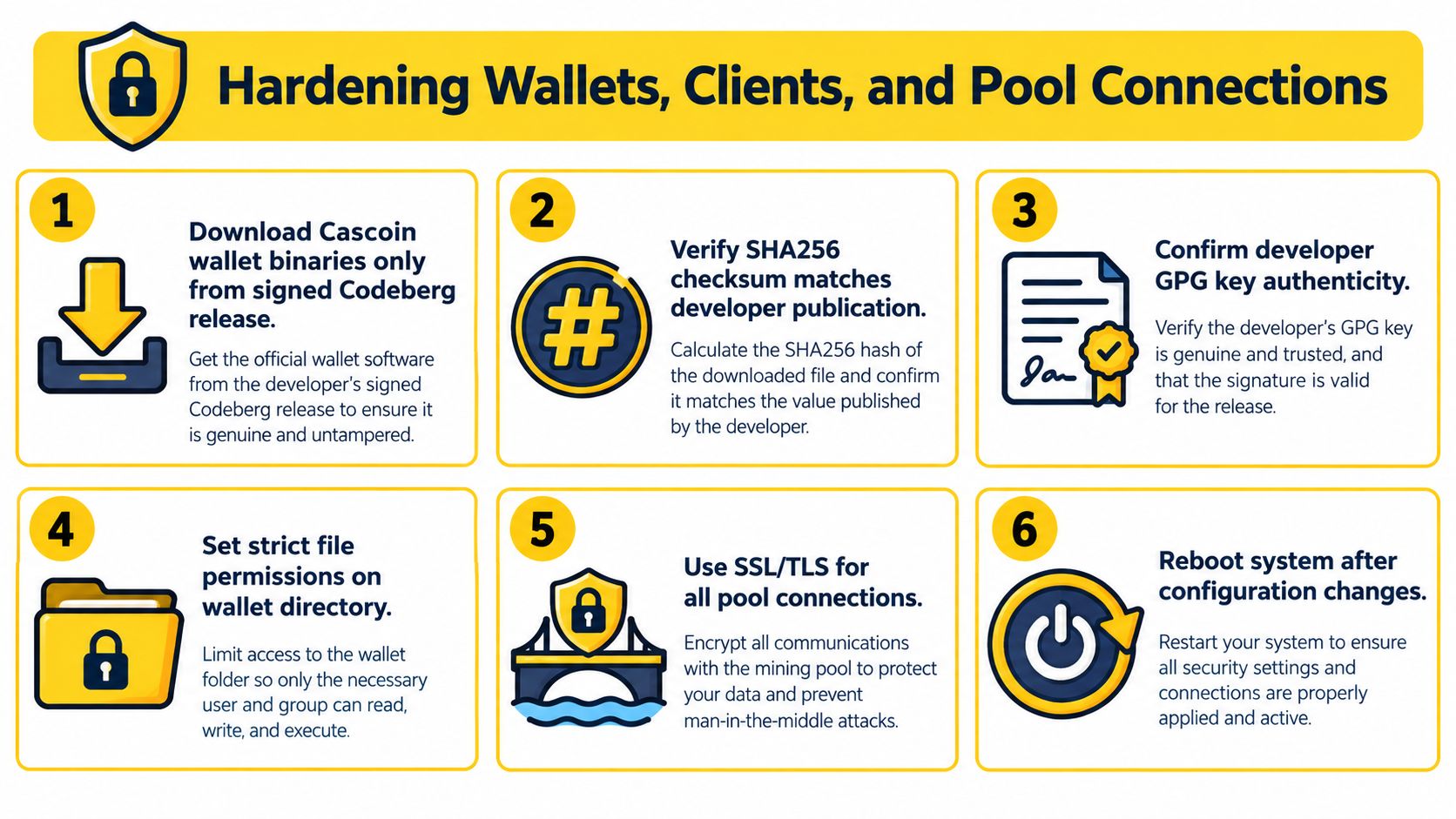
Download Cascoin wallet binaries only from the signed Codeberg release. Compare the SHA256 checksum with the developer publication and verify the developer's PGP signature using a key obtained through an independent channel. Generate the seed on an air-gapped machine, write the backup by hand, and verify recovery before the wallet receives meaningful funds.
This prevents a substituted binary, tampered download, or compromised online host from generating a seed the attacker already knows. It also separates wallet creation from the machine that spends its time running mining software.
Restrict the mining client
Pin the miner version instead of automatically tracking the newest release. Build from source where the process is practical, compare the resulting code with the canonical repository, and preserve the build metadata. Run the client as a dedicated user with no access to wallet backups, SSH keys, or unrelated home directories.
A systemd unit can reduce risk through filesystem restrictions, a private temporary directory, limited capabilities, and a read-only configuration path. AppArmor can add another policy layer. Disable configuration hot-reload unless you need it, because an attacker who can rewrite a live configuration may redirect payouts without restarting the service.
Lock down the pool path
Use stratum over TLS and verify the pool certificate. Pin the expected pool identity where your client supports it, define an explicit worker and site allowlist, and reject failover targets that aren't documented and approved. Store pool credentials outside world-readable configuration files.
This blocks the most direct forms of endpoint substitution and reduces the chance that a stolen worker credential becomes useful beyond the intended pool.
Baseline the operating environment
Use a dedicated VLAN for rigs, restrict egress through the firewall, enable automatic security updates, and disable USB autorun. A focused mining operating system can simplify maintenance, but choosing an operating system for mining doesn't replace patching, least privilege, or network controls.
Keep firmware current from the hardware vendor, set a BIOS administrator password, disable unused boot devices, and remove default credentials from management controllers. Reboot after configuration changes, then verify the service, firewall, routes, and pool certificate from the clean baseline.
A secure miner should be boring to administer. If a process needs broad privileges, unrestricted egress, or an unverified binary to work, the design is carrying unnecessary risk.
Choosing the Right Wallet Storage Strategy
Wallet storage is a decision about convenience, exposure time, and signing authority. Mining creates a steady stream of operational transactions, so the safest design usually separates the address that receives routine rewards from the address that stores accumulated reserves.
| Storage Type | Convenience | Exposure Time | Signing Authority | Recommended Use |
|---|---|---|---|---|
| Cold storage | Low | Minimal while offline | Offline device or air-gapped signer | Long-term reserves and recovery material |
| Hardware wallet | Moderate | Bounded by device use and verification | Hardware device confirms signing | Regular savings with practical access |
| Hot mining wallet | High | Continuous while the host runs | Software on or near the mining host | Small operational balances and automated payouts |
Cold storage wins on exposure time. Generate the seed offline, keep the signing device disconnected, and bring it online only when you need to authorize a transaction. The trade-off is operational friction. Sweeping every reward manually can lead operators to take shortcuts, and a backup that hasn't been tested is only assumed to work. A guide to cold storage wallets for cryptocurrency is useful when designing the offline tier.
Hardware wallets create a usable middle ground. Ledger, Trezor, and Keystone can keep the signing key off the rig while allowing regular spending. The device screen matters more than the desktop interface. Verify the receive address and transaction destination on the hardware display, because a clean-looking computer can still lie about what it is asking the device to sign.
Hot mining wallets are convenient because the miner or payout workflow can use them directly. That convenience is also their weakness. Treat the address as sacrificial, keep its balance limited, and configure a routine sweep to cold storage or a hardware wallet. Never paste a seed into a pool dashboard, and never allow a miner process to sign transactions. Mining software should submit work or report payouts, not control the reserve.
For a Cascoin setup, pair a hardware wallet with a watch-only Cascoin Core wallet for the rig's receiving address. The rig can observe balances without holding the reserve's signing authority. Set the sweep cadence according to the balance and your tolerance for exposure, then test the recovery path before relying on it.
Detecting Cryptojacking and Host Intrusions
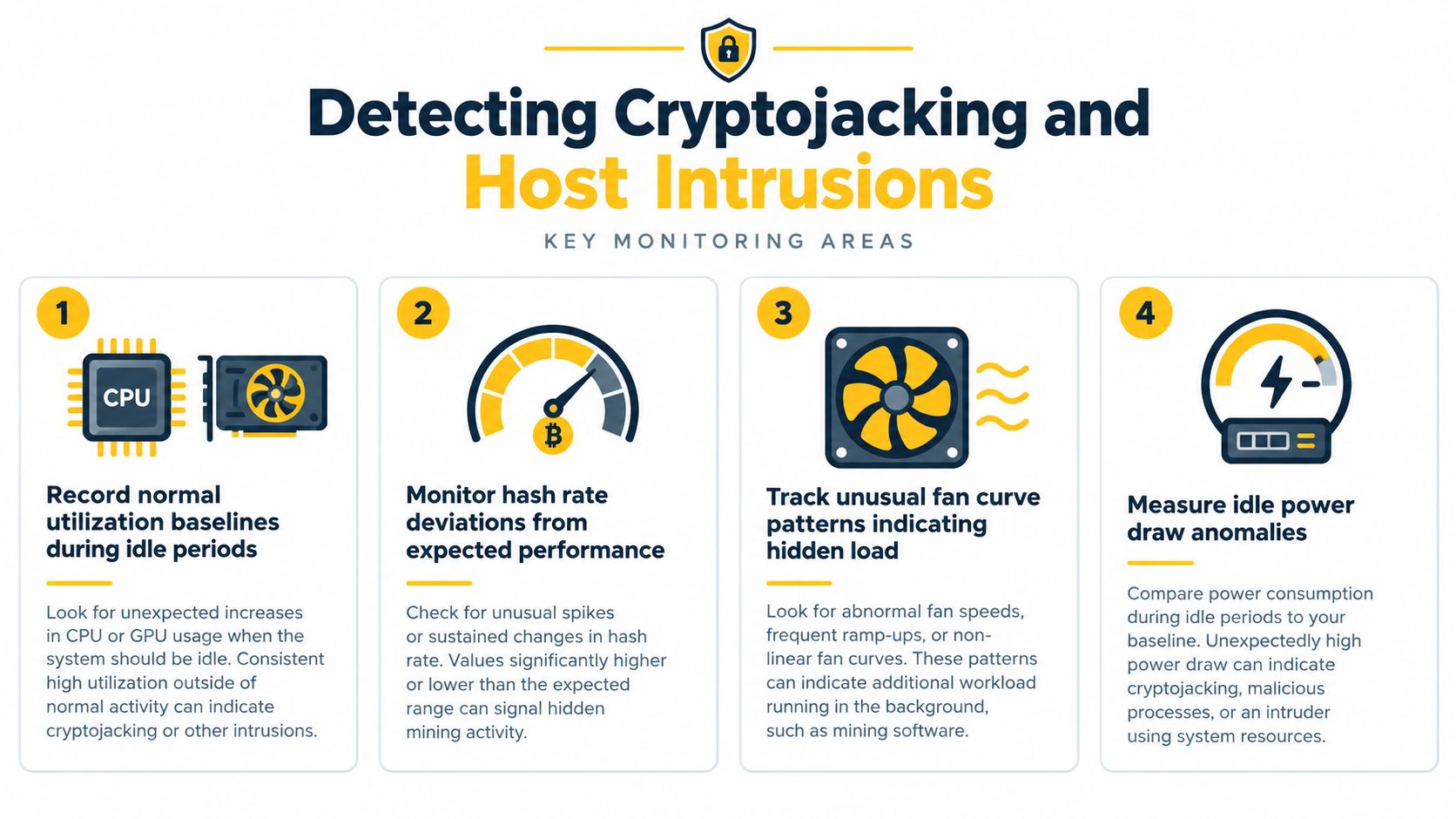
A mining host already generates useful telemetry, so detection doesn't require an enterprise platform to begin. The first step is recording the rig's normal state while no miner is running. Capture CPU and GPU utilization, expected hash rate when active, fan curves, temperatures, and idle power draw. Without a baseline, an abnormal reading looks like ordinary mining behavior.
Read the host signals
An unexpected sustained GPU load while the configured miner is stopped is the clearest local signal. A hidden process may use the GPU directly, launch a second miner, or run under a service account that doesn't appear in the normal dashboard. A sudden fan curve change or higher idle power draw can reveal activity that process monitoring misses.
Inspect process trees, not just process names. An unknown child of sshd, httpd, or systemd deserves attention, especially if it appeared after an unusual login or software update. Review /tmp, cron locations, service definitions, and writable application directories for newly dropped binaries or scripts.
Follow the network trail
Use ss or netstat to inspect outbound connections and compare them with the approved stratum endpoint. Repeated connection retries, unfamiliar pool URLs, sustained egress outside mining hours, and DNS patterns that don't match normal operation can point to a hidden miner, remote-access tool, or pool redirect.
ENISA reported 64.1 million cryptojacking hits by the end of 2019, with activity dropping 78% in the second half of 2019 compared with the first half, and identified geographic concentration across Japan, India, and Taiwan in its report (ENISA's cryptojacking analysis). The operational lesson is that low visibility doesn't mean low prevalence. Endpoint telemetry and outbound filtering must work together.
Kaspersky found that nearly one in six exploitation cases involving well-known vulnerabilities was accompanied by miner infection in the third quarter of 2022, while new miner variants exceeded 150,000 in that quarter (Kaspersky's cryptojacking report). Static hashes age quickly, so combine signatures with behavior, parent-child process analysis, connection monitoring, and patch management.
Check below the process layer
Kernel-level rootkits can hide from ps, service listings, and ordinary endpoint tools. If the host behaves inconsistently with its visible process list, boot from a trusted live USB and run read-only checks such as chkrootkit or rkhunter. Preserve evidence before making changes, because wiping the host may remove the information needed to understand the intrusion.
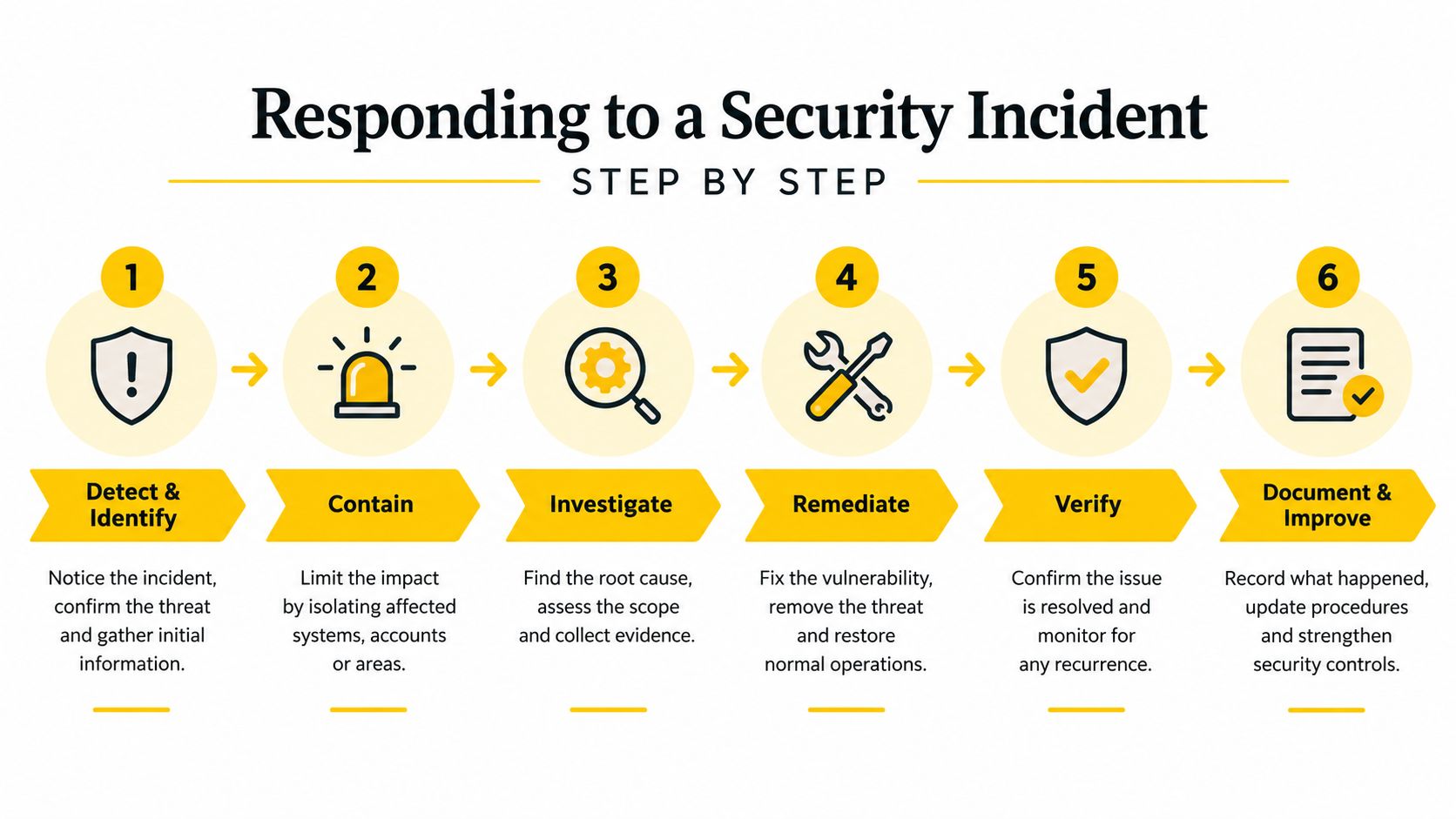
Responding to a Security Incident Step by Step
When a miner, wallet, or host is compromised, speed matters, but careless cleanup destroys evidence and leaves credentials active. Use a fixed order.
- Contain the rig: Unplug Ethernet or disconnect it from the network. If remote containment isn't trustworthy, power it off. Don't wipe the disk or start deleting files yet.
- Preserve evidence: Image the disk before rebooting where possible, capture memory if your tooling supports it, and copy miner logs, pool connection records, and SSH authentication logs to external storage.
- Rotate wallet authority: On a clean device, generate a fresh seed and sweep remaining funds to the new cold-storage address. Revoke pool, dashboard, API, and management credentials associated with the old environment.
- Audit the chain: Use Casplorer to inspect outbound transactions, record transaction hashes, tag the compromised address, and identify destination patterns. An on-chain record can't recover a payment, but it can establish scope and support community blocking.
- Notify other operators: Report the incident through the Cascoin public repository and Discord with timestamps, hashes, affected software versions, and indicators of compromise. Remove private keys and personal data from the disclosure.
- Rebuild cleanly: Install from a known-clean image, reapply the hardening checklist, restore only verified configuration, and document the root cause for the next monthly review.
For a broader operational framework covering responding to a cyber attack, focus on containment, evidence preservation, credential rotation, and communications rather than treating the event as a simple reinstall.
Start with the wallet if there is any chance the seed or private key was exposed. A clean rig with a compromised seed is still a compromised wallet. Conversely, moving funds while the infected host remains online can expose the replacement address, so perform the sweep from a trusted device.
The following incident-response video can help teams formalize roles and handoffs:
Open-Source Audit and Community Defense Habits
A secure configuration decays when nobody verifies it. Treat the rig as a small production system with a change record, a known-good build, and a recurring review.
For a reproducible Cascoin build, clone the public repository, initialize its dependencies with git submodule update --init --recursive, and record the commit, compiler, operating system image, and build flags. Before deployment, verify signed release checksums against the maintainer's published PGP key. If the checksum or signature doesn't match, stop. Don't solve the problem by downloading another binary from a random mirror.
Keep a monthly review narrow and repeatable
- Payout review: Compare pool statement hashes with expected wallet receipts and investigate unexplained gaps.
- Address review: Rotate mining reward subkeys when your operational policy calls for it, while preserving the recovery record offline.
- Privilege review: Run
find / -mtime -30 -perm -4000and investigate new SUID binaries, especially in temporary or application-writable paths. - Chain review: Confirm Casplorer shows expected payouts and inspect unexpected
OP_RETURNpayloads or unfamiliar transaction behavior. - Access review: Remove stale SSH keys, dashboard accounts, API tokens, and service users.
- Network review: Compare current connections with the approved pool and management destinations.
Community disclosure turns isolated observations into defensive coverage. Submit reproducible issues to the public repository, use the project's Signal or PGP-secured email route for sensitive findings, and publish sanitized post-mortems on Discord so other miners can search for the same indicators. Include affected versions, timestamps, hashes, and observable behavior, but never publish seeds, private keys, or credentials.
The opening wallet swap was preventable through several independent checks. Address verification would have caught the clipboard change, signed release verification could have exposed the pirated tool, and egress filtering could have blocked the fake pool. Shared telemetry makes those controls stronger because one operator's near-miss can become a patch, detection rule, or warning for the wider community.
Cascoin combines Proof-of-Work mining through SHA-256d and MinotaurX with its ecological Labyrinth Mining approach, while its open-source code and Casplorer make software and on-chain activity available for independent inspection. To apply the full-stack playbook to your own setup, visit Cascoin, review the public tools and documentation, and build your wallet, client, pool, and monitoring workflow around verifiable components.