New Altcoin Projects to Watch in 2026: 7 Early Picks
The popular advice to find new altcoin projects before everyone else skips the harder question: what can you verify before committing money, hardware, or electricity? A launch announcement isn't evidence of a maintained network, and a mining calculator isn't proof that you'll recover your costs. In its analysis of cryptocurrencies listed on GeckoTerminal, CoinGecko found that 53.2% had failed, meaning they were no longer actively traded after recording at least one trade.
These projects deserve different kinds of attention, not the same buying recommendation. Some offer accessible mining software; others introduce complex mining designs or experimental cryptography. Their websites and repositories are starting points for investigation, not independent endorsements.
The scores below are provisional evidence ratings, not investment ratings: documented means the project identifies something you can inspect, partial means important checks remain, and experimental means substantial technical uncertainty. Each rating considers the code repository, explorer, launch and supply disclosures, and risk warnings. None implies that a security audit or hands-on software test has been completed.
Table of Contents
- 1. Cascoin
- 2. Quai Network (QUAI / QI)
- 3. Sedra (SDR)
- 4. Gaelium (GAEL)
- 5. Brisvia (BRV)
- 6. Perihelion
- 7. Block Zero (BLOZ)
- How the seven new altcoin projects compare on mining fit, launch status, and key risk
- Before You Mine or Buy, a Due-Diligence Checklist
1. Cascoin
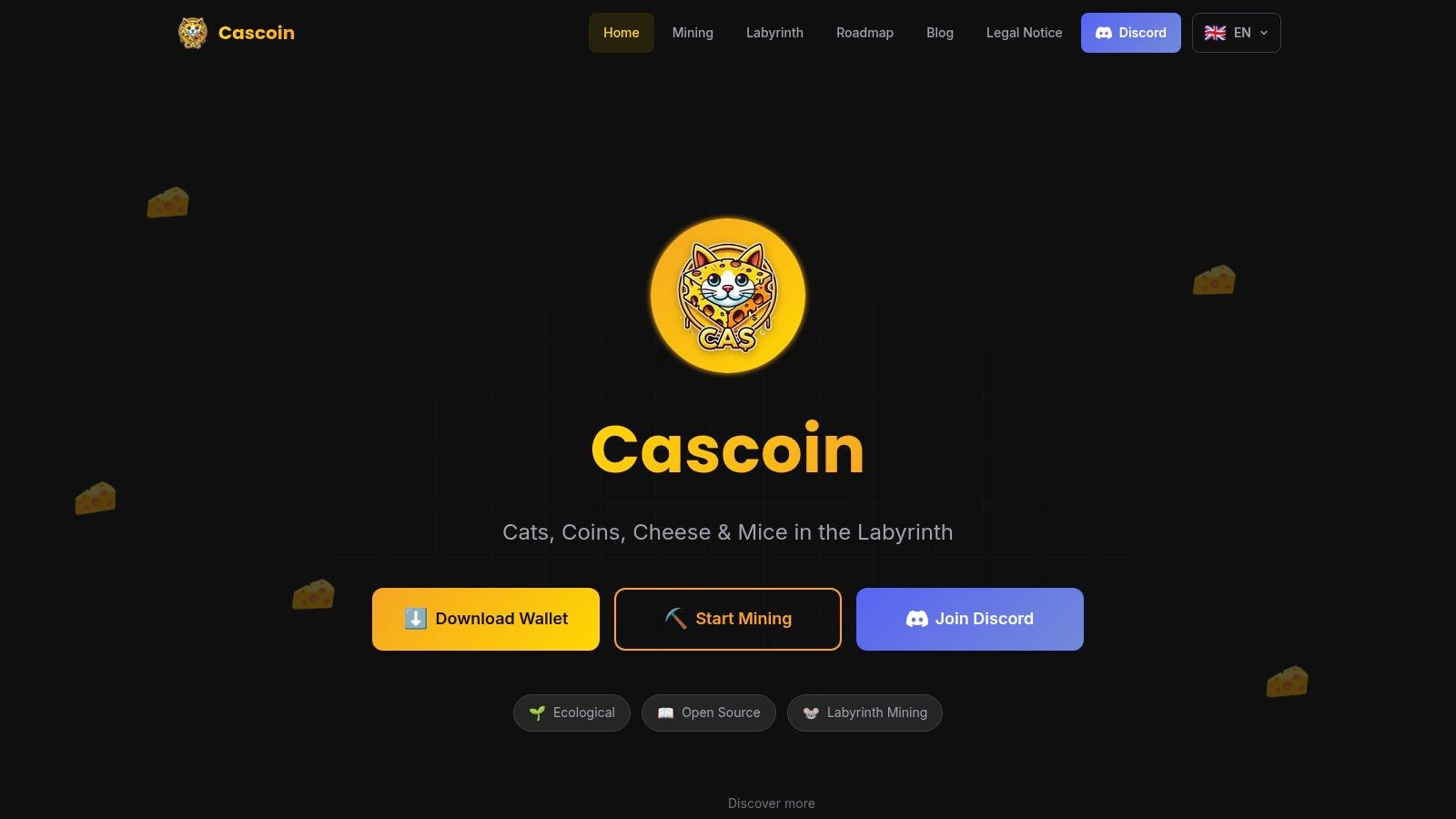
Cascoin's distinguishing feature is Labyrinth Mining, where virtual mice find their way through a maze to collect cheese. Its project materials describe this as a more engaging, potentially lower-power alternative to conventional mining, but the efficiency and reward advantages remain project claims until independently measured.
The project also offers MinotaurX for CPU participation and SHA-256 for ASIC operators. Those options serve different hardware owners; they shouldn't be compared using reward totals alone. An ASIC's wall-power consumption, a desktop's background workload, and the marketability of earned coins all affect the practical result.
Evidence Score and Practical Checks
Provisional score: documented, with performance and maintenance caveats. Cascoin identifies public MIT-licensed code, the Casplorer block explorer, wallets, mining documentation, and a public pool. That gives readers concrete inspection targets rather than only a roadmap.
- Repository: Follow the project's official repository links, inspect recent changes, and compare the available release with its source tag. Public code permits inspection; it doesn't establish that someone has audited it.
- Explorer: Check whether blocks continue arriving, inspect reward transactions, and compare pool payouts with the activity shown in Casplorer.
- Supply and launch: Locate the emission rules and initial distribution disclosures. Don't substitute a mining tutorial for an explanation of who received coins at launch.
- Risk disclosures: Account for cryptocurrency volatility and the project's dependence on a solo developer.
Practical rule: Compare mining methods by electricity consumed per accepted contribution and by rewards you can actually withdraw, not by an animated interface or headline reward claim.
The Cascoin mining rig setup guide is a useful starting point for setup planning. Keep wallet backups separate from mining experiments, and measure the complete machine at the wall.
Best fit: miners who want several participation routes and developers interested in a small, open-source project. Main trade-off: approachable documentation and community access don't eliminate maintenance concentration or prove energy efficiency.
2. Quai Network (QUAI / QI)
Quai rewards preparation more than impulse. The Quai Network website describes support for KawPoW GPUs, SHA-256 ASICs, and Scrypt ASICs, alongside merged mining and workshares, so the first question is whether a rig you already own matches a supported path. Its EVM-compatible application environment adds capability beyond basic wallet transfers, but compatibility is a feature claim until applications show sustained use.
Working score: documented, but operationally complex. Mining instructions, wallet options, pools, and solo-mining information provide entry points. The harder work is mapping how the network components and the QUAI and QI assets affect what you earn and when you can withdraw it.
Check the Payout Path Before the Hashrate
Run one small cycle before reconfiguring a stable rig: match the algorithm to the miner build, send rewards to the correct wallet asset, read the pool terms and payout threshold, then confirm a modest withdrawal clears. A cleared withdrawal outranks a dashboard estimate.
- Code and releases: identify the official node implementation and check whether the mining guide matches the current release.
- Explorer evidence: trace recent pool payouts and separate qualifying workshare rewards from rewards paid only for found blocks.
- Asset rules: read the supply and conversion documentation for QUAI and QI separately, since each can carry different conditions.
- Live versus planned: treat application compatibility as distinct from proof that useful applications have held users.
Hardware flexibility is the draw; interpretation is the cost. A miner can set up the correct algorithm and still misread which asset is being earned or which condition gates payment. Compare Quai with other proof-of-work coins only after a small payout has cleared and the reward mechanism is explained in plain terms.
3. Sedra (SDR)
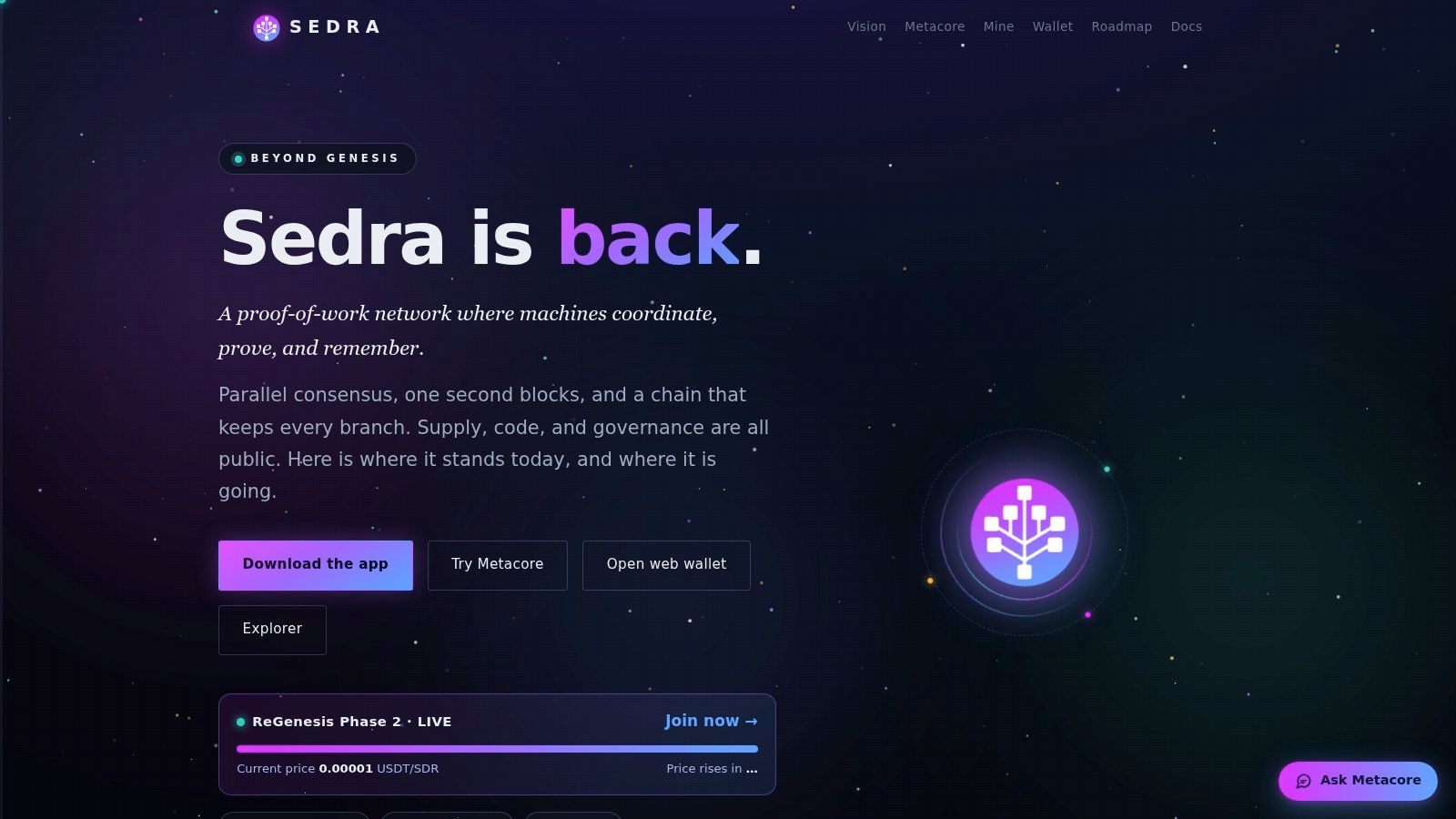
Investigate continuity before the AI narrative. The Sedra website describes a proof-of-work network using kHeavyHash and GHOSTDAG, with node, wallet, explorer, and mining resources. Its history includes a quiet period and restoration claims, so current network operation deserves more attention than an old launch announcement.
Provisional score: partial, pending continuity checks. Downloadable software and documentation are useful, but readers should establish whether the repository, explorer, and public mining instructions describe the same functioning network.
Separate Mining From Metacore
Sedra's developing Metacore proposition concerns verifiable AI work paid for in SDR. That isn't interchangeable with a live, usable service. Before assigning it value, look for runnable software, documented job submission, verifiable results, and observable settlement.
For the base network, make these checks:
- Release integrity: Compare download checksums with the published values. Remember that a checksum confirms file consistency, not the absence of malicious code.
- Network continuity: Inspect recent blocks and transactions, then compare the explorer's chain information with a synchronized node.
- Supply history: Read how any restoration affected balances, emissions, and earlier participants.
- Disclosure quality: Look for unresolved issues and pending work, not just completed milestones.
Sedra may interest technically curious miners who are comfortable investigating a project's operational history. Its wallet and mining tools offer something concrete to evaluate, while the AI component should remain a separate research question.
Main trade-off: accessible software can reduce setup friction, but it can't resolve uncertainty about liquidity, maintenance capacity, or the consequences of a restart.
4. Gaelium (GAEL)
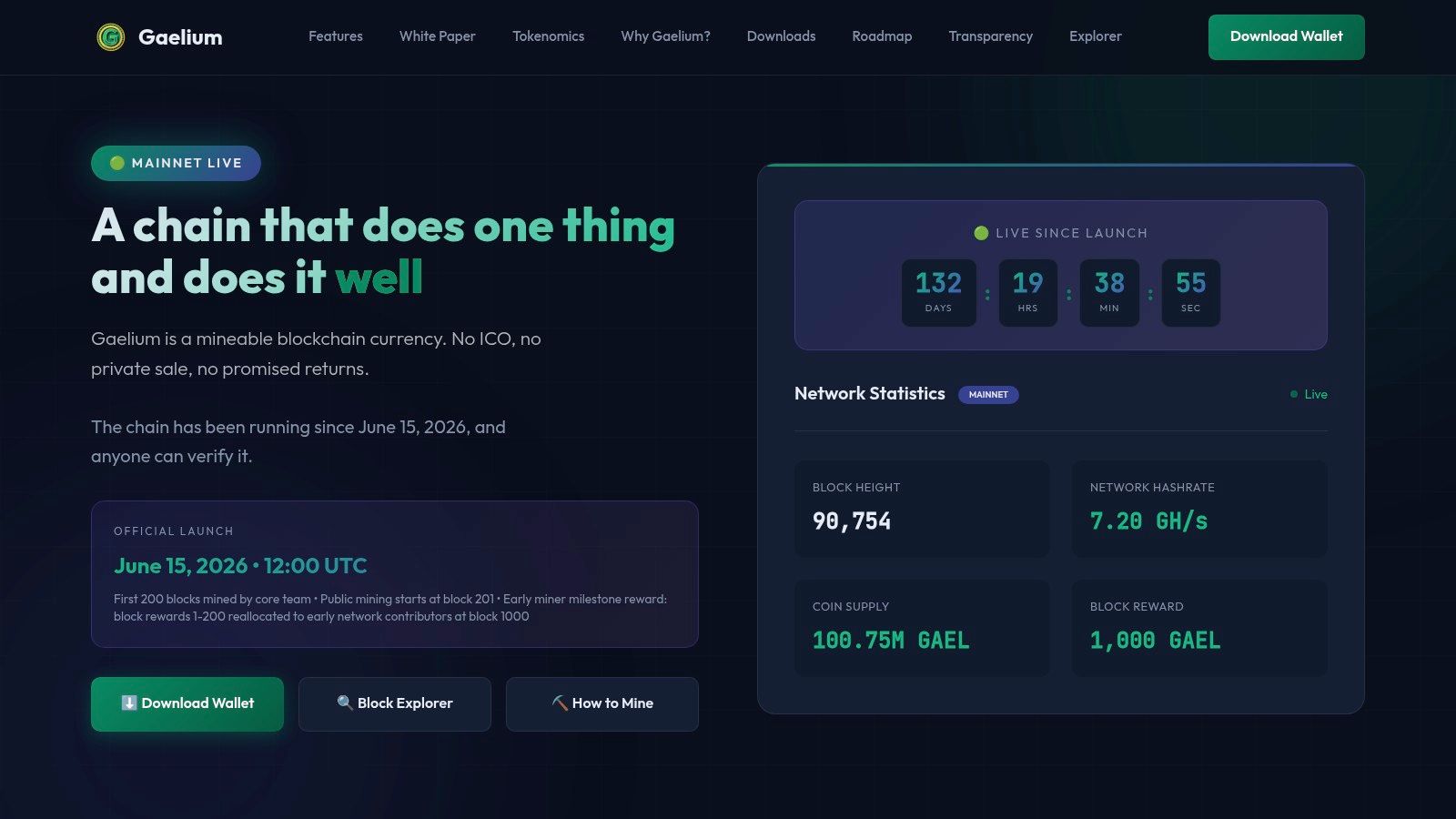
A fair-launch label needs a distribution check, not applause. The Gaelium website describes a KAWPOW GPU-mineable blockchain without an ICO or private sale, while also disclosing that the core team mined the initial blocks before public mining opened.
Those statements address different questions. Avoiding a token sale doesn't establish equal mining access from genesis, and disclosed early team mining still deserves examination.
Provisional score: partial, with launch distribution central to the review. The project lists wallets, mining information, an explorer, and an emission schedule. Verify that these resources are operational rather than treating their presence on the website as confirmation.
Follow the Early Rewards
Use the explorer to inspect the earliest available blocks and their reward destinations. Compare those records with the launch disclosure, then investigate whether early balances remain concentrated or have moved to pools, exchanges, or other addresses.
A transparent exception to a fair-launch claim is more useful than an unexplained slogan, but disclosure doesn't remove the economic effect of the exception.
For mining, check the pool's payment history and your own accepted shares. The project describes reimbursement after pool-related payout problems; treat that as a reason to inspect payout handling, not as a guarantee against another failure.
Best fit: GPU miners who prefer a relatively straightforward mining-and-payments proposition. Main trade-off: familiar mining software can make entry easier, but a young chain still needs evidence of dependable payouts, maintained releases, distributed hashrate, and usable markets.
Don't purchase hardware specifically for Gaelium until the network and your own cost measurements justify more than a small experiment.
5. Brisvia (BRV)
Brisvia's appeal is practical: try CPU mining without first buying specialized equipment. The Brisvia website presents a RandomX proof-of-work project with a desktop application combining wallet, node, and miner, plus command-line and XMRig-based routes.
Provisional score: documented entry points, limited operating-history confidence. Public source code and download-verification information make inspection possible. They don't establish independent review, reliable market access, or profitable mining.
Convenience Versus Control
An integrated application reduces configuration work, but it also combines functions with different security needs. A wallet protects keys, a node validates the chain, and a miner consumes system resources. Check whether you can disable each component independently and identify where the application stores wallet files.
- Beginner route: Verify the installer, create a wallet backup, synchronize the node, and confirm the destination address before enabling mining.
- Operator route: Use the documented command-line or XMRig configuration, inspect logs, and confirm accepted work rather than relying on CPU utilization.
- Economic check: Measure whole-system power, cooling needs, and the effect on other tasks. A computer you already own still costs money to run.
The new altcoins to mine guide can help frame hardware comparisons, but Brisvia's own consensus and supply rules need separate inspection.
Best fit: CPU owners who want a controlled learning exercise. Main trade-off: an all-in-one interface may simplify participation while making it easier to overlook key custody, network synchronization, or a miner running continuously in the background.
CPU accessibility is a participation feature, not evidence of meaningful earnings.
6. Perihelion
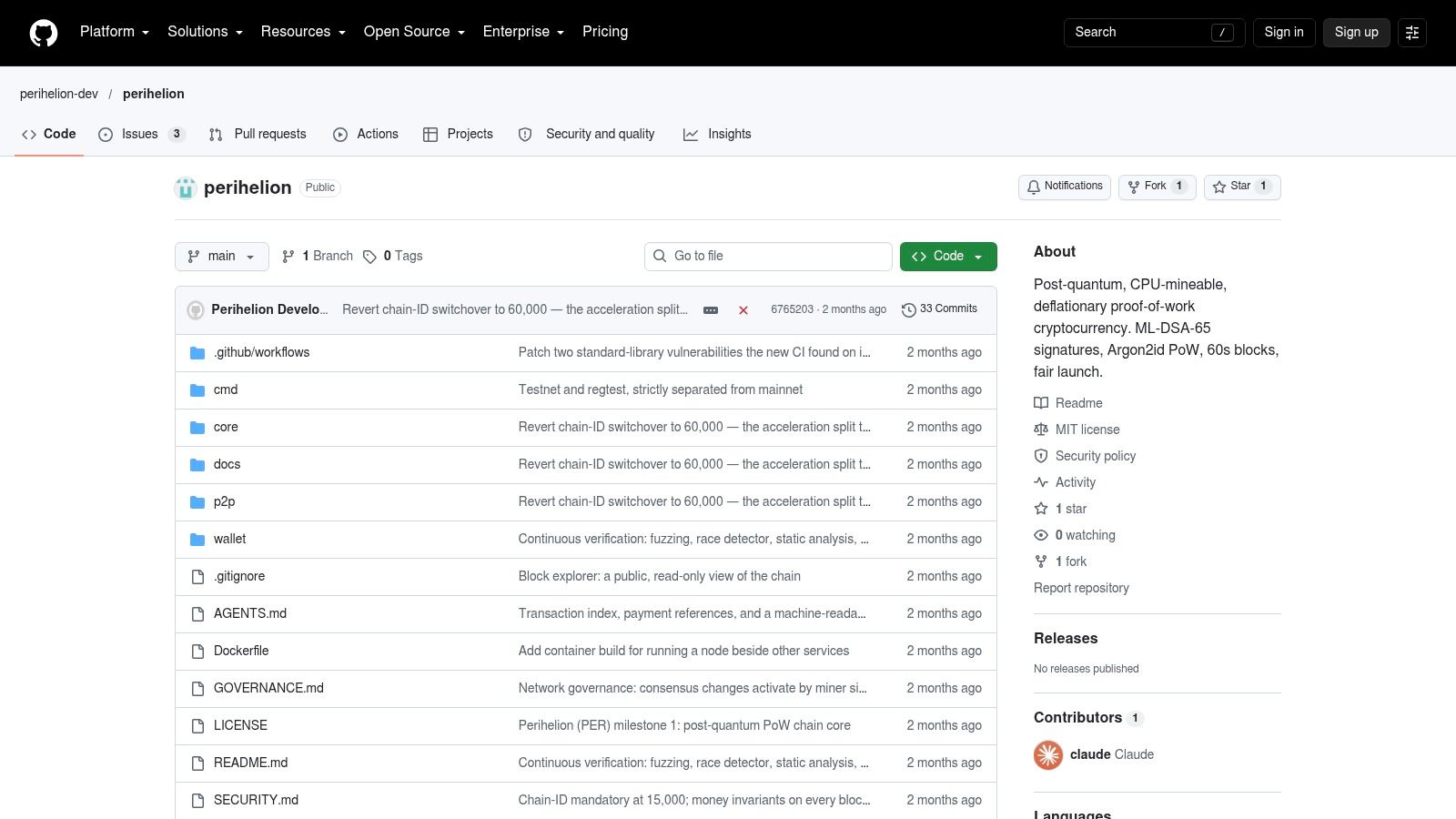
Perihelion belongs on a technical research watchlist, not a beginner's profitability shortlist. Its GitHub repository describes CPU-oriented Argon2id proof-of-work and a post-quantum signature design, alongside explicit warnings about immaturity, limited hashrate, absent independent security auditing, and potentially nonexistent market value.
Provisional score: experimental, with candid risk disclosure. The MIT-licensed implementation and supply-audit tooling offer material for developers to inspect. Neither establishes that the consensus implementation or cryptographic integration is safe.
Inspect the Implementation, Not the Label
Post-quantum describes a design objective and cryptographic approach. It doesn't establish that wallet storage, transaction validation, networking, or update delivery is secure.
Start by reviewing build instructions and automated tests. Inspect how transactions are signed and rejected, how supply is calculated, and whether the audit tooling can reproduce the claimed distribution from chain records.
- Repository check: Look for meaningful review, test coverage, issue handling, and dependencies that a maintainer must keep current.
- Explorer check: Establish whether a public explorer exists and agrees with a locally synchronized node. Missing observability is a limitation, not a neutral detail.
- Risk check: Assume mining rewards may have no realizable value and that experimental software may need disruptive fixes.
Research boundary: Keep experimental node software away from machines holding valuable wallet keys or sensitive personal data.
Perihelion's strongest feature for researchers is its explicit uncertainty. The trade-off is severe: interesting cryptography and inspectable code come with substantial implementation, network-security, maintenance, and market risks.
7. Block Zero (BLOZ)
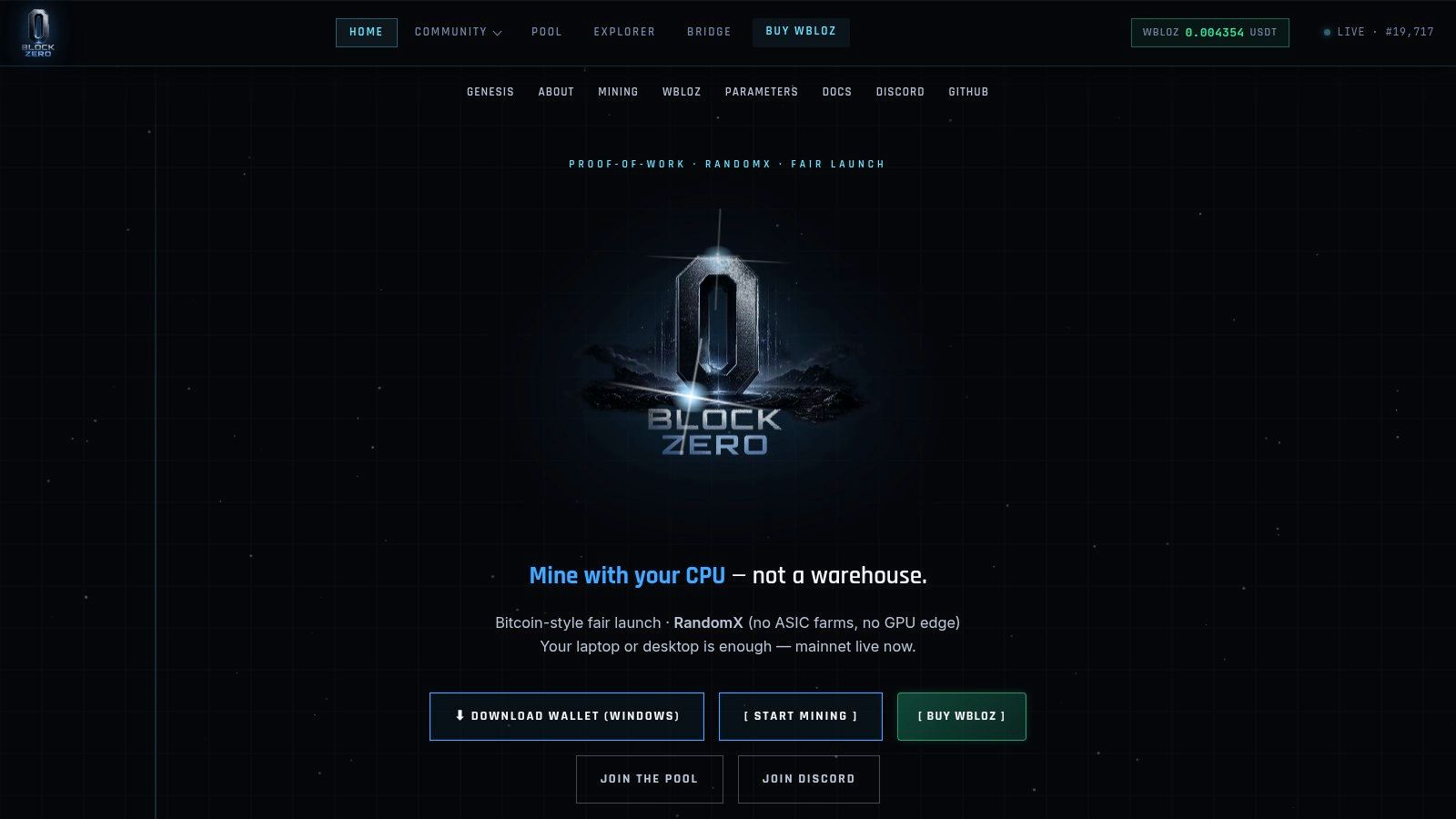
Before researching a BLOZ market, establish which asset it handles. The Block Zero website describes a native RandomX proof-of-work coin and also provides information about a wrapped-token representation. A native coin and its wrapped counterpart don't have identical custody or transfer risks.
Provisional score: partial, with separate native-chain and wrapped-token checks required. The project presents fair-launch and capped-supply claims, wallet downloads, and pool access. Those are investigation targets, not independent evidence of security or fair distribution.
Audit the Coin and Wrapper Separately
For the native chain, locate the source repository and inspect the genesis configuration, reward rules, and supply calculation. Compare those rules with explorer records and check whether a locally synchronized node reports the expected chain.
For the wrapped asset, ask different questions:
- Backing: Who holds or controls the native coins corresponding to wrapped balances?
- Permissions: Who can mint, pause, upgrade, or otherwise control the contract?
- Redemption: Can users practically return to the native asset, and what happens if the operator stops responding?
- Transfer compatibility: Does the receiving platform support the precise asset and network you intend to use?
RandomX makes CPU participation possible, but it doesn't establish that hashrate is broadly distributed or that selling rewards will be straightforward.
Best fit: technically careful CPU miners willing to investigate both chain operation and asset identity. Main trade-off: wrapping may offer another transfer route, but it introduces contract, custody, and redemption dependencies beyond the native network.
Never send a native coin to a wrapped-token deposit address just because the ticker matches.
How the seven new altcoin projects compare on mining fit, launch status, and key risk
| Item | Mining Algorithm | Hardware Fit | Launch Status | Main Risk Flag |
|---|---|---|---|---|
| Cascoin | Labyrinth Mining, MinotaurX, SHA-256 | CPU and ASIC | Live network with public explorer and pool | Solo-developer dependence; reward claims are not guaranteed |
| Quai Network (QUAI / QI) | KawPoW, SHA-256, Scrypt | GPUs and ASICs | Live network running a dual-token design | Complex token and network design |
| Sedra (SDR) | kHeavyHash | GPUs | Public mining restored after a quiet period | History and current network conditions warrant research |
| Gaelium (GAEL) | KAWPOW | GPUs | Young chain with public mining; launch details sit in its distribution review | Young network; hashrate and liquidity remain unproven |
| Brisvia (BRV) | RandomX | CPUs | Young mainnet with limited operating history | Limited history and uncertain rewards |
| Perihelion | Argon2id | CPUs | Genesis launch in 2026; very early | No independent security audit; low hashrate |
| Block Zero (BLOZ) | RandomX | CPUs | Live young chain; wrapped asset trades separately | New-chain security and wrapped-token risks |
Read the hardware column as a floor, not a recommendation. CPU-friendly algorithms like RandomX and Argon2id let you participate with equipment you already own, but they say nothing about whether the hashrate is broadly distributed or whether you can sell what you mine. GPU and ASIC entries raise the capital question: KawPoW, KAWPOW, Scrypt, and SHA-256 all have established hardware markets, while kHeavyHash and Labyrinth Mining are narrower paths tied to each project's own software.
The risk column is where the meaningful comparison lives. Cascoin's trio of mining options is verifiable today through its public repositories and the Casplorer explorer, yet its solo-developer stewardship means one person's availability shapes the codebase. Quai's multi-algorithm, dual-token structure gives miners more entry points and more design to audit. Sedra asks you to weigh a restoration story, and Block Zero asks you to evaluate a native chain and a wrapped token as two separate systems.
Treat every launch-status cell as a starting point for your own check, not a settled fact. Open each explorer, confirm recent blocks are being produced, and decide whether the network's age and activity justify the hardware and power you would commit.
Before You Mine or Buy, a Due-Diligence Checklist
Treat new altcoin projects as software, network, and distribution investigations before treating them as financial opportunities. In a sample of token-generation events reported by CoinDesk, citing Memento Research, approximately 85% of tokens launched in 2025 were trading below their initial valuations. That finding concerns token launches, not a profitability forecast for these mineable coins, but it reinforces why launch attention isn't enough.
Use the same checks regardless of how polished the website looks:
- Confirm maintained code: Follow official GitHub or Codeberg links. Inspect release tags, meaningful commits, unresolved issues, contributor breadth, and whether build instructions describe the current software.
- Verify chain activity: Open the explorer, inspect recent blocks and transactions, and compare its records with your node where practical. Distinguish genuine transfers from repeated activity among related addresses.
- Read launch and supply disclosures: Find genesis details, early allocations, emission rules, treasury control, and any ability to change consensus parameters.
- Separate live from planned: A downloadable wallet is inspectable. A proposed AI service, application platform, or efficiency improvement needs separate evidence.
- Price the complete experiment: Include wall-power consumption, cooling, pool fees, hardware wear, and the difficulty of converting rewards into usable funds.
- Test custody and payout: Back up the wallet, verify the destination network, and complete a small transfer before expanding participation.
The MemeAssist token due diligence guide offers an additional framework for investigating token claims. For mineable projects, add repository inspection and electricity measurement rather than relying solely on market or wallet-distribution checks.
Start small and keep costs below what you can afford to lose. Record the software version, pool terms, measured consumption, accepted work, and actual payout. Increase participation only when those observations support it, and leave reward or efficiency claims marked unverified until your own measurements justify a different conclusion.
Cascoin offers open-source code, Casplorer, wallet downloads, and several mining approaches for readers who want to investigate a young network rather than follow a price promise. Visit Cascoin to inspect its documentation, compare the available mining options with your hardware, and check the public chain before committing resources.