ASIC Miner Profitability: How to Calculate Real Returns
You've found an ASIC that promises impressive hashrate, entered your electricity rate into a calculator, and seen a reassuring daily profit figure. Then the power bill arrives, the pool takes its fee, network difficulty changes, and the number starts moving. The machine hasn't become slower, but your share of the network's rewards has.
That's the central problem with ASIC miner profitability. It isn't a permanent daily income stream. It's a changing operating window shaped by electricity, hardware efficiency, competition, coin economics, and the length of time your machine stays useful.
Table of Contents
- What Drives ASIC Miner Profitability
- Hashrate, Difficulty, and the Constantly Moving Target
- Calculating Daily, Weekly, and Monthly Profit Step by Step
- Comparing CPU, GPU, ASIC, and Labyrinth Mining
- Why ROI Is a Range, Not a Date
- Practical Tips to Maximize Energy-Efficient Returns
- Rethinking Profitability Beyond Daily Coin Output
- Putting It All Together Before You Switch the Rig On
What Drives ASIC Miner Profitability
You turn on an ASIC, watch the hashrate appear, and the first profit estimate looks clean. Then real mining starts. Revenue and cost move at different speeds, so ASIC miner profitability behaves less like a fixed daily paycheck and more like a shrinking window you need to use before power prices, competition, or aging hardware squeeze the margin.
Six forces shape that window.
Hashrate is the machine's output, usually measured in hashes or terahashes per second. It works like the size of your work crew. More output can earn more, but only if the extra work brings in more value than it costs to produce.
Power draw measures how much electricity the machine consumes while hashing. Newcomers often get fooled here. Two ASICs can post similar hashrate numbers, yet the one that burns fewer watts has more room to stay profitable when conditions tighten. That is why joules per hash often matter more than headline speed alone. It is also why lower-power alternatives such as Cascoin's Labyrinth Mining can change the comparison. Less raw output does not automatically mean worse economics if energy use stays much lower.
Electricity cost often decides whether a machine is earning or just making heat. Survey data from the Cambridge Centre for Alternative Finance found that electricity represented more than 80% of miners' cash-based operating expenses, with estimated median electricity costs of approximately $45 per megawatt-hour, or $0.045 per kilowatt-hour (Cambridge Digital Mining Industry Report). A miner paying $0.03 per kWh starts from a very different position than one paying $0.10 per kWh, even with the same hardware.
Pool fees reduce gross rewards. Pool mining makes earnings smoother by combining many miners' output, but the pool keeps a share. Uptime matters too. A cheaper pool loses its appeal fast if disconnects leave your machine powered on but not earning.
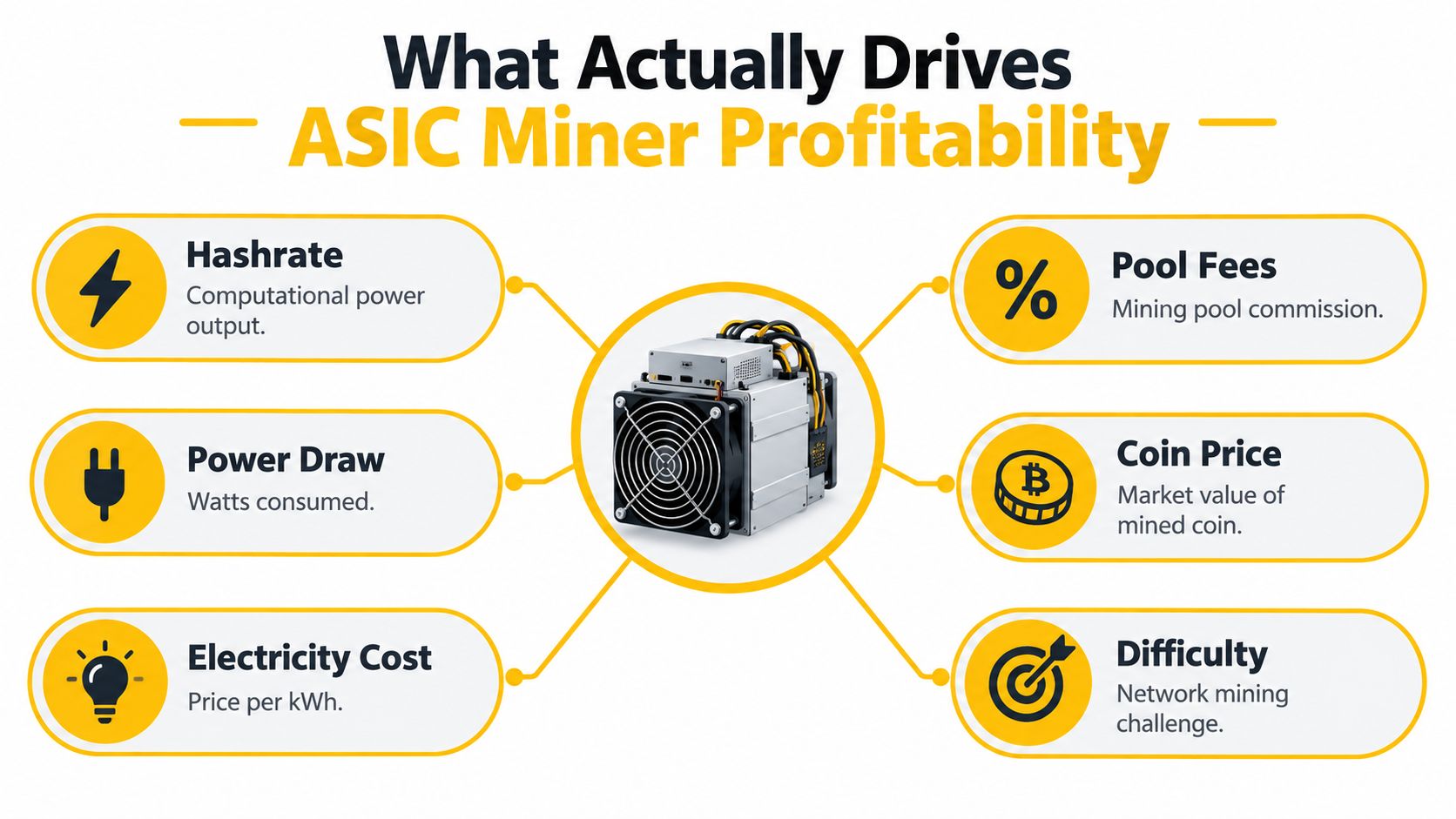
Coin price turns mined output into revenue, and network difficulty changes how much output your machine can expect to win. Together, they create the trap behind a single daily-profit figure. Price can fall while difficulty rises, and your profitable window narrows from both sides at once. A small fee matters, but energy cost, efficiency, and rising competition usually do more to determine whether the machine keeps paying for itself.
Hashrate, Difficulty, and the Constantly Moving Target
Hashrate and difficulty answer different questions.
Hashrate is your number of lottery tickets. An ASIC performs calculations continuously, and each calculation gives it another chance to meet the network's requirement. A machine with more hashrate owns more tickets, but it doesn't receive a guaranteed reward.
Difficulty is the size of the challenge. If more miners bring more tickets to the lottery, the network raises the requirement for a winning ticket. Your ASIC can keep producing the same number of hashes while earning a smaller share of the total opportunity.

Read network statistics in this order:
- Check your machine's hashrate. Confirm the pool sees roughly the output you expect. Persistent gaps may indicate heat, faulty hardware, unstable firmware, or network problems.
- Check network hashrate and difficulty. Rising network participation means your machine represents a smaller slice unless its own output increases.
- Find the retarget schedule. A difficulty adjustment, epoch, or retarget period marks a point where the network recalculates the challenge. It doesn't predict the exact next result, but it tells you when the earning environment can shift.
- Model the next adjustment. Don't use today's reward estimate as a promise for next week. Test a higher-difficulty scenario before committing capital.
The Cascoin guide to mining difficulty is useful for learning how the network challenge changes and why difficulty belongs in every profitability forecast.
A practical reading habit is to compare your expected coin output with your power cost after every meaningful network change. If revenue falls while watts remain fixed, the machine's margin contracts immediately.
Calculating Daily, Weekly, and Monthly Profit Step by Step
Start with the physics, not the coin price. An ASIC drawing 3,000 watts uses 3 kilowatts. At continuous operation, daily energy use is:
3 kW × 24 hours = 72 kWh per day
At an electricity tariff of $0.05 per kWh, daily electricity cost becomes:
72 kWh × $0.05 = $3.60 per day
Those figures describe power expense only. You still need an expected coin output from a calculator or pool estimate, plus pool fees, downtime, cooling, hosting, maintenance, financing, taxes, and hardware depreciation.
The long-form calculation
Assume your mining estimate produces $6.00 of gross coin revenue per day before fees. The calculation is:
Daily operating profit = gross coin revenue − electricity cost − pool fees − other daily operating costs
If the pool fee is represented as a fraction of revenue, then:
Daily operating profit = $6.00 − $3.60 − ($6.00 × pool-fee rate) − other costs
The result is not your return on investment. It's the cash margin produced by operating the machine for that day, before recovering the purchase price.
For a week, multiply the daily result by seven only if the machine runs continuously and the assumptions stay constant. For a month, multiply by the number of operating days in your chosen period. A cleaner model subtracts downtime explicitly:
Realized revenue = expected revenue × uptime
If the machine runs less than continuously, apply the same uptime factor to its expected revenue and power use. Then add fixed costs separately, because hosting or financing can continue while the ASIC is offline.
The short formula
Use this compact version:
Profit = (coin earned × coin price × uptime × pool-adjusted payout) − (power in kW × 24 × electricity rate × uptime) − other costs
The Cascoin mining profitability calculator can help organize the inputs, but no calculator can know your future difficulty, repair bill, tax treatment, or resale value.
Practical rule: Treat a daily calculator result as a snapshot, not a salary.
The formula breaks when you copy one market moment into a long-term forecast. Coin price changes revenue, difficulty changes your expected output, and hardware aging can reduce uptime. Calculate daily profit for operational decisions, weekly profit for cash planning, and monthly profit for budgeting. For an investment decision, use a range of scenarios instead of one attractive number.
Comparing CPU, GPU, ASIC, and Labyrinth Mining
Hardware choice depends on the constraint you're trying to solve. An ASIC usually wins at an algorithm such as SHA-256 because its circuitry is built for that narrow task. A CPU offers accessibility, a GPU offers flexibility, and a low-power approach can make sense when electricity capacity matters more than maximum coin output.
| Hardware | Typical Power Draw | Best-Fit Operator | Strength | Main Trade-Off |
|---|---|---|---|---|
| CPU | Low to moderate, depending on workload | Beginner or low-power participant | Accessible and easy to repurpose | Limited output on ASIC-dominated algorithms |
| GPU | Moderate to high, depending on cards and tuning | Flexible miner who may switch networks | Adaptable across supported algorithms | More power and maintenance than a CPU |
| ASIC | High for many industrial units | Operator with cheap power and suitable infrastructure | Strong algorithm-specific efficiency | Less flexible, noisy, heat-intensive, and exposed to obsolescence |
| Labyrinth Mining | Designed for lightweight operation | Eco-conscious or capacity-constrained participant | Focuses on joules per hash and accessible participation | Different reward model and network economics from SHA-256 |
The key comparison is joules per hash, not headline hashrate alone. ASIC development reduced the energy required per unit of computation dramatically after application-specific hardware entered Bitcoin mining. A historical hardware series reports approximately 98 J/TH in 2016, around 30 J/TH in 2020 to 2021, roughly 21 J/TH for S19 XP-class machines in 2023, and about 13 J/TH for leading air-cooled units by 2026 (Bitcoin hashrate and mining hardware overview). Cambridge estimated the global Bitcoin fleet averaged approximately 28.2 J/TH by June 2024 after improving 24% year over year, while annual electricity consumption still rose 17% to 138 TWh (Cambridge Digital Mining Industry Report). Efficiency gains can coexist with greater total consumption when operators deploy more machines.
Labyrinth Mining offers a different trade-off from a brute-force SHA-256 hash race. Cascoin describes it as lightweight client software in which virtual mice move through a maze to collect rewards, while MinotaurX provides another CPU-friendly route. For someone with constrained power, the relevant question may be reward per watt rather than raw terahash output.
Industrial operators also need to budget for monitoring, cooling, repairs, and planned maintenance. Guidance on industrial mining upkeep can help frame those non-electricity costs before you compare machines.
Why ROI Is a Range, Not a Date
A calculator may tell you that hardware reaches break-even on a particular date. That date assumes the inputs remain stable, which is precisely what mining markets rarely provide.
Academic research found that Bitcoin-mining hardware's average time to become unprofitable can be less than 1.29 years, while the OECD reported that Bitcoin hardware's useful life was under 1.5 years as of 2021 (Bitcoin mining electronic waste research). Those figures don't mean every ASIC fails financially within the same period. They show why a purchase needs a useful operating window, not just a payback date.
Build three cases for every machine:
- Optimistic case: Use a favorable electricity rate, strong uptime, stable or supportive coin conditions, and slower difficulty growth.
- Base case: Use your most defensible tariff, realistic downtime, pool costs, and a moderate difficulty increase.
- Stress case: Increase the electricity price, reduce uptime, weaken coin revenue, and assume difficulty rises faster than expected.
A machine can show positive variable profit at $0.04 per kWh and still produce a poor investment over an extended period if difficulty rises and block-reward pressure reduces revenue. The initial margin may pay for electricity while failing to recover hardware, infrastructure, financing, and maintenance costs before the machine loses competitiveness.
This is the same logic used in broader payback analysis. The explanation of how HighFlow Energy calculates payback is a useful reminder that payback depends on assumptions about savings, utilization, and changing conditions, not just a single starting figure.
ROI is the point at which accumulated cash flow catches the investment. The operating window is the period in which keeping the machine powered on remains economically sensible.
Track both. If the machine remains above variable cost but can't recover its purchase price before obsolescence, you may prefer to buy used hardware cheaply, repurpose it, sell it, or direct power toward another network.
Practical Tips to Maximize Energy-Efficient Returns
A miner can look profitable at breakfast and mediocre by dinner if power is priced wrong. That is why efficiency work starts with electricity, because in mining cost studies it is commonly the largest cash operating expense, often more than 80%, and a tariff change from $0.04 per kWh to $0.08 per kWh can flip the result from workable to unworkable. If you want the measurement side in more detail, this guide to energy-efficient crypto mining is a useful companion. General background on block production and mining mechanics is covered in How Bitcoin mining works.
Tune the machine before expanding it
Treat tuning like trimming waste from an engine. More hashrate on the screen means little if each extra unit of output costs too much power or creates instability that cuts real earnings.
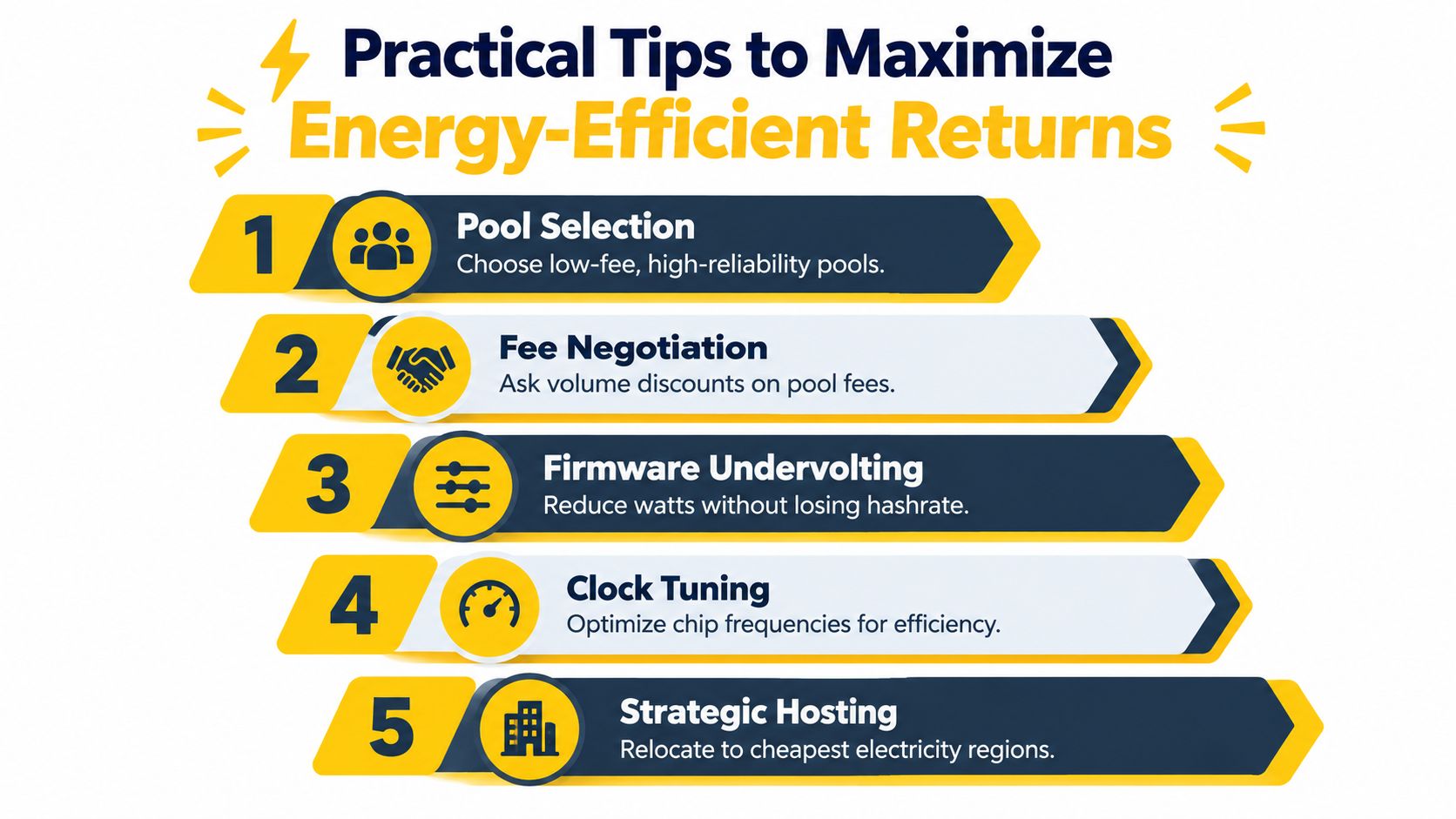
- Choose the pool carefully: Compare payout structure, reliability, server location, and fees. A slightly lower commission does not help if stale shares or disconnects reduce uptime.
- Ask about fee terms: Larger operators may negotiate pool pricing, but the saving only matters if payout consistency and support remain strong.
- Undervolt the firmware: Reduce voltage and watch watts, temperature, and stable hashrate together. The target is better joules per terahash, not a prettier headline number.
- Tune clock speed: Lower frequency can reduce draw and heat. Keep the setting only when efficiency and uptime both improve.
- Watch rejected shares: High displayed hashrate does not pay the bill if the pool rejects too much work. Accepted shares, fan behavior, restart frequency, and thermals matter more.
Run the machine around the tariff, too. If your rate changes through the day, underclock during expensive hours, pause during grid stress, and return to normal when power is cheaper. You give up some gross output, but you may preserve the operating window that matters.
Cooling changes the math in quieter ways. Better airflow and lower intake temperatures can reduce throttling and fan strain. If the heat serves a real purpose in your building, that practical value belongs in your calculation.
Algorithm flexibility adds another layer. If hardware or your setup can shift to another viable network, you are not trapped by one shrinking profit window. For Cascoin, Labyrinth Mining and MinotaurX illustrate the low-power side of that choice, where efficiency per unit of work can matter more than raw hashrate alone, while SHA-256 still suits operators already committed to specialized equipment.
Rethinking Profitability Beyond Daily Coin Output
The highest daily coin output isn't automatically the best result. A household with limited circuits may value profit per watt or profit per circuit more than total coins. A business with usable waste heat may include heat-reuse value, while an environmentally focused operator may compare emissions-adjusted revenue and survivability during price declines or reward changes.
Define your objective before buying:
- Maximum daily coins: Favor high hashrate and continuous operation.
- Lowest cost per hash: Favor strong joules-per-hash performance.
- Best profit per watt: Consider underclocking, flexible schedules, and low-power networks.
- Longest operating window: Include hardware aging, repair risk, and resale value.
- Lowest infrastructure burden: Prefer accessible CPU or lightweight mining where suitable.
Cascoin's Labyrinth Mining reflects this alternative philosophy by using lightweight maze-based client software rather than relying only on brute-force hashing. That doesn't make its rewards a guaranteed investment return. It means a miner can evaluate a different objective, especially when power capacity, heat, noise, and hardware cost matter as much as headline hashrate.
A useful personal test is simple: write down your electricity rate, available power, acceptable noise, desired payback risk, and whether you want maximum coins or sustainable participation. The right machine is the one that fits those constraints, not the one with the most impressive specification.
Putting It All Together Before You Switch the Rig On
Before powering up, confirm the revenue, power, pool, downtime, and other-cost formulas. Run optimistic, base, and stress cases, then choose whether you're optimizing coins, profit per watt, circuit capacity, or operating life. Secure reliable low-cost electricity, select hardware and an algorithm that fit it, and record your assumptions for later review.
Cryptocurrency prices and network conditions are volatile, so your own tariff, infrastructure, risk tolerance, and maintenance plan matter more than any static estimate. Tonight, enter your real power rate into a calculator and write down the condition that would make you switch the machine off.
Cascoin offers Labyrinth Mining for lightweight maze-based participation, MinotaurX for CPU-friendly mining, and SHA-256 for operators evaluating ASIC hardware. Visit Cascoin to review the available mining options, documentation, and open-source project resources before choosing your next setup.