BTC Banking Online Explained Securely and Simply
You open your banking app expecting a familiar way to buy, hold, or send Bitcoin. Instead, you find a brokerage feature, a partner exchange, or nothing at all. Even when a Bitcoin option is available, the important question isn't just whether you can purchase BTC. It's where the keys live, who can move the funds, which protections apply, and how reliably money travels from your bank account to the service.
That's why btc banking online is better understood as a choice of custody and payment rails. The interface may look like ordinary banking, but the underlying arrangement can differ sharply. Use this guide to build the right mental model, compare service types, avoid transfer mistakes, and evaluate providers with more confidence. If Bitcoin is also relevant to your business finances, this introduction to understanding digital currency for small business offers useful background in plain language.
Table of Contents
- What BTC Banking Online Really Means Today
- How Online BTC Banking Works Behind the Scenes
- Comparing Your Options for BTC Banking Online
- Security Regulation and Fees You Should Understand
- Your Step by Step Onboarding Checklist
- Best Practices for Storage KYC and Taxes
- Choosing Wisely and Staying Safe Going Forward
What BTC Banking Online Really Means Today
The phrase btc banking online can describe several different services. A regulated bank might offer Bitcoin custody through its existing app. A fintech platform might provide a bank-like balance screen while relying on an external crypto custodian. An exchange might let you fund an account by bank transfer and store Bitcoin for you, even though it isn't a bank account.
Those models can feel similar from the customer's side. You sign in, complete identity checks, transfer money, and see a BTC balance. Behind the screen, however, the provider may have very different responsibilities for private keys, withdrawals, transaction monitoring, recovery, and customer support.
The first question isn't “Can I buy Bitcoin?” It's “Who controls the key that can move it?”
A useful example is a customer who buys BTC inside a familiar financial app. If the app doesn't show a private-key backup or let the customer withdraw to an external address, the customer probably has a custodial claim rather than direct control of the underlying wallet. That arrangement may be convenient, but it creates reliance on the provider's systems, policies, solvency, and jurisdiction.
Access also varies by country and institution. A benchmark of the 25 largest global financial institutions found an overall score of 32% for integrated Bitcoin and digital-asset capabilities, with Fidelity leading at 71% and BNY Mellon at 46%. The benchmark measured custody, trading and products such as spot crypto ETFs and stablecoins, digital-asset-backed lending, and executive-level support. Its central message is practical: major institutions are building the infrastructure, but rollout remains uneven across banks and regions. The benchmark's overview of institutional Bitcoin banking adoption helps explain why one customer may see BTC tools in an app while another, in a different market, sees only a waiting list.
Before trusting a provider, identify its legal category, custody arrangement, withdrawal rules, fee schedule, and funding method. Those details matter more than a polished logo or a familiar-looking dashboard.
How Online BTC Banking Works Behind the Scenes
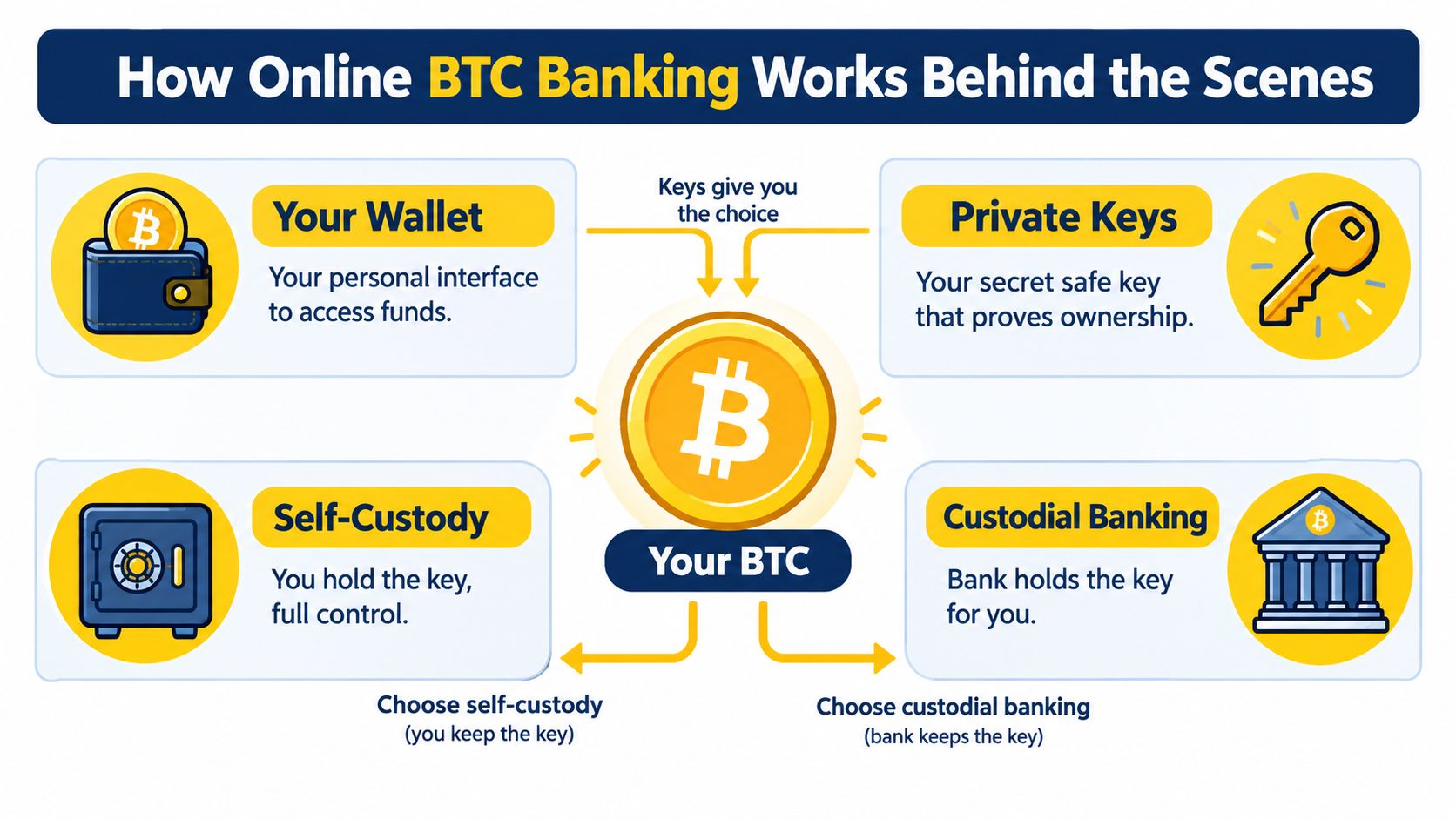
When you deposit BTC into a regulated platform, the institution or its specialist partner may control the private key while you retain a claim on the underlying asset. Your account can show a balance and accept withdrawal requests, yet the provider remains responsible for authorizing movement. Self-custody places that authority with you, along with the responsibility for protecting it.
The online wallet is the visible interface, not necessarily where the Bitcoin is held. It displays balances, presents addresses, and accepts instructions. The private key is the authorization secret behind those actions. Whoever controls it can generally authorize transactions from the associated wallet, subject to the network's rules.
The four moving parts
A typical online arrangement connects four layers:
- Your interface lets you view balances and submit instructions.
- The custody layer stores or controls the private keys.
- The authorization system checks identity, permissions, fraud signals, and withdrawal instructions.
- The settlement rail moves fiat through bank transfers and broadcasts Bitcoin transactions to the network.
These layers explain why a bank-like app can still impose withdrawal reviews or limits. The provider may be coordinating key-management systems, address screening, sanctions controls, approval steps, and external vendors rather than only updating a displayed balance.
U.S. national banks and federal savings associations can provide Bitcoin custody and execution services when assets are held in custody at the customer's direction. They may also outsource permissible crypto activities while maintaining appropriate third-party risk controls, as described in the Office of the Comptroller of the Currency guidance on bank crypto custody and execution services. A bank BTC product therefore depends on private-key access controls, transaction authorization, vendor oversight, and operational resilience, not only a wallet screen.
Bitcoin transactions still require network verification and settlement. The explanation of how Bitcoin transactions are verified helps separate two events: the provider approving a withdrawal and the Bitcoin network recording it. A delay in either stage can affect when funds arrive.
Custody reduces the work of protecting keys, but it also limits direct control. Self-custody gives you more authority while making backup, device security, and recovery your responsibility.
Comparing Your Options for BTC Banking Online
Choosing BTC banking online starts with one question: where will the keys live? A person making occasional purchases may prefer guided recovery and familiar support. Someone seeking direct control may accept responsibility for backups and device security. A business may prioritize approval controls, records, and predictable settlement over a simple mobile interface. The choice is a custody and transfer decision, not only a way to buy Bitcoin.
| Service Type | Key Control | Best For | Key Trade-off |
|---|---|---|---|
| Custodial bank custody | The bank or appointed custodian controls the private keys | Users prioritizing institutional procedures and managed access | You rely on the provider for withdrawals, recovery, and operational continuity |
| Non-custodial self-custody wallet | You control the private keys | Users who want direct authority over their Bitcoin | Lost or exposed recovery information can create serious access or security problems |
| Crypto-bank or fintech app | Usually the platform or a custody partner controls the keys | Users seeking a smooth bank-like experience | The legal structure, protection, and withdrawal terms can vary widely |
| Centralized exchange | The exchange controls keys while funds remain on its platform | Active trading and broad market access | Trading convenience can come with account reviews, platform risk, and withdrawal constraints |
Look past the app design
A bank-branded product is not automatically a deposit account. An exchange balance is not automatically protected like cash at a bank. If an app advertises “secure storage” but gives you a recovery phrase, you still carry the risk of losing that phrase. If the platform holds the keys and offers account recovery, it manages that risk instead, while you depend on its rules and availability.
Ask for direct answers before transferring funds:
- Who holds the private keys? Look for a clear statement, not general security language.
- Can you withdraw BTC to an external address? If not, you may have only an internal claim or restricted exposure.
- How does recovery work? Check whether recovery depends on customer support, a recovery phrase, or institutional procedures.
- What limits apply? Review deposit, trading, and withdrawal conditions before funding the account.
- Which protections apply? Confirm whether the product is a bank service, brokerage arrangement, custodial account, or exchange account.
Transfer friction matters as much as the interface. A provider may approve your withdrawal before the Bitcoin network records it, so both the provider's process and network settlement affect arrival time. Custody can reduce the chance of losing a seed phrase, while self-custody removes platform dependence for ordinary transactions.
If you move funds monthly, custodial service can reduce backup work and recovery risk. If you hold for years, self-custody can remove dependence on a platform, provided you can protect and recover the keys. Active traders may accept exchange withdrawal reviews for market access, while businesses may prefer approval procedures and records. Each option shifts control, responsibility, and transfer friction to a different place.
Security Regulation and Fees You Should Understand
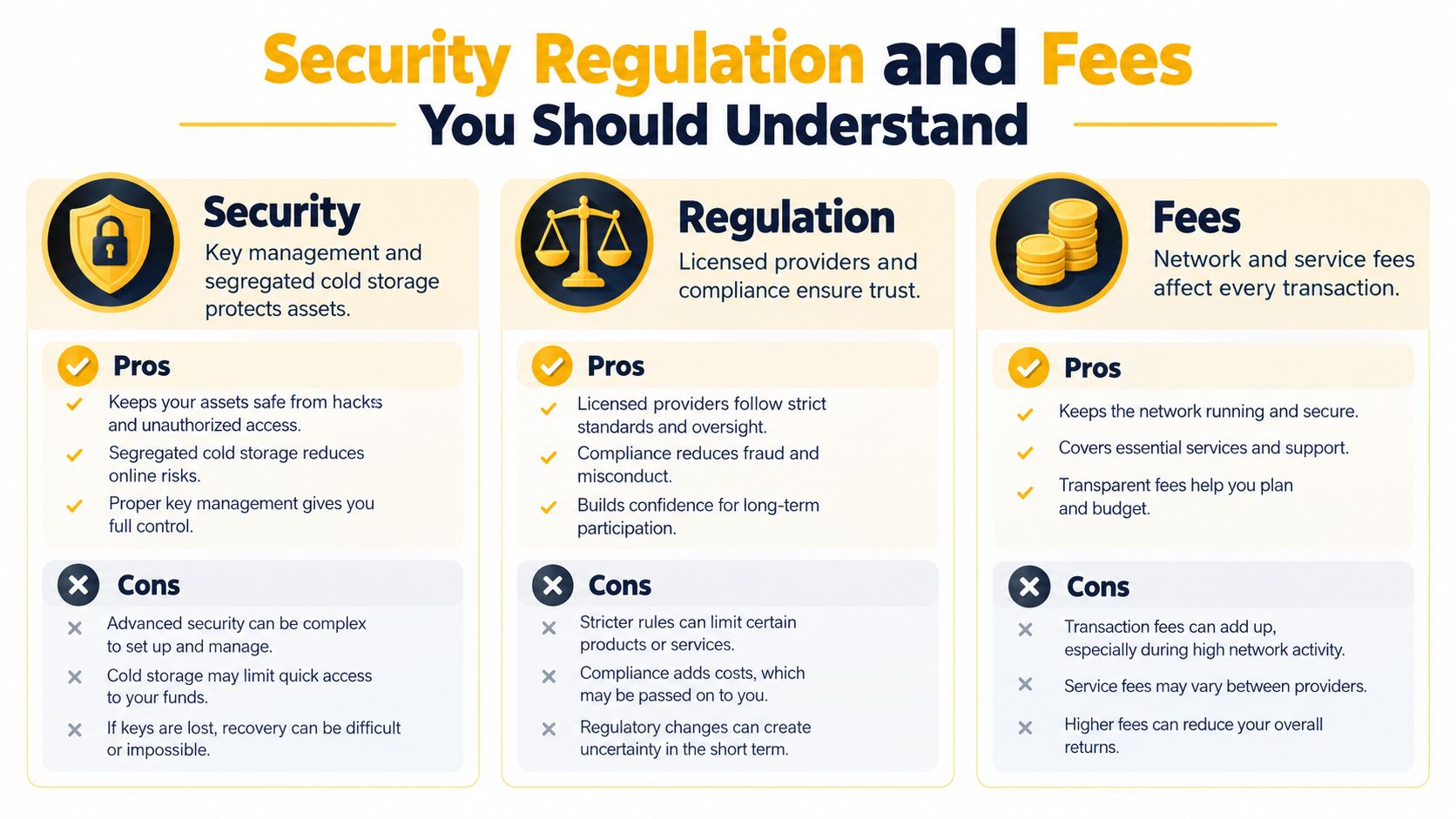
Security, regulation, and fees determine what your online BTC account does. The app may look like a bank dashboard, yet the underlying arrangement can involve a custodian, an exchange, a brokerage, or several parties. Identify the protections that apply, the costs built into each transfer, and the risks that remain with you.
Security begins with key boundaries
Institutional custody usually places private keys, wallet infrastructure, and safekeeping under the provider's control while the customer retains beneficial ownership. Self-custody places key control directly with the customer. U.S. Bancorp resumed institutional Bitcoin custody in 2025 through an early-access program using segregated custody, controlled access, and institutional onboarding. That arrangement differs from a retail custodial account because the holder of the Bitcoin and the controller of the keys can be different parties. The distinction is explained in coverage of the bank custody race and institutional Bitcoin safekeeping.
Check for strong authentication, withdrawal confirmations, role-based approvals, address allowlisting where appropriate, incident procedures, and separation between customer assets and operating systems. These controls cannot remove Bitcoin risk. They show whether the provider treats custody as a controlled financial process rather than just displaying an account balance.
Regulation creates friction for a reason
A historical BIS working paper based on end-2020 supervisory data found that only a handful of internationally active banks reported cryptocurrency exposure. Average exposure was less than 0.02% of risk-weighted assets, no bank exceeded 0.05%, and total reported exposure was $188 million at the end of 2020, according to the BIS working paper on banks' cryptocurrency exposures. The figures show how limited regulated-bank involvement was before later growth in custody and related services.
Online providers require identity verification, sanctions screening, transaction monitoring, source-of-funds information, and manual reviews. These checks can delay a transfer, while also showing how a regulated institution addresses financial crime and operational risk. For the legal framework surrounding digital assets, review this guide to blockchain law and crypto regulation.
Tax and legal notices also depend on accurate financial records. A guide to responding to a levy notice explains how official collection actions differ from ordinary account reviews. It does not replace advice about your own situation.
Fees hide in the route money takes
Trace the full route from fiat deposit to Bitcoin withdrawal. The total can include custody charges, trading commissions, the spread between quoted buy and sell prices, bank-transfer fees, and network or withdrawal fees. Some charges reduce the amount before confirmation. Others come out of the amount received.
Compare the delivered amount, not just the advertised trading fee.
A low visible commission can still accompany a wide spread or a withdrawal process that adds friction. Read the fee schedule, test the support process, and check whether charges change by funding method or account type. Before approving a transfer, compare the fiat debited, the BTC credited, and the final amount that can reach your external destination. That comparison reveals the cost of the custody and payment rails, not just the price shown on the trading screen.
Your Step by Step Onboarding Checklist
A safe first deposit is a verification exercise, not a race to buy. Complete each stage before sending meaningful funds, and save the provider's terms where you can retrieve them later.
Verify the provider type. Confirm whether you're dealing with a bank, licensed brokerage, fintech platform, custodial wallet, or centralized exchange. Search the provider's legal entity, operating jurisdiction, and published terms rather than relying on app-store branding.
Confirm the custody model. Ask whether the provider controls the private keys, whether a named third-party custodian is involved, and whether external Bitcoin withdrawals are available. If the service only shows an internal balance, treat that as a different product from a wallet you control directly.
Complete KYC carefully. Use your legal name consistently and prepare the documents the provider requests. A mismatch between your identity details and the bank account sending funds can trigger a review or delay settlement.
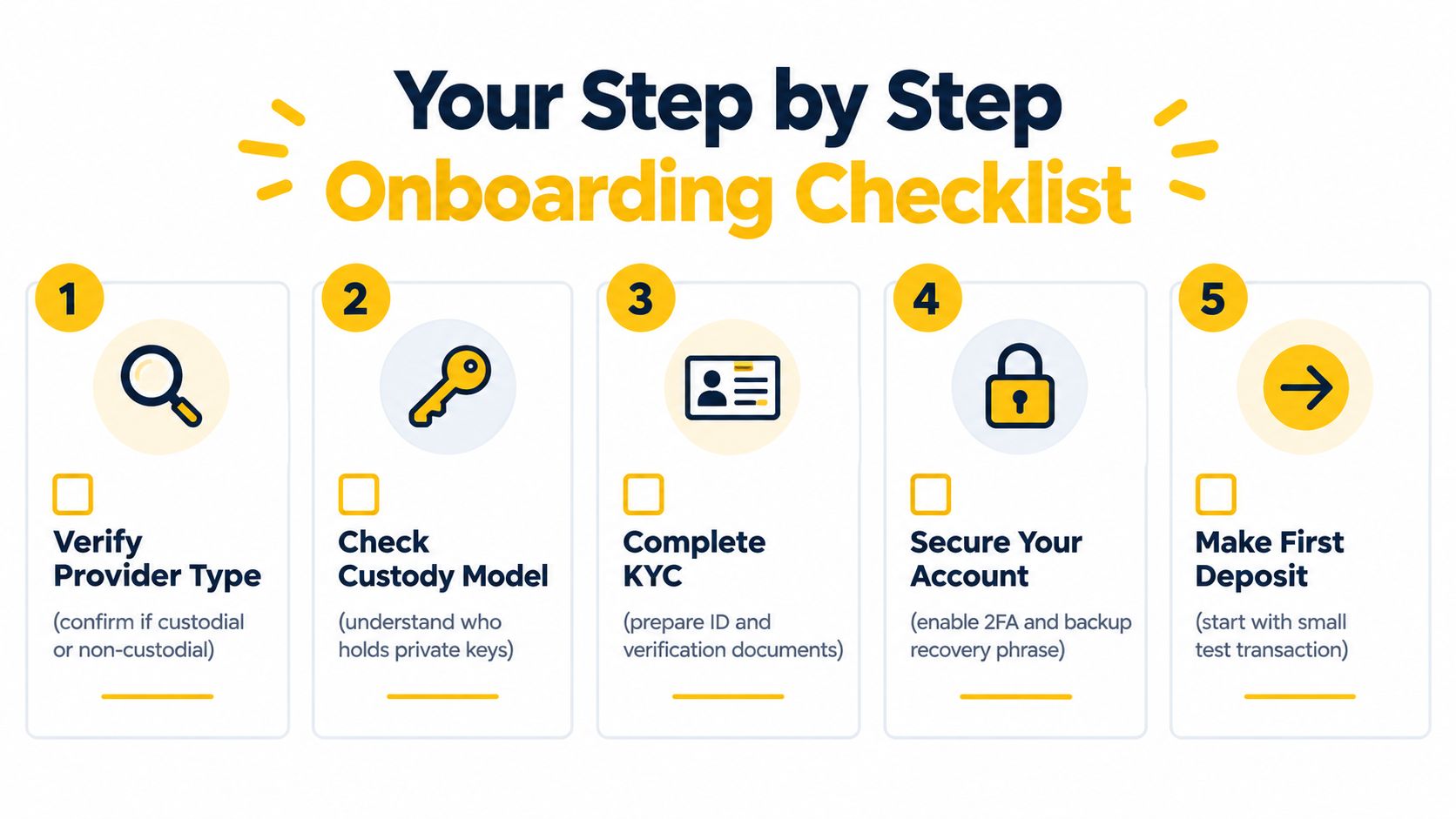
Secure the account before funding it. Enable an authenticator-based second factor where available, protect the email account attached to the profile, and store recovery information offline. Never place a seed phrase in a screenshot, cloud note, or message thread.
Link the funding rail and read the instructions twice. Some purchase flows require you to copy an IBAN, send the transfer through internet banking, and enter a unique reference code exactly. That reference allows the provider to match the payment to your account. A missing digit or altered reference can result in a delayed or unmatched deposit.
Start with a small test transfer. Check the beneficiary name, account details, currency, transfer method, and reference before approving the payment. Once the test settles, verify the credited balance and only then consider a larger transfer.
Bank-transfer speed and reliability vary by country, bank, currency, compliance review, and payment rail. Instant-bank-transfer options may reduce waiting in some markets, but they don't remove identity checks or incorrect-reference errors. Keep the confirmation receipt and the provider's transaction ID until the funds and any withdrawal have completed.
Best Practices for Storage KYC and Taxes
Safe BTC banking online requires a routine after onboarding. Treat storage, identity records, and tax documentation as three separate jobs that support one another.
For storage, keep only the amount you need for regular activity in a custodial service or connected wallet. Consider self-custody for funds you want to control directly, but protect the recovery phrase as carefully as you'd protect the key to a physical safe. Use a dedicated device when appropriate, install wallet software from the publisher's official channel, and verify addresses before approving transactions.

KYC records deserve regular attention. Keep copies of verification confirmations, account agreements, deposit records, withdrawal records, and correspondence about restrictions. Review account limits and supported countries when your circumstances change, especially if you move, open a business account, or begin using a different bank account.
Tax records should connect each transaction to a date, asset amount, fiat value, fee, wallet or platform, and purpose. Depending on your jurisdiction, purchases, sales, swaps, payments, rewards, and transfers may receive different treatment. Keep transaction exports in their original format and reconcile them against your own records instead of assuming the platform's annual report captures every wallet.
A practical storage guide can help you compare hardware wallets, software wallets, and custodial arrangements. Use this resource on how to store Bitcoin as a starting point, then confirm the details against your provider's current documentation and your local tax rules.
Set a recurring review habit. Check account access, backup locations, recent addresses, KYC status, and transaction records. This small discipline can prevent a forgotten recovery method or missing cost-basis detail from becoming a larger problem later.
Choosing Wisely and Staying Safe Going Forward
The best btc banking online choice isn't the platform with the most features. It's the arrangement you understand well enough to use safely. Start with custody, then examine the provider's legal structure, withdrawal process, funding rails, support quality, fee schedule, and recordkeeping tools.
Institutional participation is moving forward, but it remains uneven. The benchmark discussed earlier shows that large financial institutions are at different stages of building custody, trading, lending, and leadership support. That unevenness means you should verify availability in your own jurisdiction instead of assuming a product offered in another market will work the same way for you.
Use transparent evidence wherever possible. Read the custody agreement, test a small deposit, preserve transfer receipts, and check a public block explorer when a provider gives you a transaction ID. Open documentation and observable settlement are more useful than broad claims about safety.
Risk remains part of the decision. Bitcoin can be volatile, providers can impose reviews or limits, and both custodial and self-custodial arrangements have failure modes. For readers interested in structured analysis of financial stress scenarios, the crypto banking crisis prediction dataset can provide a research-oriented perspective, but it shouldn't replace due diligence or professional advice.
Choose deliberately. If you can't explain who controls the keys, how your bank transfer is matched, and what happens when you request a withdrawal, pause before funding the account.
Cascoin offers an open-source, community-driven approach for people who want to explore transparent cryptocurrency infrastructure while keeping energy efficiency and verifiable activity in view. Visit Cascoin to review its wallets, mining options, public documentation, and block explorer before deciding whether it fits your crypto journey.