Community Based Cryptocurrency Explained: How It Works
Your mining software is running, the fans are humming, and a dashboard is showing blocks, shares, or rewards. Then a more difficult question appears: who decides what happens next? Can one company change the rules, can a small group of developers block a proposal, and can an ordinary participant do anything besides hold coins?
That question sits at the center of a community based cryptocurrency. The label isn't meaningful because a project has a busy chat room or colorful branding. It matters when people can inspect the code, observe network activity, discuss changes publicly, and participate in the systems that distribute influence. It also matters when the project makes those promises testable rather than asking newcomers to trust a slogan.
Table of Contents
- What a Community Based Cryptocurrency Actually Means
- How Governance and Open Participation Shape These Networks
- Economic Models, Consensus, and Why Energy Use Matters
- Mining Choices Compared and Why Cascoin Built a Maze
- A Look Inside Cascoin's Labyrinth Mining and Community Stack
- How to Join a Community Based Cryptocurrency Project
- Risks, Misconceptions, and the Limits of Decentralization
- Key Takeaways for Choosing a Community Driven Coin
What a Community Based Cryptocurrency Actually Means
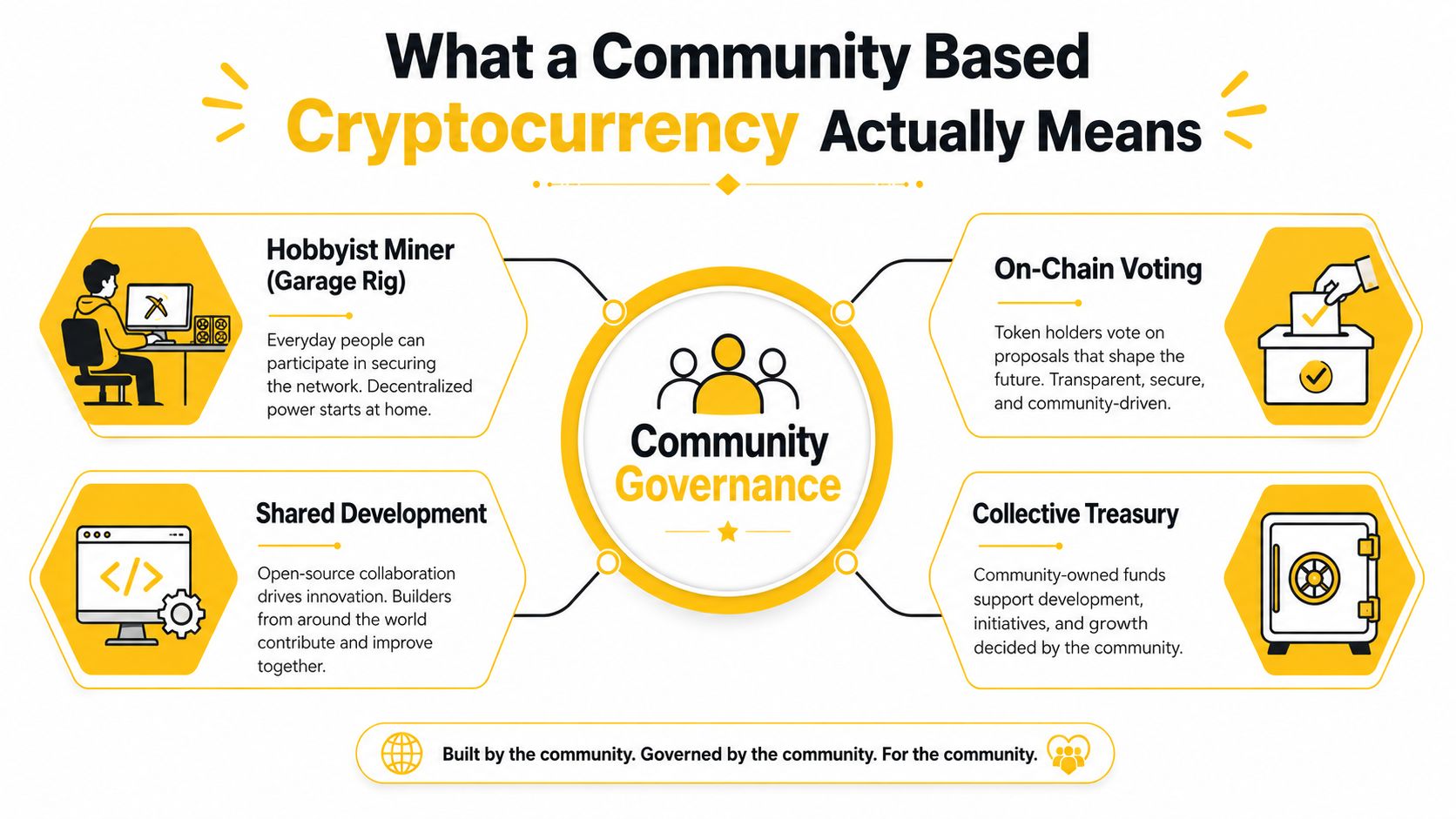
A hobbyist miner might begin with a normal desktop or a small rig in a garage. The machine connects to a network, follows its software rules, and tries to earn rewards. But if the protocol changes tomorrow, the miner needs to know whether that change came from an open process or from a private decision made by a company, foundation, or insider group.
A community based cryptocurrency is a digital asset whose code, rules, development process, and direction are open to public participation. No single organization should be able to rewrite the protocol unilaterally without users, developers, validators, miners, or other stakeholders having a meaningful opportunity to inspect and challenge that change. The important shift is from “Can I buy this coin?” to “Can I read the code, run the software, propose an improvement, or create a fork?”
A useful analogy is a public park rather than a private mall. A mall operator controls access, opening hours, and major changes. A public park still has rules and maintenance responsibilities, but its use and future aren't supposed to depend on one commercial owner. In crypto, the comparison isn't perfect, yet it helps separate public coordination from private control.
The access test beginners often miss
A project can call itself decentralized while giving outsiders little practical access. Check whether the repositories are public, whether discussions are visible, whether proposal rules are documented, and whether participants can run compatible software without permission. Public branding isn't the same as public control.
Ethereum provides a useful benchmark. A 2025 academic study described Ethereum as an autonomous, self-regulating open-source community without centralized ownership or control, and noted that improvement proposals are disclosed and discussed in public venues involving thousands of people according to the study. That model shows how open discussion and distributed contributors can coordinate major technical work, while also reminding us that openness doesn't eliminate informal influence.
For readers exploring the broader idea, this peer-to-peer cryptocurrency explanation offers useful context. The practical questions are always the same: who writes the rules, who can challenge them, who runs the software, and who benefits when the network grows?
How Governance and Open Participation Shape These Networks
Governance is the process a network uses to decide what changes, who implements them, and how disputes are handled. It isn't limited to a formal vote. A proposal can be written in a forum, debated in a developer call, tested by client teams, adopted by node operators, and accepted only when enough participants choose to run the updated software.
Three ways communities make decisions
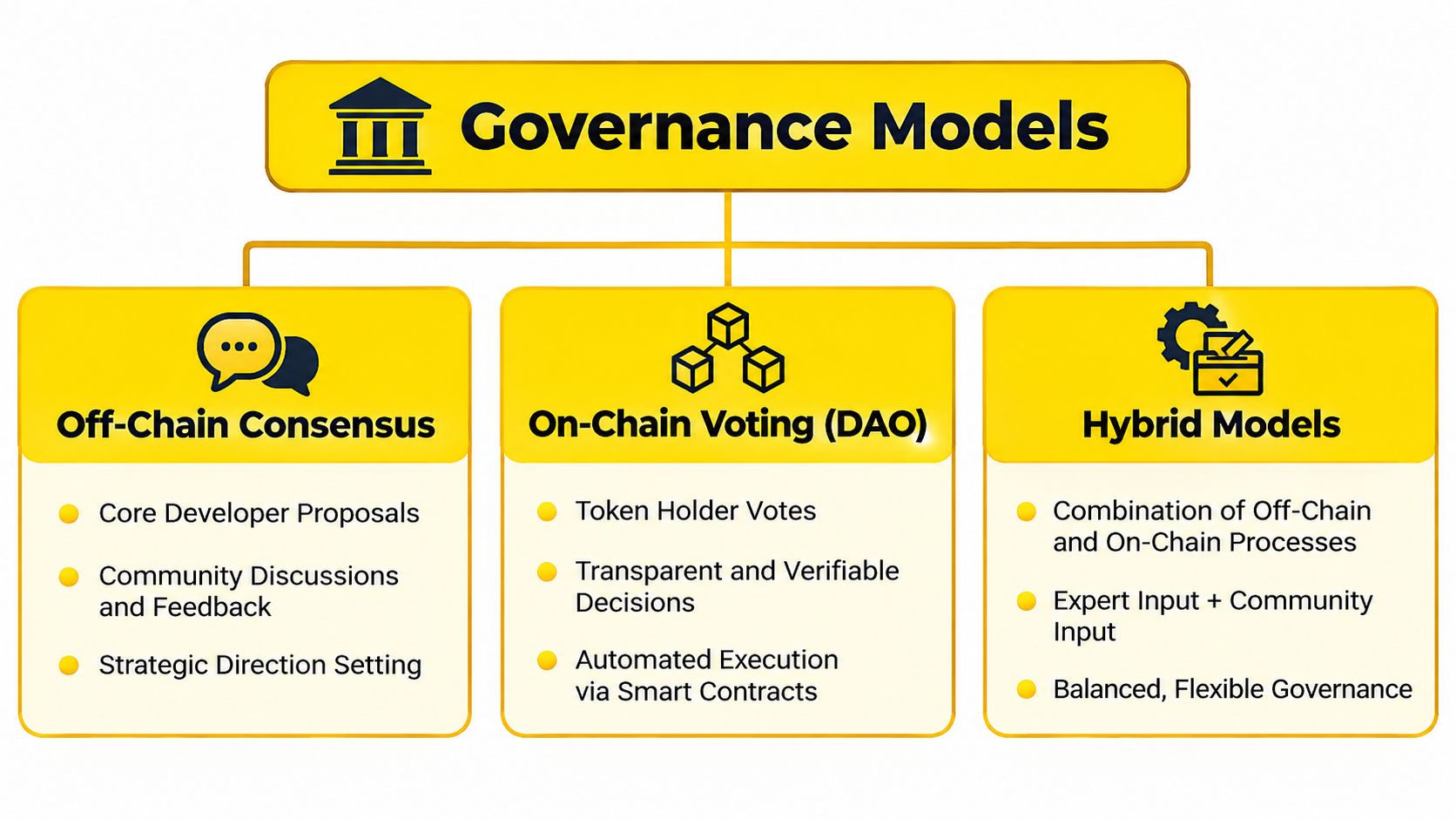
Off-chain rough consensus resembles the culture around Bitcoin Core. Developers publish proposals and code, contributors review changes, and users or operators decide whether to adopt releases. Anyone may submit an idea, but maintainers and experienced reviewers often control what reaches a usable release. The veto power is informal, yet it can be significant because people may ignore a proposal that trusted maintainers don't support.
On-chain token voting places proposals and votes inside a blockchain or DAO framework. A token holder may vote directly or delegate voting power to another address. This approach creates a visible record, but the record doesn't automatically create equal influence. If voting weight follows token balances, a large holder can carry more influence than many smaller participants combined.
Hybrid governance combines public discussion with an operational group, such as a multisignature council. The community might debate a treasury payment or protocol change in public, while designated signers execute the final transaction. This can make urgent coordination easier, but the signer set becomes a key point of control.
Where authority hides
A beginner often sees “community vote” and assumes the decision is democratic. Start with four questions:
- Who can propose? Is submission open to every user, or only approved delegates?
- Who can vote? Do miners, validators, developers, and users have separate roles?
- How is voting weight calculated? Does one address equal one vote, or does ownership determine power?
- Who ships the result? A vote may recommend an outcome, while maintainers, signers, or client teams still implement it.
Ethereum's governance path demonstrates the difference between open participation and equal control. The academic benchmark describes public proposals and broad engagement, but technical coordination still depends on contributors and client teams capable of reviewing and releasing software the 2025 study documents this structure. That isn't necessarily a flaw. Complex systems need people who can maintain code. It does mean readers should distinguish visibility, voice, and final execution authority.
Governance also determines economic outcomes. A rule change can affect who receives block rewards, which transactions pay fees, how a treasury spends funds, and whether a validator or miner can remain competitive. The next question is therefore practical: what does the network ask participants to contribute, and who can afford to contribute it?
Economic Models, Consensus, and Why Energy Use Matters
Consensus determines how a network agrees on the next block. That choice also decides which resources participants must provide. Proof of Work asks miners to perform computational work, Proof of Stake asks validators to lock capital and operate software, and hybrid systems combine elements of both.
Proof of Work can be accessible in theory because anyone with suitable hardware can attempt to mine. In practice, electricity costs, specialized equipment, cooling, and competition can push activity toward professional operators or regions with cheaper power. The same mechanism that protects the ledger can make participation harder for a small household.
Proof of Stake replaces continuous hash competition with locked capital and probabilistic block selection. An energy-focused financial research paper reports an estimate from the Ethereum Foundation of about 5.13 GW continuously for Proof of Work versus 2.62 MW for Proof of Stake, implying roughly a 1,900x reduction in ongoing power demand when consensus shifts away from brute-force computation as described in the FTSE Russell research paper. That difference changes the participation question. A validator may need capital and reliable software rather than an industrial mining setup, although capital concentration can create its own governance problem.
| Mechanism | Energy profile | Who can participate | Typical centralization risk |
|---|---|---|---|
| Proof of Work | Continuous computational demand | Miners with compatible hardware and affordable electricity | Specialized hardware, pooled mining, and cheap-power concentration |
| Proof of Stake | Much lower ongoing energy demand than major Proof of Work systems | Participants able to acquire stake and operate validator software | Large holders, delegation clusters, and validator concentration |
| Hybrid models | Depends on the design | Miners, stakers, or both | Control can accumulate across more than one participant group |
Independent blockchain-energy research reports that Proof of Stake systems have negligible energy use compared with major Proof of Work blockchains, while EU research emphasizes that design choices determine scalability and energy demand the peer-reviewed analysis explains the relationship. Energy therefore isn't only an environmental issue. It decides whether a student with a desktop, a home operator, or a small community node can participate at all.
Token issuance matters just as much. Emission schedules, halving-style reductions, and fee routing determine how rewards move through the network. A project can publish open code while still directing a large share of new supply toward early insiders, a treasury, or a narrow validator set. Cascoin's Labyrinth Mining is one response to the participation trade-off, using a gamified, energy-aware design instead of relying only on a raw hash race. Its approach belongs in the wider conversation about blockchain consensus mechanisms, where technical rules and community access cannot be separated.
Mining Choices Compared and Why Cascoin Built a Maze
A first-time miner usually starts with the wrong comparison. They ask which pathway promises the largest payout, but the better question is which pathway matches their hardware, electricity situation, patience, and technical confidence. A laptop miner, a graphics-card operator, and a pooled block miner aren't solving the same problem.
| Pathway | Hardware needed | Typical power use | Skill level | Best for |
|---|---|---|---|---|
| CPU mining | A compatible laptop or desktop processor | Lower than dedicated multi-card setups, depending on software and workload | Beginner to intermediate | Learning, testing, and low-power participation |
| GPU mining | One or more consumer graphics cards with suitable cooling | Higher than CPU mining and dependent on cards, settings, and runtime | Intermediate | Users who already own compatible hardware |
| Solo or pooled block mining | Compatible mining hardware and wallet software | Varies with the selected algorithm and equipment | Intermediate to advanced | Solo operators seeking direct block discovery or miners who prefer pool coordination |
CPU mining offers the gentlest starting point because the hardware is familiar. The trade-off is that a general-purpose processor may not compete with specialized equipment on algorithms designed for high throughput. It still has educational value: you can learn wallet configuration, node communication, logs, shares, and payout handling without buying a separate rig.
GPU mining gives more tuning options. A miner can adjust performance, temperature, and power settings, but those controls introduce new failure points. Drivers, cooling, fan wear, and electricity costs all affect whether the experiment is sensible.
Solo and pooled mining describe how a miner works with the network, not only what hardware they own. Solo mining keeps the reward tied to a block found directly by the miner, while a pool combines participants and distributes rewards under its payout rules. Pools can make income less erratic, but they also create an important centralization question because many miners may depend on one operator.
Why a maze changes the conversation
Cascoin's Labyrinth Mining uses lightweight client software to simulate mice navigating a virtual maze to collect “cheese,” with rewards described as reaching up to 3x higher than traditional approaches in Cascoin's publisher information. The key design idea is that useful participation should depend less on buying the most powerful hardware and more on solving the network's changing puzzle.
A maze-style system doesn't make mining risk-free or guarantee earnings. It does provide a different design target: reduce the importance of empty hash races, keep power use more predictable, and give smaller miners a clearer entry point. For a community based cryptocurrency, that matters because the reward mechanism can either widen participation or reserve influence for operators with the deepest equipment budgets.
A Look Inside Cascoin's Labyrinth Mining and Community Stack
Consider two miners starting at the same time. One runs a large facility with substantial hardware. The other uses a bedroom computer and wants to learn without turning the room into a heat source. In a conventional hash race, raw processing capacity can dominate the experience. In a maze-based design, the conceptual task is different: software explores a changing route and looks for the path that reaches the target.
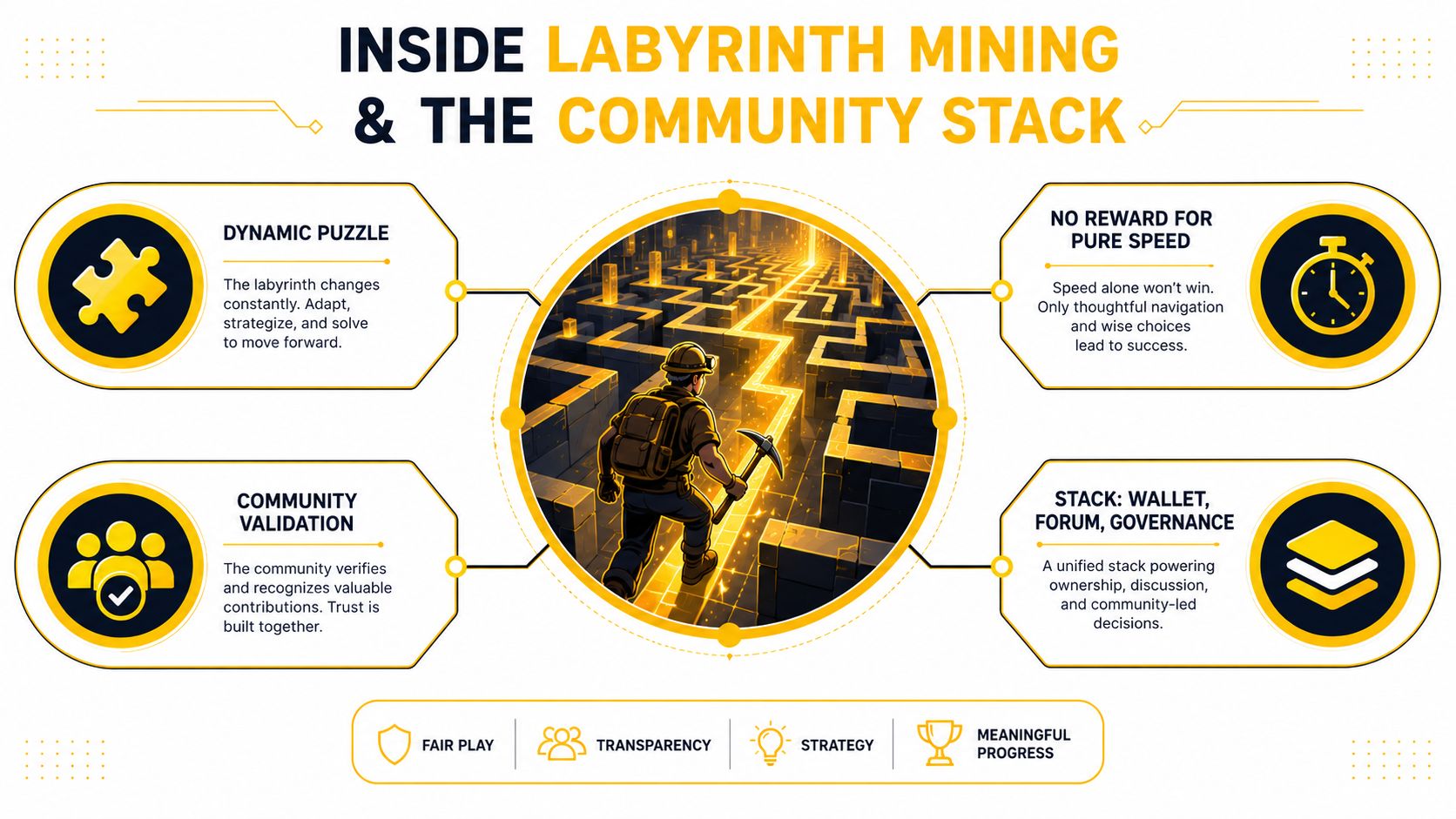
Labyrinth Mining treats mining as a dynamic puzzle rather than a pure speed contest. The client doesn't repeat identical calculations and hope that more hardware creates an overwhelming advantage. It simulates movement through a virtual maze, where routing and puzzle-solving form part of the work. That design can make electricity costs easier to reason about and can reduce the assumption that a datacenter must always outclass a small operator.
Three layers of verifiability
The mining algorithm is only one part of a trustworthy community stack.
- Codeberg and public repositories let developers inspect the implementation, identify assumptions, and propose changes. Open code doesn't prove that every design choice is safe, but it gives reviewers something concrete to examine.
- Casplorer, the public block explorer, gives users a way to inspect transactions and network activity rather than relying only on screenshots or private dashboards.
- Discord serves as a coordination space where contributors can ask questions, compare observations, and watch how maintainers handle disagreement.
These tools answer different questions. The repository asks, “What does the software say?” The explorer asks, “What happened on the ledger?” The community channel asks, “How do people explain, challenge, and improve the system?”
That combination is more useful than a slogan about transparency. A participant can compare the documented rules with the running software, inspect visible activity, and observe whether conversations remain open to criticism. The solo-developer model also makes verification especially important, because a project with a small maintainer group needs outside contributors to test assumptions and reduce dependency on one person.
How to Join a Community Based Cryptocurrency Project
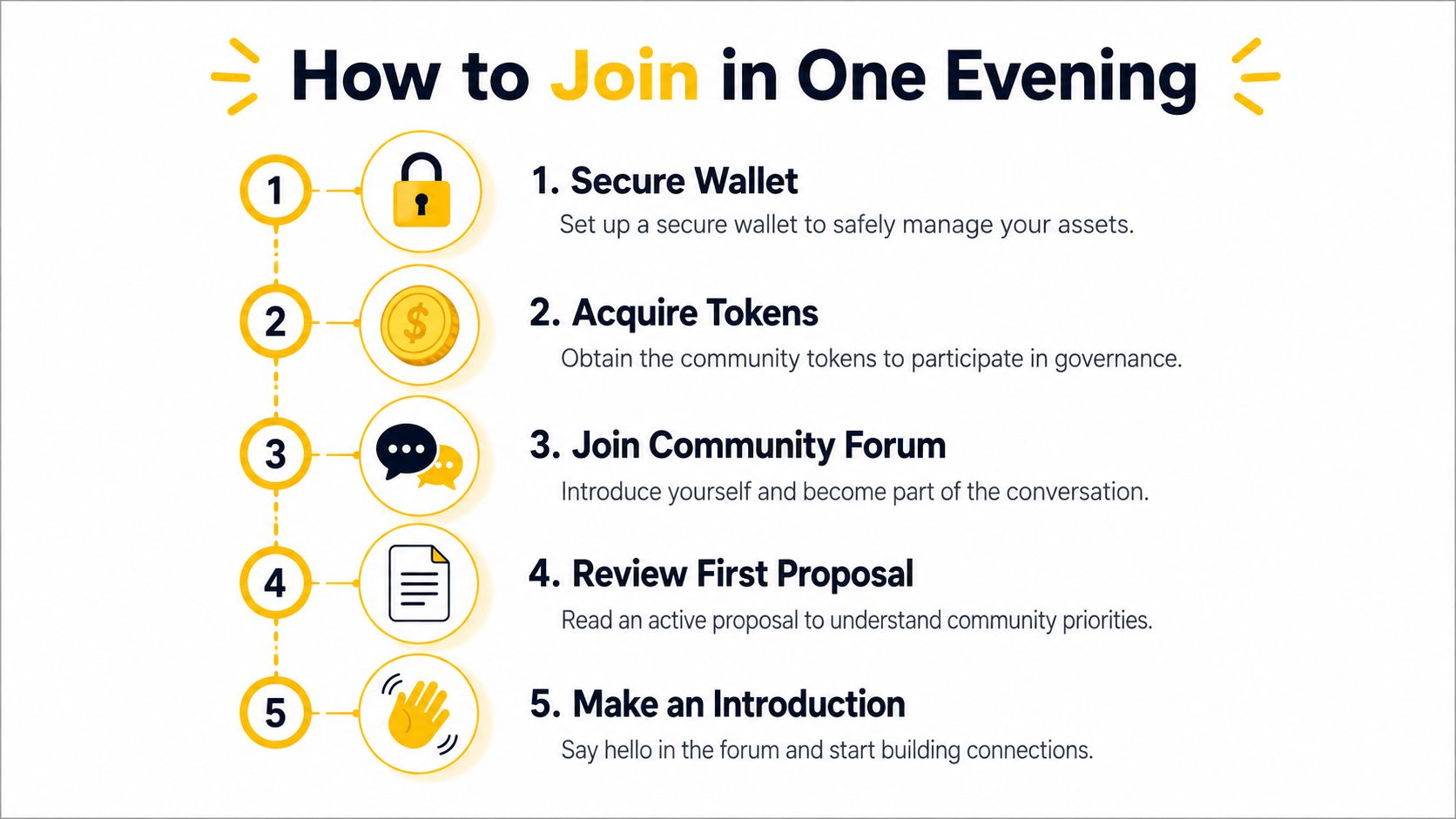
You don't need to begin by buying expensive equipment or making a large transaction. A careful first evening can be enough to inspect a project, create a wallet, join the conversation, and decide whether you want to mine, build, or simply observe.
Start with control of your wallet
Secure a compatible wallet. Download it from an official project channel and verify that the software matches the published documentation. Write the seed phrase on paper or another offline medium. Never paste it into Discord, a website, or a support form.
Acquire a small amount of native coin. You need enough to test a transaction and cover applicable network fees. Start with an amount you can afford to lose, because crypto transfers can be difficult or impossible to reverse.
Send a test transaction. Verify the destination address character by character. Then use the public explorer to confirm that the transaction appears on the ledger, rather than trusting only the wallet interface.
Observe before you contribute
Join the project's Discord and read pinned guides before asking for help. Look for explanations of wallet versions, mining configuration, proposal procedures, and known issues. Pay attention to how maintainers answer basic questions. A healthy community doesn't require newcomers to pretend they understand jargon.
Security rule: No legitimate maintainer needs your seed phrase or private key to diagnose a wallet problem.
If you want to build, clone the public Codeberg repository, read the contribution notes, and start with documentation, testing, or a small issue. This open-source project contribution guide can help you understand the mindset before you submit code.
If you want to mine, begin with the least complex compatible pathway. Run the software long enough to understand its logs, connection status, accepted shares, and payout process. Don't treat a displayed reward as guaranteed income. Treat it as a test of whether your setup works.
Risks, Misconceptions, and the Limits of Decentralization
Community does not automatically mean decentralized. A project can have public channels, open repositories, and enthusiastic members while power remains concentrated among a few wallets, validators, maintainers, or treasury signers.
Recent governance research warns that token voting can concentrate authority in a small group of holders, while an ECB working paper published in 2026 emphasizes that DAO governance still depends on identifiable actors with voting rights rather than on perfectly diffuse participation the working paper examines this dependence. Frontiers research on blockchain applications for local communities treats tokenization as an exploratory participation model, not a solved answer to governance capture the research frames the area as developing.
The common failure modes
| Risk category | What it looks like | Red flag signal |
|---|---|---|
| Whale dominance | A few large holders can decide proposals or move markets | Voting weight follows balances with little delegation diversity |
| Validator concentration | Many users depend on a narrow set of operators | Delegation clusters around familiar providers |
| Low voter participation | A small active group decides for a quiet majority | Proposals pass with limited discussion or turnout |
| Treasury capture | A foundation or signer group controls shared funds | Spending rules and signer changes aren't clearly documented |
| Insider-favoring issuance | Early allocations or emissions benefit a restricted group | Supply records don't match the public explanation |
| Maintainer dependency | One developer handles releases, infrastructure, and reviews | Little repository activity beyond one person |
| Abandoned governance | Forums exist, but no one responds or implements decisions | Proposals remain open without accountable follow-through |
Open source helps, but it doesn't guarantee safety. A public repository can still contain bugs, weak key management, undisclosed wallets, or an emission schedule that favors insiders. A public explorer can show balances without explaining who controls an address.
A community project also needs real-world usefulness beyond speculation. Research on commons-based money notes that community currencies can connect with savings groups and local institutions, but implementations often remain geographically limited and dependent on specific communities the academic discussion describes these constraints. Ask whether users return, merchants accept the asset, and local participants can explain its value without repeating price predictions.
Better definition: Decentralization is a condition you keep checking, not a badge a project earns at launch.
Key Takeaways for Choosing a Community Driven Coin
A useful evaluation begins with evidence, not atmosphere. Friendly moderators and active memes can make a project enjoyable, but they don't tell you who controls the code, supply, treasury, or upgrade process.
Use this checklist before you commit time or money:
- Inspect the repository. Check whether contributors are active, whether issues receive responses, and whether releases can be reproduced from visible code. Don't assume a public link means active maintenance.
- Verify the ledger. Compare the public explorer with the project's stated supply and transaction rules. Follow a test transaction from wallet to explorer.
- Map the major holders. Identify whether voting or staking power sits with a broad set of participants or a narrow group of addresses. Concentration doesn't prove misconduct, but it changes the governance risk.
- Read real proposals. Look for technical details, objections, revisions, and implementation records. A forum full of announcements but no disagreement may indicate marketing rather than governance.
- Trace the reward path. Determine whether mining or staking rewards reach different kinds of participants, or whether a known pool, foundation, or early group receives most of the influence.
- Test participation yourself. Run a node, wallet, miner, or development environment if the project makes that practical. Small experiments reveal friction that promotional pages hide.
- Separate facts from promises. Treat claims about efficiency, fairness, adoption, or rewards as hypotheses until the code, explorer, and community discussion support them.
Community participation has a national-scale audience. A 2025 report estimated that 21% of American adults, roughly 55 million people, owned at least some crypto, while a separate memecoin community study collected responses from 2,219 people, with 1,414 completing the survey the report and study are summarized in this research source. Scale alone doesn't prove quality, but it shows why governance and participation deserve more attention than a simple “decentralized equals good” conclusion.
The guiding principle is simple: trust verifiable transparency over community language. A project that invites scrutiny and survives it deserves attention. A project that obscures its mechanics, avoids difficult questions, or makes participation dependent on blind trust deserves distance.
Cascoin offers an open-source network built around Labyrinth Mining, a gamified mining approach designed to reduce reliance on pure hash-power competition, with public code, ledger visibility through Casplorer, and community coordination through Discord. Visit Cascoin to inspect the project, review its documentation, and decide whether its mining and contribution paths fit your own risk tolerance.