Is Mining Sustainable? a Real Look at Crypto's Cost
The most popular advice about crypto mining is also the least useful: “Use efficient hardware” or “Switch to renewable energy.” Both suggestions can help, but neither answers the full question. A device can use less electricity while a network's total demand rises, and a mining operation can claim renewable power while shifting water use, air pollution, hardware waste, or grid pressure somewhere else.
So, is mining sustainable? The answer depends on what a mining system can measure and defend. A serious evaluation must examine energy per unit of useful network activity, the carbon intensity of the electricity used, water and land impacts, local air quality, equipment lifecycles, security, and the communities near mining sites.
Table of Contents
- What Sustainability Really Means for Crypto Mining
- The Energy and Emissions Numbers Behind the Debate
- Why Consensus Design Is the First Lever to Pull
- The Impacts That Carbon Accounting Leaves Out
- How Cascoin's Labyrinth Mining Tries to Change the Equation
- Mitigation Strategies That Actually Move the Needle
- A Reader's Checklist for Judging Mining Claims
What Sustainability Really Means for Crypto Mining
Sustainability isn't a label attached to an algorithm or a machine. It's a measurement problem. A credible mining project should show how much energy it consumes, where that energy comes from, what physical resources its infrastructure requires, and whether its environmental burden is reduced or merely transferred.
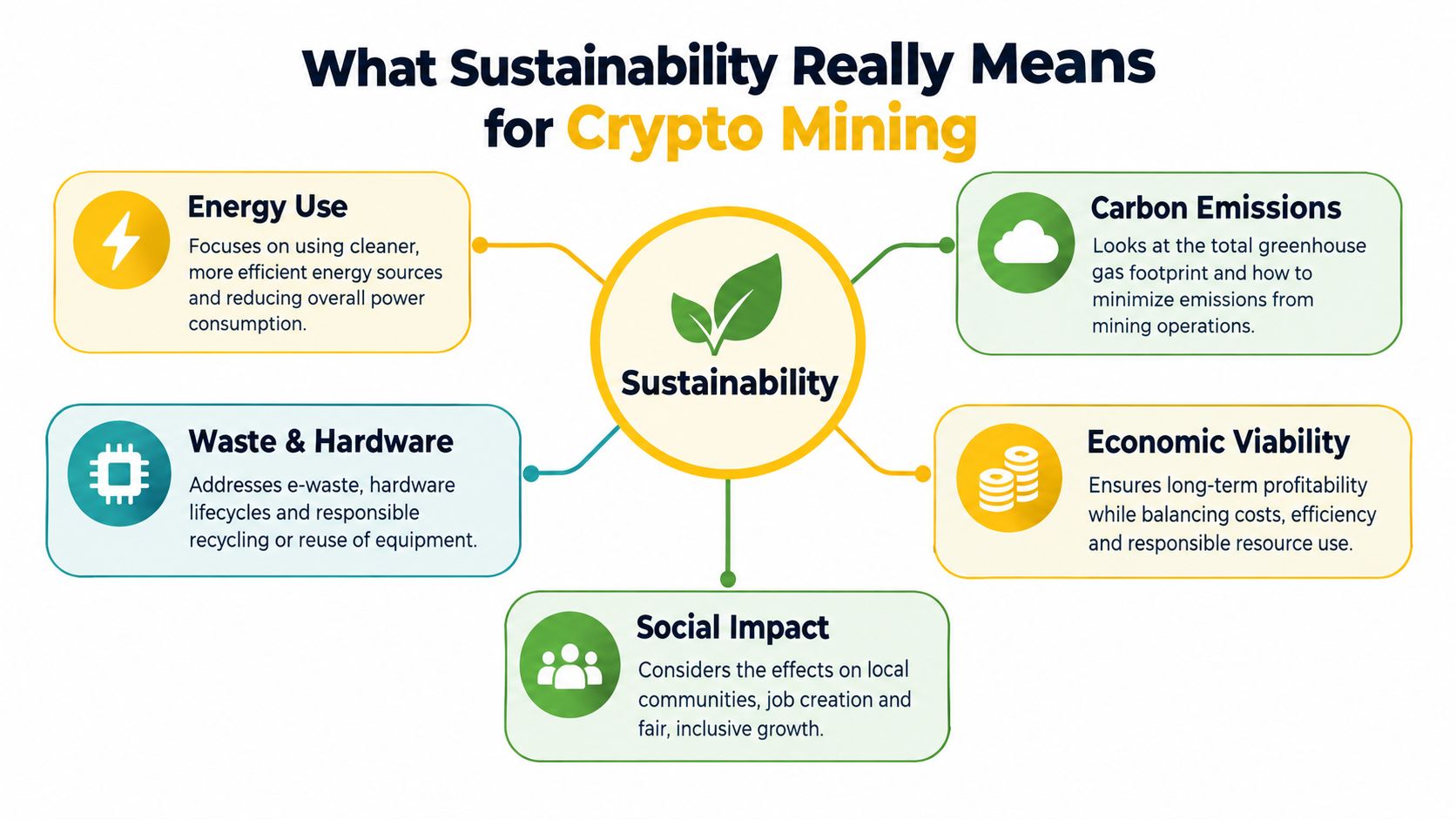
The five questions behind the word sustainable
Energy use asks how many joules the network consumes for a useful result, not merely how many watts one machine draws. In a proof-of-work system, that distinction matters because many participants may calculate unsuccessful results before one miner wins.
Carbon emissions depend on the electricity source and operating region. The same hardware can have a different emissions profile on a low-carbon grid than on a fossil-heavy grid, so “efficient” hardware doesn't provide enough information by itself.
Water and land matter because power generation, cooling systems, buildings, and transmission infrastructure can all require physical resources. A mining site can reduce direct electricity consumption while increasing pressure on another resource.
Hardware and waste include manufacturing, replacement cycles, repairs, and disposal. A specialised machine that becomes obsolete quickly has a wider footprint than its operating wattage suggests.
Social impact includes local air pollution, noise, employment, grid competition, and community consent. The question isn't only whether miners can operate cheaply. It's whether nearby residents carry costs that the operator doesn't disclose.
The U.S. Energy Information Administration estimated global Bitcoin mining electricity use in 2023 at 67 to 240 TWh, with a midpoint of approximately 120 TWh, equal to roughly 0.2% to 0.9% of worldwide electricity demand. Its estimate for U.S. cryptocurrency mining was about 0.6% to 2.3% of national electricity consumption. These ranges show why system-level accounting matters more than a device label. (U.S. Energy Information Administration analysis)
Practical rule: Treat “green mining” as a claim that requires a boundary, a method, and evidence.
That evidence should be organised as carefully as any other operational accounting system. Resources such as see how Gegan structures accounts illustrate why consistent categories help teams track inputs and outcomes rather than relying on attractive summaries. For a crypto-specific overview of the broader issue, this analysis of cryptocurrency environmental impact provides useful context.
The Energy and Emissions Numbers Behind the Debate
A mining system does not become sustainable because one headline number looks favourable. The useful question is narrower and more demanding: what must the system prove on electricity use, emissions, and operating conditions?
A Cambridge Centre for Alternative Finance study published in April 2025 estimated annual Bitcoin electricity consumption at 138 TWh, approximately 0.5% of global electricity use, with associated emissions of 39.8 million tonnes of carbon-dioxide equivalent. The same study also reported that 52.4% of mining energy came from sustainable sources, including 42.6% from renewables and 9.8% from nuclear power, up from 37.6% in 2022.
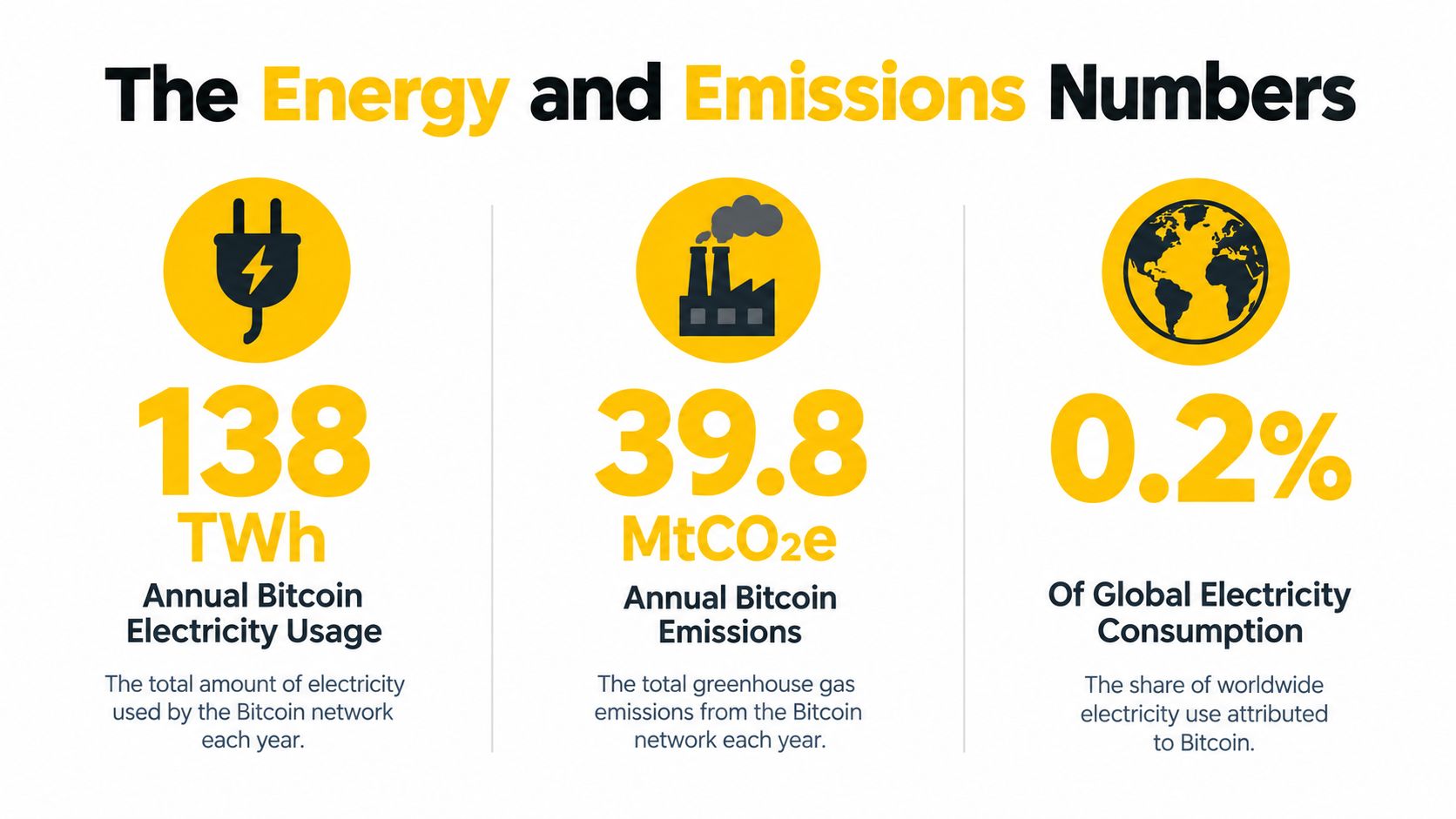
Why the renewable percentage doesn't settle the issue
That cleaner energy mix matters. It does not answer the whole sustainability question. The study still identified 47.6% of mining energy as coming from non-sustainable sources, and a lower carbon share can sit alongside very high total electricity demand.
The easiest way to see the gap is to compare two measurements that are often blended together. One is absolute demand, the total electricity the network consumes. The other is emissions intensity, which depends on the carbon profile of the grid supplying that electricity. A system can improve on one and still perform poorly on the other.
Industrial facilities face the same distinction. A plant that switches part of its supply to cleaner electricity reduces emissions per unit of power used. If the plant still draws a huge amount of power, the total footprint can remain large. Mining should be judged with the same discipline.
For readers who want a closer look at how network demand, machine efficiency, and site conditions interact, this guide to crypto mining power consumption is a useful companion. Hardware turnover belongs in the same accounting frame. ITAD e-waste program insights show why equipment handling should be measured alongside electricity and emissions.
The two-part energy test
A credible mining assessment should report several measurable criteria together:
- Absolute demand: how much electricity the entire network consumes.
- Intensity: how many joules are required per accepted computational result, block, or comparable unit of useful security.
- Grid intensity: the carbon profile of the actual operating region.
- Load behaviour: whether demand is constant, flexible, or concentrated during periods of grid stress.
This checklist helps readers compare Bitcoin mining, Cascoin's Labyrinth Mining, and other systems on equal terms. A miner may advertise low power draw per machine while network competition keeps total demand high. A flexible site may claim to use curtailed electricity, but that only improves the case if it does not displace other users, increase local pollution, or extend fossil generation.
Why Consensus Design Is the First Lever to Pull
The biggest sustainability decision often happens before anyone chooses a processor. It is the consensus mechanism, the method a network uses to agree on valid transactions and resist attacks.
In Proof-of-Work, miners compete by performing calculations. Most attempts fail, and only a winning result is accepted for the relevant block. As participation and difficulty rise, the network can consume more energy even though the accepted outcome remains singular.
Proof-of-Stake uses a different security model. Validators commit or stake assets, and the protocol selects participants through rules that don't require a global race of processors. Directed-acyclic-graph approaches use another family of structures and coordination methods.
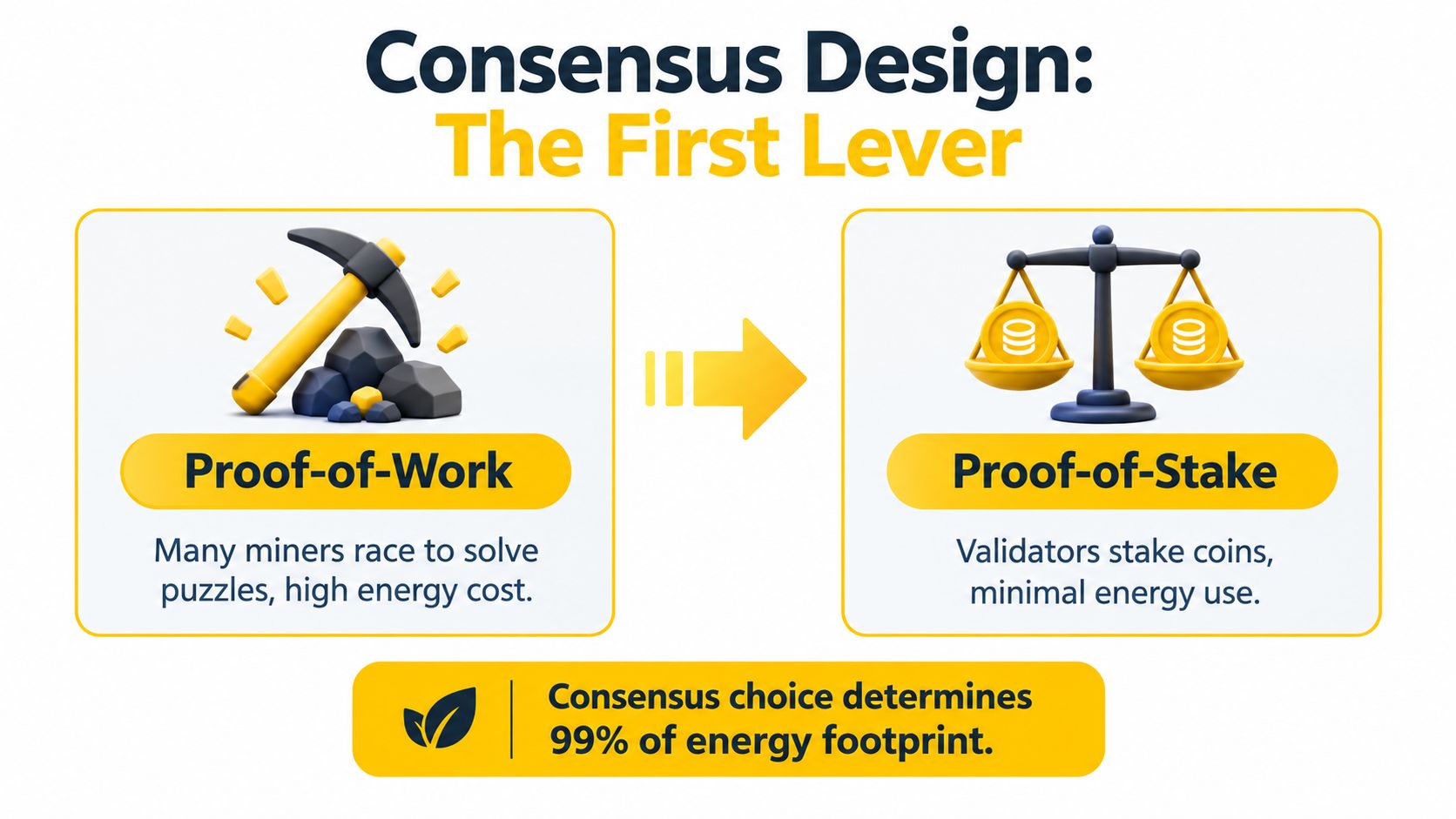
The energy advantage and its limits
A 2025 systematic literature review reports that Proof-of-Stake and directed-acyclic-graph approaches can reduce energy use by more than 99% relative to Proof-of-Work. The same review notes possible trade-offs involving decentralisation and security. (Systematic literature review on blockchain sustainability)
That comparison is powerful, but it isn't a universal verdict. A lower electricity requirement doesn't automatically prove that a system offers equivalent resistance to Sybil attacks, comparable auditability, or the same distribution of control. Proof-of-Stake can reduce wasted computation, yet it introduces dependence on ownership, staking rules, validator concentration, and penalties.
Energy reduction is meaningful only when the comparison preserves the security outcome being measured.
Networks that retain Proof-of-Work therefore need to focus on reducing wasted work without weakening the properties that make the mechanism useful. Relevant metrics include joules per hash, joules per accepted block, difficulty-adjusted energy growth, stale or rejected work, and the share of low-carbon electricity.
A project shouldn't treat a reward multiplier or lightweight client as proof of sustainability. It should disclose the workload, hardware, software version, security assumptions, and measurement boundary so an independent party can reproduce the result. A helpful introduction to the subject is this explanation of blockchain consensus mechanisms.
What a fair comparison looks like
Compare systems on more than electricity:
- Security: What makes an attack expensive or detectable?
- Decentralisation: Who can participate, and what hardware or capital is required?
- Verification: Can outsiders inspect the rules and activity?
- Resource intensity: What energy and materials support the full network?
- Participation effects: Does lower individual cost attract enough additional activity to offset savings?
Consensus design is the first lever because it determines whether the network needs a computational race at all. But a lighter proof-of-work design still has to prove its security, resource use, and lifecycle impacts.
The Impacts That Carbon Accounting Leaves Out
A mining system does not become sustainable because its carbon figure looks better on a dashboard. Carbon is one checkpoint in a longer checklist. To judge mining fairly, ask what it does to air, water, land, hardware supply chains, and the people living near the equipment.
A 2024 study of 34 Bitcoin mines in the United States estimated that they used 32.3 TWh of electricity between mid-2022 and mid-2023, 33% more electricity than Los Angeles during the comparable period. The researchers estimated that 85% of this electricity came from fossil fuels and that Bitcoin mining caused 13.1% of PM2.5 fine-particle pollution over parts of Metropolis, Illinois. (Study of Bitcoin mining impacts)
That helps clarify a common point of confusion. A lower average carbon intensity can coexist with high local harm if the surrounding grid still relies heavily on fossil generation or if emissions from power plants concentrate in nearby communities. Climate impact is global. Particulate pollution is local.
One activity, several resource burdens
Broader life-cycle research found that the United States, China, and Kazakhstan together accounted for 65% of global Bitcoin mining. The same research modelled a U.S. water footprint of 419 million cubic meters, a Chinese land footprint of 900 square kilometers, and Kazakhstan greenhouse-gas emissions exceeding 25 MtCO2e.
| Impact | What it measures | Documented scale |
|---|---|---|
| Electricity | Power consumed by mining operations | U.S. mines used 32.3 TWh in the studied period |
| Fossil dependence | Share of electricity from fossil fuels | 85% in the studied U.S. mines |
| Air pollution | Local PM2.5 contribution | 13.1% over parts of Metropolis, Illinois |
| Water | Water associated with mining activity | Modeled U.S. footprint of 419 million cubic meters |
| Land | Land occupied or affected by infrastructure | Modeled Chinese footprint of 900 square kilometers |
| Greenhouse gases | Country-level emissions | Kazakhstan exceeded 25 MtCO2e in the research model |
The pattern matters more than any single row. One region may be constrained by water. Another may face dirtier power and worse air pollution. Somewhere else, land use, waste heat, or discarded equipment may dominate. A carbon-only view flattens those differences and can make unlike systems look comparable.
The lifecycle boundary matters
This is also where sustainability claims often shrink the boundary too much. The mining algorithm is only the visible engine. The full system also includes client computers, mining-pool servers, networking gear, cooling, replacement hardware, and disposal. A processor-only measurement works like rating a data center by the chip and ignoring the building around it.
Smaller networks are not exempt. Their direct computational draw may be lower, but they still need to show where impacts occur, how often hardware is replaced, and which supporting systems are counted. Otherwise, the claim describes one component, not the mining system people use.
Local effects belong on the same checklist as global totals. Noise, traffic, waste heat, and grid competition can affect residents even if an operator buys renewable certificates or reports a better average carbon number. Sustainable mining has to prove more than lower emissions per unit of computation. It has to show a believable boundary, measurable local impacts, and a hardware lifecycle that does not move the burden off the carbon ledger.
How Cascoin's Labyrinth Mining Tries to Change the Equation
Cascoin tests a different premise: mining efficiency may depend on the task a network assigns, not only on faster hardware performing the same hash race. Its Labyrinth Mining uses lightweight client software to simulate mice moving through a virtual maze to collect “cheese.” The project describes up to 3x higher rewards compared with traditional approaches while consuming less power, a claim that still requires independent testing against network-wide energy use and security.

Three participation paths
Cascoin presents three ways to contribute:
- Labyrinth Mining: A lower-power approach based on maze simulation and lightweight client software.
- MinotaurX: A CPU-oriented route for participation without specialised ASIC hardware.
- SHA-256: A more hardware-intensive option for experienced ASIC operators.
This range changes the evaluation question. Instead of asking only how many watts one device uses, assess what participation the protocol encourages as its user base grows. A lightweight client may lower an individual miner's demand and broaden access. It does not, by itself, establish lower total electricity use. The relevant evidence includes aggregate activity, accepted and rejected work, security achieved, electricity sources, and equipment replacement.
The reward comparison also needs a clear denominator. Reward per unit of power can indicate operating efficiency, but it does not automatically prove lower network-wide emissions or comparable security. A fair test should specify the hardware, workload, software version, operating period, and system boundary. The useful benchmark is whether the network delivers security with fewer joules per accepted result, alongside lower carbon, water, air, and hardware impacts.
Transparency is part of sustainability
Cascoin makes its code available through Codeberg and GitHub, offers on-chain verification through the Casplorer block explorer, and uses an MIT license. Development is supported by a solo developer and community contributions. These features do not prove a particular environmental outcome, but they give researchers and users ways to inspect the implementation and observe activity.
Labyrinth Mining is therefore a testable design proposal, not a completed sustainability verdict. To judge it fairly, compare measurable energy intensity, grid carbon, local pollution and water effects, hardware lifecycle, and network security with the same criteria used for other mining systems.
Mitigation Strategies That Actually Move the Needle
A credible mitigation plan connects each intervention to a specific impact. Efficiency addresses electricity demand. Low-carbon power addresses emissions intensity. Flexible operation can reduce grid pressure. Disclosure makes it possible to identify whether any of those measures work.
Use cleaner electricity carefully
Miners can reduce emissions by operating in regions with low-carbon electricity, especially where flexible demand uses curtailed renewable generation without displacing other users. Location alone isn't proof. A seasonal “nomad” mining study found that operations moved between hydro-dependent and coal-dependent regions as conditions changed, and the seasonal shift toward coal increased coal-related emissions by 17.6%. The study estimated a pollution-health cost of $0.75 for every $1 of coal-powered Bitcoin. (Research on seasonal nomad mining)
Measure efficiency at network level
Hardware improvements matter, but the stronger benchmark is joules per accepted result or unit of useful security. Projects should publish average and peak load, stale-work rates, difficulty-adjusted energy growth, and the effect of new participants on total demand.
Build disclosure into operations
A serious disclosure package should identify:
- Electricity: Operating regions, actual grid mix, load timing, and demand flexibility.
- Infrastructure: Cooling, pool servers, client devices, and networking equipment.
- Lifecycle: Manufacturing assumptions, replacement cycles, repair practices, and e-waste handling.
- Local effects: Water, land, noise, air pollution, and community concerns.
- Security: What efficiency changes preserve, and what assumptions they alter.
Lower per-device power can create a rebound effect if it attracts enough additional miners to keep total resource use flat or raise it. The network must report both individual efficiency and aggregate consequences.
A Reader's Checklist for Judging Mining Claims
When someone asks, “Is mining sustainable?”, don't answer from a slogan. Ask for evidence against the same criteria every time.
- What is the useful unit? Look for joules per accepted result, block, or security outcome, not watts per device.
- Where does the electricity come from? Check the actual operating grid and whether mining increases fossil generation or displaces other users.
- What happens beyond carbon? Look for water, land, PM2.5, noise, cooling, hardware manufacture, and e-waste reporting.
- Can outsiders verify the claim? Public code, reproducible benchmarks, and inspectable on-chain activity provide stronger evidence than marketing language.
- Does lower energy preserve security? A reduction is incomplete if it comes from weaker attack resistance, less participation, or a smaller security budget.
- Does the network disclose total demand? Per-user efficiency isn't enough if network-wide activity expands.
- Are local communities included? A global average can hide concentrated costs near a mining site.
Sustainable mining isn't a permanent label. It's a claim that must survive measurement.
Apply this checklist to Bitcoin, Cascoin, and future networks without changing the standard. Sustainability isn't a verdict on crypto as a category. It is a set of measurable conditions that each mining system must defend.
Cascoin offers Labyrinth Mining for lightweight maze-based participation, MinotaurX for CPU-friendly mining, and SHA-256 for experienced ASIC operators. Visit Cascoin to review its open-source project, verify its network activity, and evaluate its approach against the sustainability criteria discussed here.