What Is SHA-256: The Hash Function Powering Bitcoin
You want to send digital money to someone without asking a bank to keep the official record. The payment appears on your screen, but what stops you from copying the same digital coin and spending it again? Unlike a physical coin, digital information can be duplicated perfectly.
SHA-256 helps solve the broader trust problem by turning data into a fixed digital fingerprint. Bitcoin uses that fingerprinting process as part of its system for linking transaction records, competing to add blocks, and making past records difficult to alter. Regarding what is SHA-256, the short answer is this: it's a cryptographic hash function that converts an input into a fixed-length output in a predictable but practically irreversible way.
That definition sounds abstract, so start with a practical image. Think of SHA-256 as a highly sensitive seal placed on a document. Anyone can check the seal, but even a tiny change to the document produces a different seal. The algorithm doesn't prove that a payment is morally legitimate, and it doesn't decide who owns a coin by itself. Instead, it gives computers a dependable way to detect changes and coordinate agreement.
Table of Contents
- Introduction to Cryptographic Hashing
- How SHA-256 Works Step by Step
- Core Security Properties Explained
- SHA-256 in Blockchain and Bitcoin
- Alternative Approaches like Cascoin Mining
- Practical Examples and Demonstrations
- Conclusion and Key Takeaways
Introduction to Cryptographic Hashing
Suppose Alice wants to send digital money to Bob. Alice needs more than a message saying, “I paid Bob.” The network needs a record that identifies the payment, connects it to Alice's available funds, and lets other participants verify that nobody altered the details afterward.
A hash function doesn't encrypt the payment. Encryption is designed so an authorized person can recover the original message with the right key. Hashing works differently. The network feeds the transaction data into an algorithm, then records the resulting digest. Anyone with the same data can calculate the digest again and compare the results.
A hash is a fingerprint, not a locked box. It identifies data by its characteristics, but it isn't meant to be opened to reveal the original input.
The fingerprint analogy isn't perfect, because physical fingerprints can sometimes be similar and hash outputs can technically collide. Still, it captures the useful idea: the output is short and easy to compare, while the original material may be much larger. A transaction, a file, or a block of records can all be represented by a compact digest.
Bitcoin combines hashing with digital signatures, transaction rules, and a distributed ledger. SHA-256 doesn't single-handedly prevent double spending. Instead, it supplies reliable evidence that data is unchanged and creates a computational challenge for the mining process. Hashes also support chained records, where each new record refers to the fingerprint of an earlier one. That relationship is explained with a practical example in hashing with chaining.
The important mental model is simple:
- Input: Transaction details, a file, or any other data.
- Process: SHA-256 performs a fixed series of mathematical operations.
- Output: A fixed-length hexadecimal digest.
- Check: Change the input, and the digest changes dramatically.
That predictability makes hashing useful for verification. The same input always produces the same output, so different computers can perform the calculation independently. The one-way design makes it impractical to reconstruct the input from the digest alone.
How SHA-256 Works Step by Step
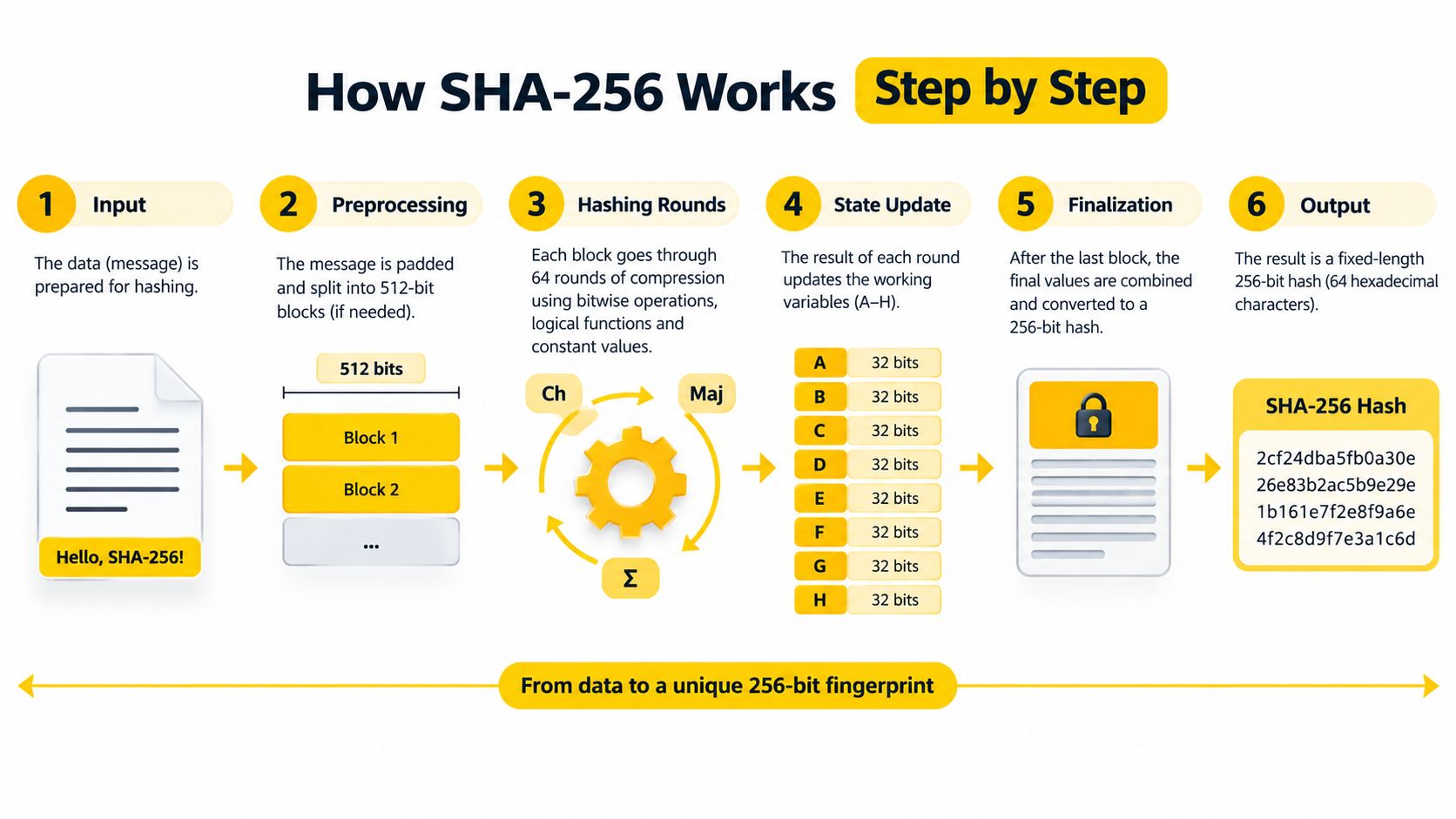
SHA-256 accepts data of many sizes, but it produces an output with a fixed format. The result is commonly written as a hexadecimal string made from 64 characters, representing 256 bits, or 32 bytes, as described in this technical walkthrough of SHA-256. A short greeting and a large software archive can therefore produce outputs with the same visible length.
A wax seal offers a useful analogy. You press a seal into a document, and the resulting mark depends on the document and the seal. If someone edits one word, the old mark no longer verifies the document. SHA-256 is much more complex than wax, but the workflow has a similar shape.
Preparing the message
First, the algorithm converts the input into binary data. It then adds structured padding. Padding might seem unnecessary, but it gives the algorithm a consistent way to mark where the original message ends and to include the original length.
SHA-256 processes the prepared message in blocks of a defined size. For a small input, the padding may create a single block. A longer input becomes a sequence of blocks processed in order.
Expanding the information
The algorithm organizes each block into smaller words and expands them into a message schedule. Bit rotations, shifts, and exclusive-or operations mix information from different parts of the block.
This stage spreads local changes through later calculations. If you alter one character near the beginning of a message, that change doesn't stay in one isolated area. It influences many later values.
Mixing working values
SHA-256 starts with fixed initial values and uses round constants during its compression process. It then repeatedly combines the message schedule with eight working variables.
You don't need to calculate every binary operation by hand to understand the purpose. Each round blends information, moves values between positions, and applies logical functions that make the final result depend on the whole input. Repetition increases diffusion, meaning a small input difference can affect the entire digest.
Producing the digest
After processing the message blocks, SHA-256 combines the final working values into one digest. The result is deterministic. Run the same bytes through the same implementation, and you'll receive the same hexadecimal output.
The operation is also one-way in practical terms. You can calculate a digest from a message quickly, but finding a message that produces a chosen digest requires trying possibilities rather than reversing the steps. That difference explains why hashing can support verification without exposing a direct route back to the original data.
Core Security Properties Explained
SHA-256 earns its place in security systems through several related properties, not because the output looks random to a human reader. The design makes useful attacks difficult while keeping ordinary verification efficient.

Collision resistance
A collision occurs when two different inputs produce the same hash. Because SHA-256 has a fixed output space while possible inputs can be much larger, collisions must exist mathematically. The security goal isn't to make collisions impossible. It's to make finding a useful one impractical.
Think of a library assigning a short catalog code to every book. If the code space is limited, two books could eventually receive the same code. A secure assignment method makes it extremely difficult for someone to deliberately choose two meaningful books with matching codes.
In real systems, collision resistance protects identifiers and integrity checks. An attacker shouldn't be able to modify a document, transaction record, or software object while preserving the digest that other computers trust.
Pre-image resistance
Pre-image resistance addresses a different challenge. Given a digest, an attacker shouldn't be able to discover an input that produces it through a shortcut.
A sealed envelope illustrates the distinction. You can inspect a seal on an envelope and compare it with another seal, but the seal doesn't provide a practical method for reconstructing the letter inside. An attacker can guess possible letters and hash them, but the work becomes difficult when the original data has enough uncertainty.
Hashing isn't a replacement for every security control. In particular, a fast general-purpose hash isn't the right standalone method for storing user passwords, because attackers can test guesses rapidly. Password systems need password-specific key derivation functions that deliberately make guessing more expensive. For everyday device and account protection, readers can also review these actionable mobile security tips.
A visual explanation can help connect these ideas to ordinary security workflows. The following video demonstrates the role of cryptographic hashing and related concepts:
Why small changes matter
SHA-256 has an avalanche effect. Change a small part of the input, and many parts of the output change. That behavior prevents an observer from making a subtle edit while keeping most of the fingerprint familiar.
The digest doesn't tell you what changed. It tells you that the complete input is no longer the same. That is exactly what a verification system needs.
SHA-256 in Blockchain and Bitcoin
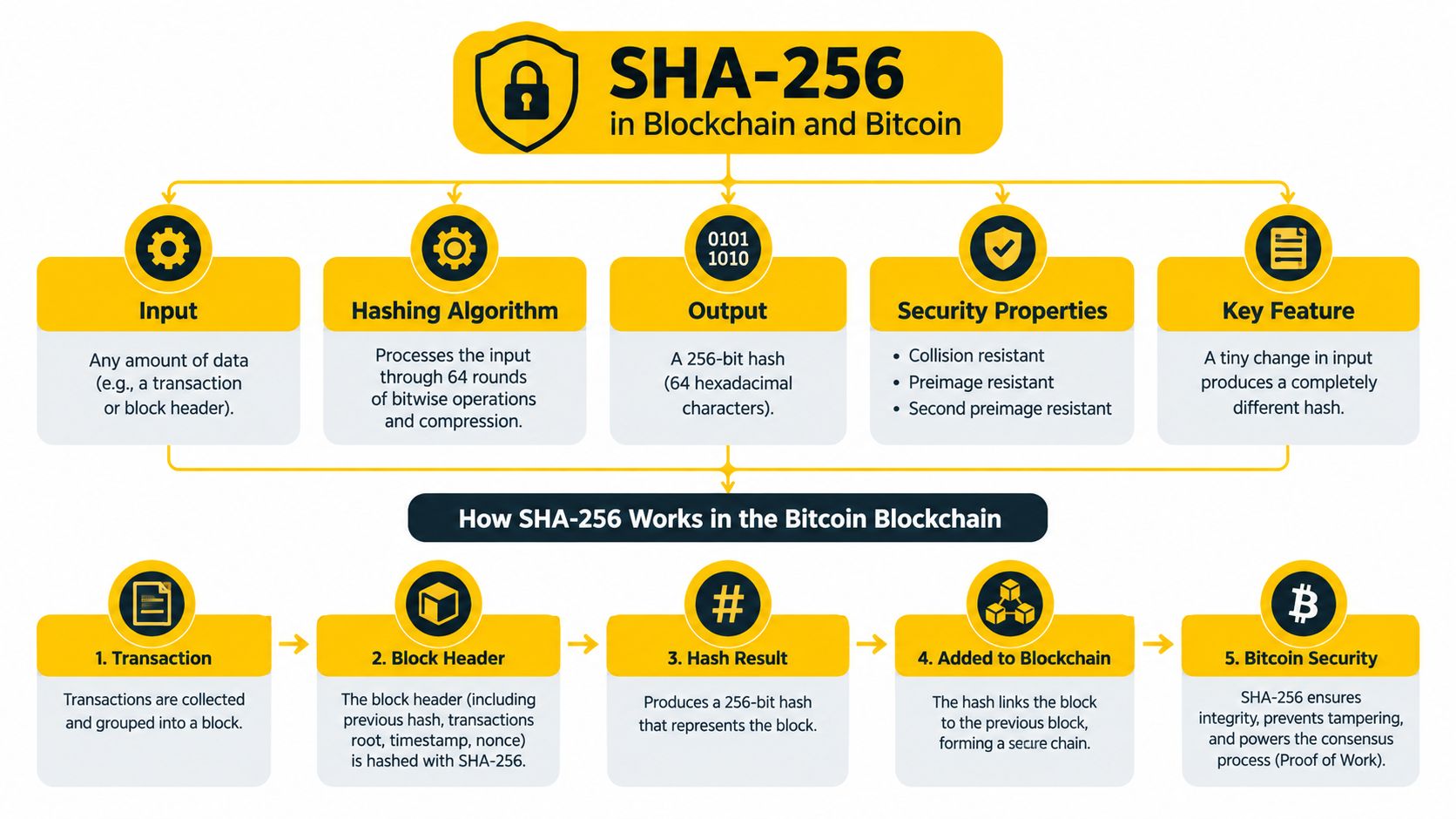
Bitcoin turns hashing into a competitive process. Miners assemble candidate blocks containing transaction information, references to earlier records, and a changing value called a nonce. They repeatedly hash the candidate data, searching for an output that satisfies the network's current target condition.
The miner can't steer SHA-256 toward a desired result through a simple algebraic shortcut. Instead, the miner changes the nonce or other permitted fields and calculates another candidate. Most attempts fail. A successful result gives the miner a block that other participants can verify quickly.
Mining as proof of work
This arrangement creates an asymmetry. Finding a qualifying hash takes repeated computation, while checking a proposed result takes a straightforward hash calculation and comparison with the target.
That asymmetry is the point of proof of work. A miner can't just announce a block and expect everyone to accept it. The block must carry evidence that the required computational search occurred.
Mining hardware performs this work at high speed. In Bitcoin's traditional model, specialized ASICs are built to calculate the relevant hash process efficiently. The operator's practical experience therefore involves hardware selection, electricity management, heat, noise, pool configuration, and the probability of finding an acceptable result.
Linking blocks together
Each block includes information connected to the preceding block's fingerprint. If someone changes an old transaction, the altered block receives a different hash. The next block's reference no longer matches, and the attacker must rebuild the affected chain from that point forward while competing against ongoing honest mining.
That doesn't make alteration physically impossible. It makes unauthorized rewriting computationally demanding and publicly detectable. Nodes can reject a chain whose hashes, transactions, or proof of work don't satisfy the rules.
For a beginner-focused explanation of the checking process, how Bitcoin transactions are verified provides a useful companion view. The key distinction is that SHA-256 supplies cryptographic evidence, while the wider Bitcoin protocol defines which transactions and blocks count as valid.
What miners actually experience
To a miner, SHA-256 isn't just a security theory. It becomes a repeated loop of candidate construction, hashing, submission, and verification. A miner may perform vast numbers of unsuccessful calculations without learning anything useful from each failed attempt, then receive a valid result that the network can check rapidly.
Mining doesn't solve a puzzle by discovering a hidden formula. It searches a large space of possible inputs until one produces an acceptable hash.
That search protects the ledger because rewriting history requires repeating the same work for the changed block and all dependent blocks. The hash function makes every altered detail visible, while proof of work makes large-scale revision costly.
Alternative Approaches like Cascoin Mining
Traditional SHA-256 mining is a hash race. Operators use specialized hardware to calculate candidate hashes, and the network accepts a qualifying result under its proof-of-work rules. This model suits miners who already understand ASIC equipment and want to participate through raw computational throughput.
A different mining interface can preserve the importance of verifiable computation without presenting the task as a constant race between industrial machines. Cascoin's Labyrinth Mining uses lightweight client software that simulates mice navigating a virtual maze to collect cheese. The game layer changes how participation feels, while the underlying network still needs a method for evaluating work and distributing rewards.

Comparing the mining experience
| Approach | Main activity | Typical equipment focus | Practical character |
|---|---|---|---|
| SHA-256 proof of work | Repeated hash calculations | Dedicated ASIC hardware | Competitive and hardware intensive |
| Labyrinth Mining | Client-based maze simulation | Lightweight computing resources | Game-oriented and accessible |
| CPU-friendly mining | Algorithm-specific computation | General-purpose processors | Lower barrier to entry |
These approaches appeal to different people. An ASIC operator may value predictable hardware operation and high hashpower. A beginner may prefer software that runs on an existing computer and offers a more interactive way to understand participation. Someone focused on energy use may compare the workload and equipment requirements before choosing a network.
Cascoin also provides a conventional SHA-256 mining path for experienced ASIC operators, alongside its gamified Labyrinth Mining and CPU-friendly MinotaurX option. The broader lesson is that a mining interface can change without making cryptographic verification irrelevant. Hash functions remain part of the trust mechanism, even when users experience the work through a maze rather than a stream of hexadecimal results.
Before choosing a method, learn the hardware, software, reward, and risk assumptions for each option. This explanation of cryptocurrency mining can help beginners distinguish mining mechanics from investment claims. Cryptocurrency values are volatile, so technical participation shouldn't be treated as a promise of financial return.
Practical Examples and Demonstrations
The easiest way to see SHA-256's avalanche effect is to hash two nearly identical messages. The first input might be hello world, while the second is hello World, with only the capitalization changed. A person sees a tiny edit. The algorithm treats the byte sequence as a different message and produces a substantially different digest.
A standard example uses the input hello world, which produces the following SHA-256 output:
B94D27B9934D3E08A52E52D7DA7DABFAC484EFE37A5380EE9088F7ACE2EFCDE9
The output is written in hexadecimal, so each character represents part of the underlying binary result. You don't need to read the digest as a sentence. Treat it as an identifier that other computers can recalculate.
SHA-256 input and output examples
| Input Text | SHA-256 Hash |
|---|---|
hello world |
B94D27B9934D3E08A52E52D7DA7DABFAC484EFE37A5380EE9088F7ACE2EFCDE9 |
Hello world |
A different SHA-256 digest |
hello World |
A different SHA-256 digest |
The table deliberately avoids pretending that similar text should create similar hashes. SHA-256 doesn't preserve meaning, spelling distance, or visual similarity. It maps each exact input to a digest through its defined operations.
A simple verification exercise
You can demonstrate the process with a local hashing tool or a trusted cryptography library.
- Enter
hello worldexactly, including the space. - Record the digest.
- Change one character, such as the first letter's capitalization.
- Hash the revised text.
- Compare the two outputs.
The result should show why a file checksum can reveal accidental corruption. If a download changes during transfer, the recalculated digest won't match the publisher's original digest. The checksum doesn't explain whether the change came from a transmission error or an attacker. It flags that the data isn't identical.
That limitation matters. SHA-256 verifies data relationships, but a secure system still needs trustworthy software, key management, identity checks, and sensible protocol rules.
Conclusion and Key Takeaways
SHA-256 is a cryptographic hash function that turns an input of arbitrary size into a fixed-length digest. It doesn't encrypt the input, and it doesn't independently prove that a transaction is authorized. Instead, it creates a dependable fingerprint that computers can recalculate and compare.
Its security value comes from several properties working together. The same input gives the same output, small changes cause broad output changes, reversing a digest is impractical, and deliberately finding a useful collision is difficult. Bitcoin uses those properties to connect blocks, support proof-of-work mining, and make historical changes detectable.
For miners, SHA-256 becomes a practical search process. ASIC operators race through candidate inputs, while the network checks successful results efficiently. Alternative models can present computation through different experiences, including low-power or game-oriented participation, but they still need reliable rules for validating work.
The clearest answer to what is SHA-256 is therefore practical: it's a compact, repeatable fingerprinting mechanism that helps computers agree when data has stayed the same.
Cascoin offers several ways to participate, including SHA-256 mining for experienced ASIC operators and Labyrinth Mining through lightweight maze-simulation software. Visit Cascoin to explore its open-source network, mining options, wallet resources, and documentation before deciding which approach fits your interests.