Energy Efficient Crypto Mining: A Practical Guide
Energy-efficient crypto mining means combining lower energy per unit of computing work with cleaner electricity, not just buying a faster machine. Bitcoin's network efficiency moved from roughly 40–50 J/TH in 2020 to 17.5 J/TH in 2024, while annual electricity demand later reached about 190 TWh by December 2025, so better hardware alone doesn't guarantee lower total consumption.
Why can mining equipment become more efficient while the network still consumes more power? The answer lies in the difference between efficiency per unit of work and energy use across the whole system. If newer machines make hashing cheaper, operators may deploy more computing capacity, increase total hashrate, or move workloads to previously unused electricity.
This guide explains how to evaluate that tradeoff. You'll learn how joules per terahash, cooling, firmware, power sourcing, and workload design fit together. You'll also see why CPU-friendly and gamified models can give beginners a practical way to participate without entering an ASIC-only market.
Table of Contents
- Rethinking Energy Efficiency in Crypto Mining
- Key Metrics for Measuring Mining Efficiency
- Comparing Algorithm Approaches for Low-Power Mining
- Hardware and Software Optimizations for Efficiency
- Cascoin Labyrinth Mining Case Study
- Building Your Own Energy-Efficient Mining Strategy
Rethinking Energy Efficiency in Crypto Mining
The common definition of efficient mining is simple: use fewer watts to produce the same amount of hashpower. That definition is useful, but incomplete. A miner can improve a machine's energy performance while the wider operation continues to consume more electricity because it runs more machines, operates for longer, or expands into new locations.
The main device-level metric is joules per terahash, or J/TH. A joule measures energy, while a terahash represents a unit of hashing work. Lower J/TH means a machine needs less electricity to perform the same amount of hashing. It doesn't, by itself, tell you whether a mining site uses renewable electricity, wastes energy through poor cooling, or increases its total load after installing more efficient hardware.
A review cited a 5,814% increase in Bitcoin mining hardware efficiency over eight years, alongside a global network efficiency level of 48.9 J/TH. The same review placed annual Bitcoin electricity demand in the broad range of 100–170 TWh in recent years, demonstrating that large network demand can coexist with major improvements in machine performance (peer-reviewed review of Bitcoin mining energy use).
The machine is only one layer
A useful way to assess energy-efficient crypto mining is to separate four layers:
- Chip efficiency: How much energy the ASIC or CPU uses for its computing work.
- Facility efficiency: How much electricity goes to cooling, networking, lighting, pumps, and other support systems.
- Electricity source: Whether the operation uses hydropower, solar generation, curtailed power, fossil generation, or a changing grid mix.
- System response: Whether miners reduce or shift their load when electricity is scarce and increase it when surplus power is available.
This broader view changes the practical question. Instead of asking only, “Which machine uses the fewest watts?”, ask, “How many watts does the full operation use, what work does it produce, and what electricity would otherwise be available?”
Practical rule: Treat J/TH as a starting point, not a complete environmental scorecard.
Bitcoin's historical growth makes this distinction important. One peer-reviewed analysis reported annual electricity consumption increasing from 0.06 TWh in 2013 to 138.96 TWh in 2023, while another estimate placed 2023 consumption at about 121.13 TWh (analysis of Bitcoin's environmental footprint). Hardware has improved, but competition and total deployed computing capacity can still push network consumption upward.
For a wider discussion of how crypto mining affects environmental systems, see this explanation of cryptocurrency's environmental impact. The central lesson is clear: lower energy intensity is valuable, but cleaner sourcing and flexible operation determine whether that improvement reduces real-world impact.
Key Metrics for Measuring Mining Efficiency
A power bill tells you how much electricity an operation bought. It doesn't tell you whether the operation used that electricity well. To evaluate mining performance, track the machine, the facility, and the amount of useful computing work produced.
The first metric is J/TH. It expresses energy required for each terahash of hashing work. A lower figure generally means a miner can produce a given hashrate with less electricity, which can reduce operating costs when other conditions remain stable.
W/TH describes the same relationship from a power perspective. Since a watt is a joule per second, the figures are closely related in practical mining comparisons. Manufacturers and operators may use either term, so check the measurement conditions before comparing equipment.
Separate hardware from facility performance
A mining site also needs a facility metric. Power usage effectiveness, or PUE, compares total facility power with the power consumed by the computing equipment. A site with efficient miners can still waste substantial electricity if fans, pumps, air conditioning, transformers, or other infrastructure consume excessive power.
Use this simple approach:
- Record total electricity entering the facility.
- Record electricity reaching the mining hardware.
- Divide total facility power by IT or mining-equipment power.
- Track the result over comparable operating periods.
The closer the result is to the hardware's direct consumption, the less overhead the facility adds. You should also record uptime, rejected shares, temperature, hashrate stability, and curtailment periods. A machine that looks efficient on a specification sheet may perform poorly if heat causes throttling or unstable power causes repeated restarts.
| Metric | What It Measures | Lower Is Better |
|---|---|---|
| J/TH | Energy required for a unit of hashing work | Yes |
| W/TH | Power required for a unit of hashrate | Yes |
| PUE | Facility power compared with mining-equipment power | Yes |
| Rejected-share rate | Work submitted but not accepted by the pool | Generally yes |
| Temperature variance | Operating stability across the equipment | Not always, but lower swings help |
A 2026 review reported Bitcoin network efficiency moving from roughly 40–50 J/TH in 2020 to 17.5 J/TH in 2024 for the latest Antminer S21, with an expected 5.5 J/TH in Q4 2025 for the newest generation (review of Bitcoin mining energy efficiency). These figures show why lower J/TH can reduce electricity cost per unit of work, but they don't establish a site's total energy use or emissions.
Calculate energy cost per unit of work
Start with the miner's input power and electricity tariff. Then compare the result with its stable, accepted hashrate rather than its advertised peak. If two machines produce similar hashrate, the one drawing less power should have a stronger cost position, provided reliability and maintenance are comparable.
Before purchasing equipment, test several electricity prices, uptime assumptions, and hashrate conditions in a mining profitability calculator. Profitability changes over time, so treat the output as a scenario rather than a promise.
Comparing Algorithm Approaches for Low-Power Mining
Not all mining algorithms ask the same hardware to perform the same type of work. SHA-256, used by Bitcoin, favors specialized ASICs because those machines are designed around one narrow computational task. ASICs can be highly efficient for that task, but the hardware is expensive, loud, power intensive, and difficult for a casual participant to repurpose.
CPU-friendly algorithms take a different route. They make ordinary processors more relevant, which can lower the barrier to entry. That doesn't automatically make every CPU mining setup environmentally superior. A computer running inefficiently, sitting idle between tasks, or using power from a carbon-intensive grid still has an energy footprint. The advantage is that participants can use existing equipment without adding a specialized industrial appliance.
Match the algorithm to the participant
Independent 2026 coverage places fleet-weighted Bitcoin mining efficiency around 28 J/TH, with commercially available machines near 13–15 J/TH (overview of Bitcoin's environmental impact). Those figures illustrate the efficiency gap between professional ASIC fleets and casual hardware. A home user competing directly against those fleets with older equipment may consume electricity without producing meaningful rewards.
| Algorithm | Hardware Required | Energy Profile |
|---|---|---|
| SHA-256 | Specialized ASIC miners | High-performance, concentrated electricity use |
| MinotaurX | CPU-friendly consumer hardware | Lightweight participation suited to ordinary computers |
| Labyrinth Mining | Lightweight client software | Gamified, low-power participation based on maze activity |
| Other CPU-oriented Proof of Work designs | CPUs, sometimes mixed consumer hardware | Depends on software settings, processor efficiency, and uptime |
The table is a design comparison, not a guarantee of equal results. An algorithm's energy profile depends on the implementation, the hardware, the operating schedule, and the electricity source. You should measure actual wall power instead of relying on the algorithm's label.
Why accessibility matters
ASIC concentration creates a practical gatekeeping problem. Specialized operators can obtain newer equipment, negotiate power arrangements, and manage cooling infrastructure that ordinary users can't easily reproduce. CPU-friendly models offer a different form of participation. They may support learning, experimentation, and network involvement without requiring a dedicated mining farm.
Cascoin's open-source network presents Labyrinth Mining as a gamified alternative in which lightweight client software simulates mice moving through a virtual maze to collect cheese. Its published description says the approach can provide up to 3x higher rewards than traditional approaches while consuming less power (Cascoin's Labyrinth Mining overview). Treat that claim as a project-reported feature, and verify current software, reward rules, and network conditions before committing resources.
The responsible choice depends on your purpose. If you operate industrial ASICs, focus on J/TH, cooling, uptime, and power sourcing. If you're learning or participating from a personal computer, a CPU-friendly design may offer a more proportionate way to explore mining.
Hardware and Software Optimizations for Efficiency
Efficiency improvements often begin before you replace a machine. Measure wall power, accepted hashrate, temperature, rejected work, and downtime for your current setup. That baseline helps you distinguish a genuine improvement from a change that merely increases peak performance.
Tune the machine carefully
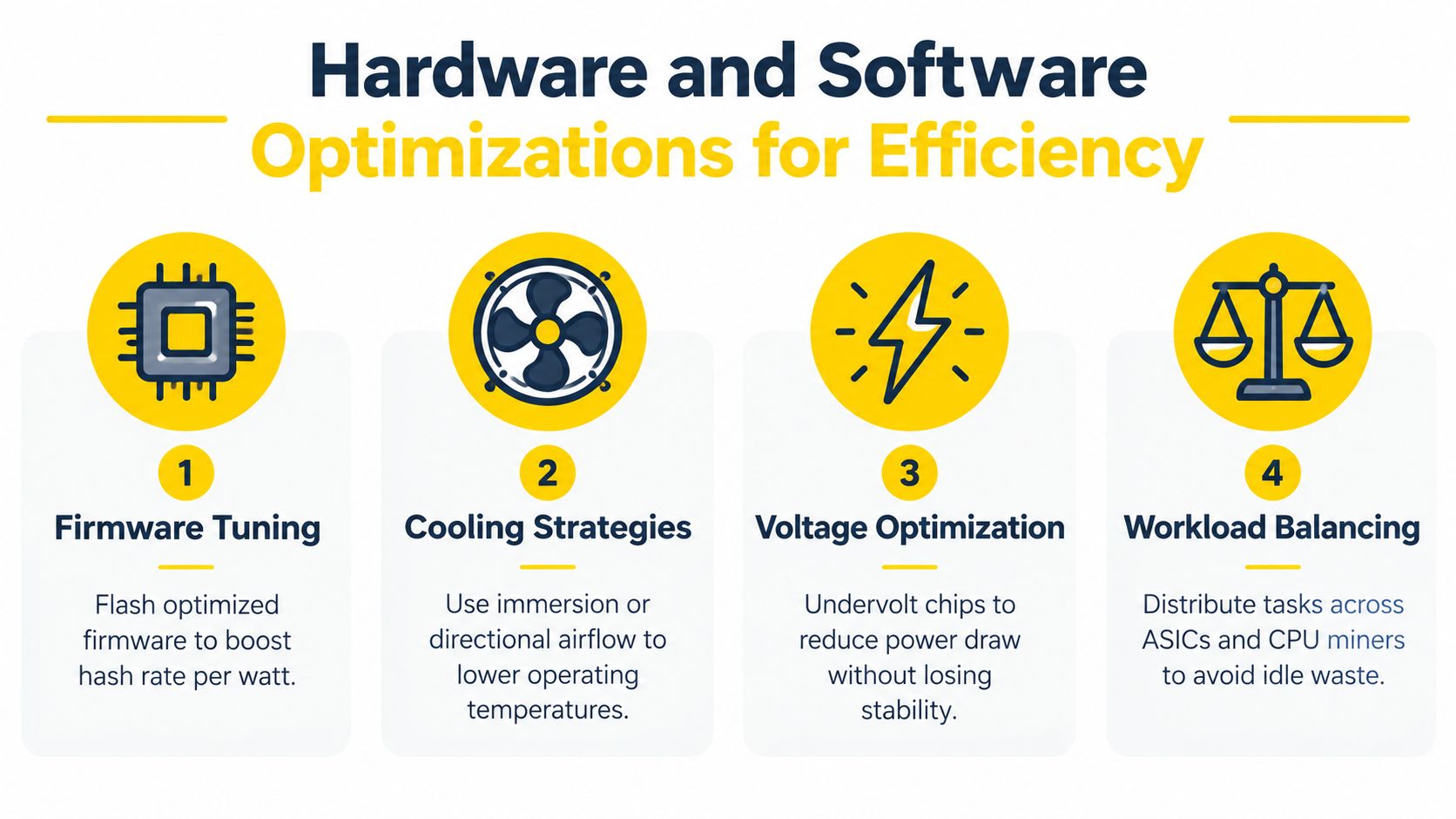
Firmware tuning can change the balance between hashrate, voltage, fan speed, and stability. Use reputable firmware, preserve a recovery path, and test changes gradually. The best configuration isn't the one with the highest displayed hashrate. It's the one that produces stable accepted work without disproportionate power draw or hardware stress.
Voltage optimization can reduce consumption when the chips remain stable at a lower operating point. Undervolting too aggressively may cause errors, rejected shares, or restarts, which wastes both energy and time. Record power and accepted hashrate before and after each change.
Cooling strategy affects both energy use and reliability. Direct airflow, clean filters, sensible rack spacing, and heat separation can reduce the work required from cooling equipment. Immersion or liquid-assisted systems may suit larger installations, but they add pumps, fluids, maintenance, and capital requirements. A practical guide to cooling efficiency for mining can help you compare the tradeoffs.
Treat workload as a flexible resource
A miner doesn't need to run at maximum output every hour. Software can reduce load during expensive or carbon-intensive periods, then resume when surplus renewable electricity is available. This approach is particularly useful for sites connected to variable solar generation, hydropower, or electricity that would otherwise be curtailed.
An IEEE study found that supplying 3.5 MW of hydropower to 1,000 Bitcoin Miner S19 units and 21 ECV18000 FreeCooler units was financially and economically superior to conventional fossil-fuel systems (IEEE study of hydropower-supported Bitcoin mining). The finding illustrates why site design matters as much as machine selection.
Measure the whole loop: A lower ASIC power draw is useful only if the cooling system, power conversion, operating schedule, and rejected work don't erase the gain.
Set alerts for temperature, hashrate drops, fan failures, and rejected shares. Review those logs on a schedule. Efficiency is an operating habit, not a setting you apply once.
Cascoin Labyrinth Mining Case Study
Labyrinth Mining shows how a project can redesign participation around accessibility rather than a pure race for specialized hashing hardware. Instead of asking every participant to assemble an ASIC setup, the model uses lightweight client software to simulate mice navigating a virtual maze and collecting cheese.
The practical appeal is straightforward. A user can start with a compatible computer, install the client and wallet, connect to a public pool, and observe activity without building an industrial facility. The software turns mining into a visible process, which can make concepts such as work, rewards, uptime, and power consumption easier to understand.
Cascoin describes the model as ecological and gamified, with up to 3x higher rewards compared with traditional approaches while consuming less power (project description of Labyrinth Mining). That statement describes the project's own positioning, not a universal result for every computer or operating environment. Actual consumption depends on processor type, client settings, uptime, and the electricity source.
What to check before joining
A responsible setup process should include more than downloading software:
- Verify the software source: Use the project's published downloads and documentation, and check that the client matches the intended operating system.
- Measure wall power: Software estimates may not include the monitor, cooling, networking equipment, or other components.
- Review pool information: Understand how work is assigned, how rewards are calculated, and how payouts are recorded.
- Inspect transparency features: Public code repositories and an on-chain explorer make it easier to examine implementation and network activity.
- Set a power limit: A low-power participant should define an electricity budget before leaving a computer running continuously.
The open-source model also gives developers and researchers a way to inspect code, identify issues, and contribute improvements. Community discussion can help users compare configurations, but community advice shouldn't replace independent measurements.
This example also clarifies the difference between accessible mining and industrial efficiency. An ASIC farm may produce more hashing work per watt for a specific algorithm. A lightweight client may still be the more suitable option for a beginner who already owns a computer and wants to participate without purchasing specialized equipment.
Building Your Own Energy-Efficient Mining Strategy
Start with your purpose. A person learning about networks, a household experimenting with a CPU, and an industrial operator managing a large ASIC fleet need different strategies. Choosing equipment before defining that purpose often leads to excess cost, excess power use, or unrealistic expectations.

Build the plan in layers
First, audit the electricity. Identify the tariff, time-of-use structure, reliability, and generation mix. Renewable sourcing can reduce emissions, but intermittent supply may require flexible scheduling, storage, grid interaction, or automatic shutdown rules.
Next, choose the algorithm and hardware. ASICs suit specialized operators pursuing high hashrate on an ASIC-dominant network. CPU-friendly and gamified designs suit users who value low-power access, experimentation, or community participation. Don't compare a consumer CPU and a Bitcoin ASIC as though they perform the same task.
Then, establish a measurement baseline. Track wall power, accepted work, uptime, temperature, rejected shares, and facility overhead. Compare performance over consistent operating periods, and record configuration changes so you know what caused an improvement.
Finally, test the economics conservatively. Use several electricity assumptions and avoid treating projected rewards as guaranteed income. Mining revenue, network competition, equipment performance, and token markets can change, so a strategy that works under one set of conditions may not work under another.
The systems-level risk is easy to miss. Cambridge data cited in recent analysis placed Bitcoin mining electricity use at about 138 TWh in April 2025, followed by reporting of around 190 TWh by December 2025, even as the energy mix became cleaner (analysis of Bitcoin's changing energy demand). This is why lower J/TH should be paired with renewable sourcing and flexible workloads. Efficiency can lower the energy needed for each unit of work, while total consumption still rises if the network deploys more work overall.
Site safety matters too. Operations that use batteries, fuels, generators, or industrial equipment need appropriate handling procedures. For teams managing fuel-related infrastructure alongside mining systems, these tips for gas material storage provide useful context on safe storage and material handling.
A durable strategy balances three questions: How much energy does the equipment use, where does that energy come from, and can the workload respond when conditions change?
Use those questions to select the smallest suitable setup, configure it for stable performance, and expand only when measurements justify expansion. That approach supports responsible participation whether you're testing a CPU-friendly client, joining a community network, or operating specialized hardware.
Cascoin offers an open-source, gamified Labyrinth Mining model for lower-power participation, alongside CPU-friendly and ASIC-oriented options for different users. Visit Cascoin to review the documentation, available mining paths, and community resources before choosing a setup that matches your hardware and energy goals.