8 Labyrinth Ideas for Gamified Crypto Mining
You launch a lightweight mining client, watch a mouse enter a procedural labyrinth, and follow its search for cheese. The animation is easy to understand. The harder questions sit underneath it: why did this maze appear, which decisions count toward a reward, and could someone else reproduce the same round?
That's where useful labyrinth ideas move beyond decoration. A playable mining network needs an understandable visual concept, a distinct navigation challenge, and a reward or progression system that gives each round a meaningful purpose. Those elements should agree with the verification rules, not conceal them.
For product designers, game developers, and open-source contributors, the practical challenge is connecting the experience on screen to a deterministic system underneath. A branching passage might create an interesting decision, but it also needs a defined movement cost, a reproducible state transition, and a clear relationship to cheese collection.
Design principle: Make the mouse's journey readable to players and reproducible by independent implementations.
The same discipline applies when you craft interactive story games: choices need understandable consequences. In a mining interface, however, narrative progression and cryptocurrency rewards must remain clearly distinguished.
The approaches below are proposed design patterns, not claims about a deployed mining protocol. They range from straightforward corridor generators to streaming layouts and publicly reproducible seeds. None makes navigation a secure mining mechanism by itself. That requires separate rules for validating work, preventing replay, and issuing rewards.
Table of Contents
- 1. Recursive Backtracker (Depth-First Search Maze)
- 2. Prim's Algorithm Maze
- 3. Kruskal's Algorithm Maze
- 4. Wilson's Algorithm (Loop-Erased Random Walk) Maze
- 5. Eller's Algorithm Maze
- 6. Braided Maze (Loop-Enhanced Maze)
- 7. Unicursal Labyrinth (Single-Path Cretan Design)
- 8. Seeded Maze Generation from Verifiable Blockchain Data
- Comparison of 8 Labyrinth Generation Ideas
- Build the Labyrinth Users Can Trust
1. Recursive Backtracker (Depth-First Search Maze)
Start with recursive backtracking when you want a readable baseline. Carve from the current cell into a randomly selected unvisited neighbor, continue until no unvisited neighbors remain, then return through the traversal history. Stop when every cell has been visited.
The resulting connected layout has no loops, so there's a unique route between any pair of cells. For a mouse-and-cheese experience, that makes route inspection straightforward: an auditor can distinguish forward exploration, retracing, and successful arrival without resolving competing routes.
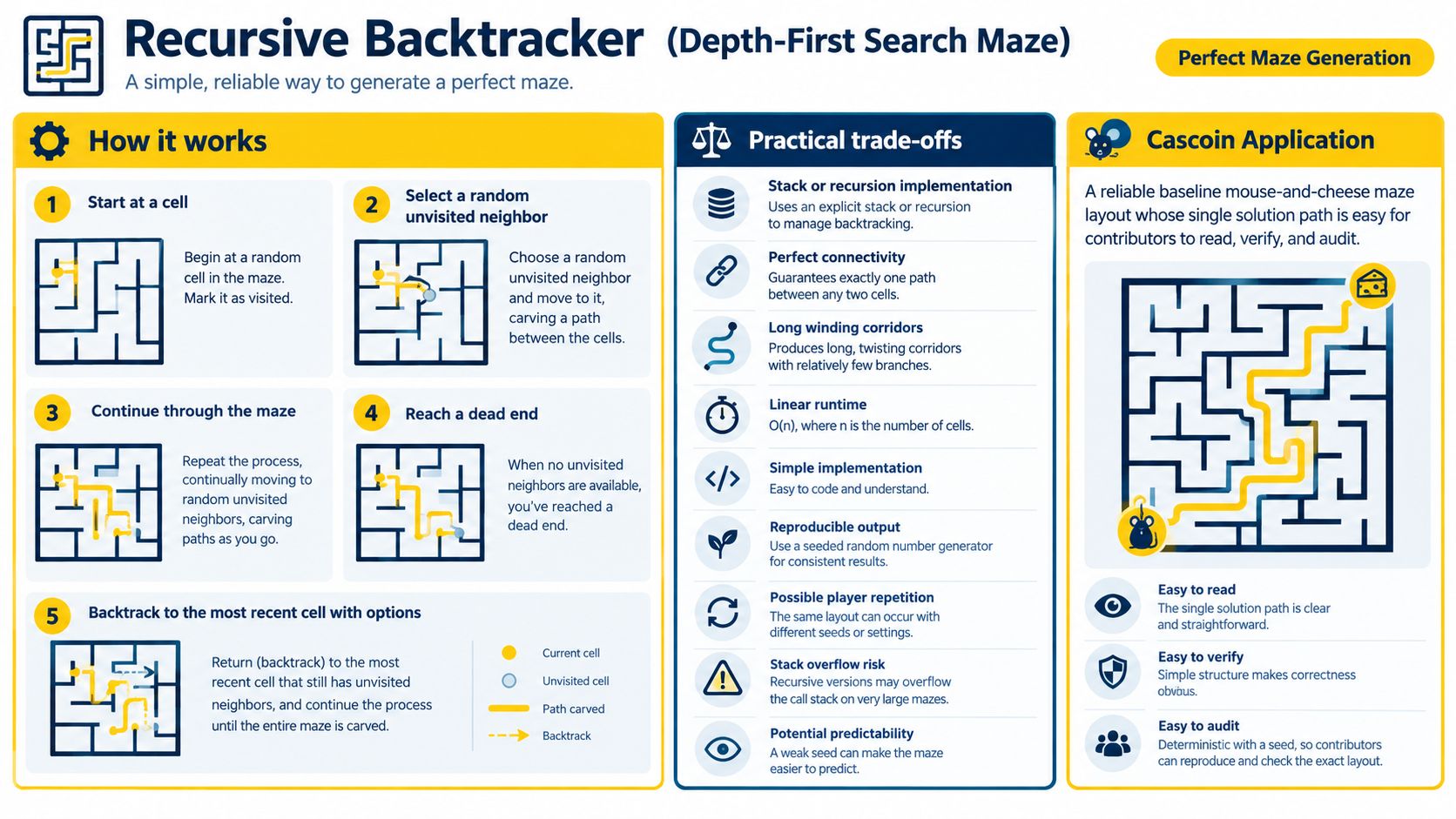
A practical prototype could use narrow stone corridors, a visible breadcrumb trail, and cheese placed at a designated goal. For a Labyrinth Mining implementation, treat that presentation as a view of the underlying state rather than the authority that decides rewards.
Keep traversal and reward rules separate
Use an explicit stack instead of recursive function calls so generation doesn't depend on the runtime's call-stack limit. Store wall openings compactly, and specify neighbor ordering before applying seeded random selection.
- Reproducibility: Record the seed, generator version, grid dimensions, and starting cell.
- Validation: Check connectivity and the absence of cycles before accepting a generated board.
- Reward accounting: Validate cheese collection against the accepted movement trace, not an animation event.
Long corridors can make movement legible, but repeated retracing may become tedious. Add visible exploration progress or optional playback acceleration rather than paying for every step, which could encourage pointless movement.
This is a strong first prototype because the rules remain inspectable. It's less suitable when players need frequent route choices or opportunities to recover from a wrong turn without walking back.
2. Prim's Algorithm Maze
A mouse reaches a junction, follows a short branch, and quickly returns to explore another. Prim-style generation is worth testing when you want exploration to feel like repeated local decisions, rather than a long commitment down a corridor.
Begin with a visited region and maintain a frontier of candidate connections to unvisited cells. Randomly select a candidate, open it if it still reaches an unvisited cell, and update the frontier. The frontier representation and selection procedure are part of the design specification, not interchangeable implementation details.

For a browser-based demonstration, use a tree-root visual theme: the mouse explores branching tunnels while completed branches remain clearly marked. Keep the camera stable so players can understand those decisions without constantly reorienting themselves.
Design feedback around junctions
A mouse-navigation study reported learning across sequences of 10 binary choices after about 10 reward experiences. That's animal-navigation evidence, not proof of human engagement or mining performance, but it provides a useful reason to test short feedback cycles rather than assume sparse rewards work best.
Separate learning feedback from coin issuance. A route marker, discovered chamber, or completion animation can acknowledge progress without changing the protocol's economic rewards.
The main implementation trap is an ambiguously defined frontier. Selecting candidate walls and selecting candidate cells needn't produce identical layouts, even with the same seed.
Document which procedure you use, how duplicate candidates are handled, and when random values are consumed. Then test candidate boards for route length, revisit frequency, and time to completion before deciding they're appropriate for short sessions.
3. Kruskal's Algorithm Maze
Kruskal-style generation suits a board-first workflow. Instead of extending a passage from a current position, begin with isolated cells and a shuffled collection of interior walls. Remove a wall only when its neighboring cells belong to different connected components.
A disjoint-set structure, also called union-find, tracks those components. Once all cells belong to the same component, the board is connected, and the accepted connections haven't introduced cycles.
For a desktop prototype, present the maze as a tiled warehouse where mice search aisles for cheese. Generate the full board before the round begins, then let an inspection panel show the seed, topology digest, and generator identifier.
Make the construction trace inspectable
This design offers a useful separation between construction and play. Developers can inspect the wall-processing sequence without needing to understand the mouse's navigation policy.
- Wall enumeration: Define a canonical order before shuffling, including orientation and coordinate order.
- Shuffle behavior: Specify the random generator and bounded-integer selection procedure.
- Component checks: Test that rejected walls already connect cells within the same component.
- Final acceptance: Verify connectivity independently of the generator's own bookkeeping.
Don't describe the result as statistically unbiased merely because it looks evenly distributed. Visual balance and equal probability across possible mazes are different requirements.
The trade-off for lightweight clients is the working state. A complete candidate-wall collection and component structure may be less attractive than a streaming design when the board grows large.
Use Kruskal's method when an inspectable whole-board generation process matters more than incremental delivery. To compare its navigation experience with another generator, keep the visual theme and reward conditions unchanged so you're testing the layout rather than several changes at once.
4. Wilson's Algorithm (Loop-Erased Random Walk) Maze
Choose Wilson's algorithm when the sampling method itself matters, not because a maze looks irregular. Build an initial visited region, start a random walk from an unvisited cell, erase loops from that walk, and attach the remaining path when it reaches the existing tree.
With the appropriate random-walk construction, this produces a uniform spanning-tree sample of the underlying connected graph. That property concerns the maze's topology; it doesn't imply equal route lengths, equal player difficulty, or fair cryptocurrency rewards.

A useful deployment scenario is a research client comparing navigation agents across reproducible boards. A watercolor theme could make the experience approachable, while a separate technical view exposes the graph and generation record.
A neutral topology sampler doesn't automatically create a fair reward system. Goal placement, movement rules, and agent capabilities still matter.
Budget for unpredictable generation work
Random walks can spend substantial effort revisiting cells before joining the existing tree. Benchmark generation latency, peak memory, and cancellation behavior on the actual devices you intend to support.
For a responsive interface, run generation away from the main rendering thread and display honest progress states. Don't replace a slow board with a different algorithm, because that changes the published generation procedure.
Caching can help presentation, but verification must still be possible from the documented inputs. If a server supplies the topology, the client should be able to regenerate or otherwise validate it under the chosen protocol.
Reserve this approach for a clear sampling requirement. If your main objective is understandable rounds on constrained hardware, a simpler generator may be the better engineering choice.
5. Eller's Algorithm Maze
A client doesn't always need the entire labyrinth in memory. Eller's algorithm provides a row-by-row design, maintaining connectivity information across the current row rather than constructing a complete board before anything can appear.
Assign cells to sets, join eligible neighboring sets horizontally, and carry connections downward. Every active set needs a downward continuation unless the maze is being finalized; otherwise, part of the layout can become permanently disconnected.
For a lightweight client, this suggests an unfolding tunnel: the mouse progresses through newly generated territory while the interface retains only the visible region and the state needed for continuation. Treat this as a proposed streaming mode, with explicit rules for what happens behind the viewport.
Streaming needs a stopping rule
A finite maze needs finalization logic that merges remaining components without creating cycles. An ongoing stream instead needs checkpoint and segment rules, especially if players can pause, reconnect, or revisit previous territory.
- Generation state: Save set membership, row position, and random-generator state.
- Boundary integrity: Verify that each unfinished component continues into the next row.
- Replay support: Regenerate discarded sections from checkpoints when inspection requires them.
- Completion conditions: Define when cheese collection finishes a segment and what state carries forward.
The practical mistake is treating low generation memory as low total memory. Movement logs, rendered assets, retained history, and verification records still consume resources.
A scrolling display can also make backtracking confusing. Keep a stable position indicator and offer a nonanimated map view for users who find continuous motion uncomfortable.
Choose Eller's method when streaming is a real product requirement. If players need unrestricted access to a persistent whole-board map, account for that storage separately rather than assuming the generator has solved it.
6. Braided Maze (Loop-Enhanced Maze)
Dead ends aren't the only way to create challenge. A braided maze starts with a connected maze and opens selected additional walls, creating loops and alternative routes.
Consider a mouse that misses a turn near the cheese. In a tree-shaped maze, it may need to retrace its route; in a braided layout, it might circle around and recover through another passage. That gives you a different design problem: choosing among routes rather than merely discovering the route.
For a proposed social exploration mode within a crypto ecosystem, alternate paths could support optional discoveries and noncompetitive exploration. Keep those features distinct from any protocol-defined mining eligibility.
Reduce frustration without hiding the rules
Braiding is a topology adjustment, not an accessibility certification. Loops may reduce forced retracing, but extra route choices can also increase cognitive load.
Universal-design guidance emphasizes clear wayfinding, reduced distractions, and understandable text and visual cues. Apply those principles through distinguishable junctions, optional route highlighting, keyboard-operable controls, and cues that don't rely on color alone.
Accessibility rule: Offer help with navigation without making the reward ledger harder to inspect.
Choose additional openings deterministically. Specify candidate-wall order, eligibility rules, and how the seed controls selection so another implementation can reproduce the braided topology.
Reward validation needs particular care because multiple valid routes now exist. If the rules reward efficiency, define the movement metric; if they reward cheese collection, reject repeated claims without penalizing legitimate detours.
Test shortest-path calculations again after braiding. Also test with users who prefer simpler navigation, because fewer dead ends won't necessarily mean an easier experience.
7. Unicursal Labyrinth (Single-Path Cretan Design)
A unicursal labyrinth removes route choice entirely. The mouse follows a continuous path toward a goal, making this a useful onboarding concept rather than a substitute for a branching navigation challenge.
The historical form offers a strong visual identity. Labyrinth designs have evidence spanning at least four millennia, with early reliably datable Southern European examples generally following a seven-circuit pattern. Use that heritage thoughtfully without implying that every circular labyrinth shares the same design or cultural meaning.
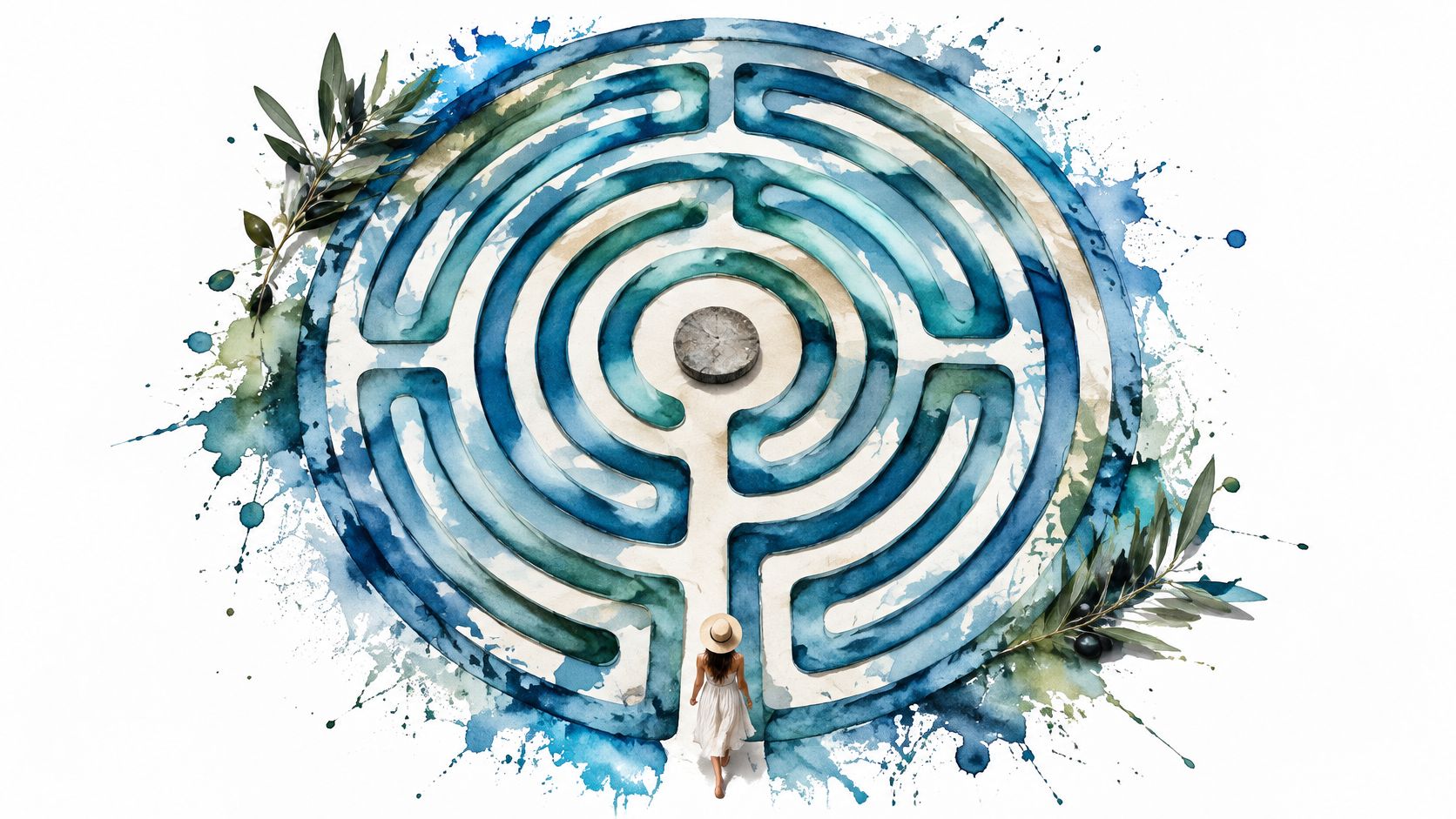
For a wallet tutorial, a guided mouse could demonstrate movement, cheese collection, and receipt inspection along an unambiguous route. A progress indicator should reflect actual distance remaining, since visual proximity to the center can be misleading.
Teach the client before testing navigation
Use this mode to explain controls and verification concepts without also demanding route planning. Let users pause, reduce motion, or move directly to an accessible textual explanation.
Don't disguise the absence of navigation choices with arbitrary delays. If the mouse follows a predetermined path, describe the experience and clarify whether it's a demonstration, a simulation, or a protocol-relevant action.
A calm presentation also shouldn't become a medical claim. A scoping review of labyrinth walking describes generally positive reported outcomes while emphasizing the limited evidence base; that doesn't establish therapeutic benefits for a digital mining interface.
The trade-off is limited strategic depth. Unicursal layouts work well for onboarding and optional reflective presentation, but a system that claims to assess navigation choices needs a challenge in which meaningful choices exist.
8. Seeded Maze Generation from Verifiable Blockchain Data
A reproducible board begins with a precise input contract. Seeded generation combines a documented seed derivation with a specified random generator and maze algorithm so independent clients can reconstruct the same topology.
For a proposed daily challenge, participants could derive a board from an agreed blockchain reference and a domain-separated challenge identifier. If you include a miner identifier, document that participants may receive different boards and explain how the protocol evaluates those differences.
This is the practical connection to blockchain transparency: disclose enough information to reproduce the result, then distinguish that reproducibility from stronger security claims.
Publish the entire determinism contract
A seed alone isn't enough. Implementations can disagree because of text encoding, byte order, integer behavior, neighbor ordering, or differences in random-number consumption.
- Input definition: Specify accepted blockchain references and their serialization.
- Algorithm version: Pin generation, braiding, and cheese-placement procedures.
- Test vectors: Publish inputs with expected topology digests and reward-relevant outputs.
- Replay rules: Bind accepted claims to the correct participant, challenge, and protocol state.
A public block-derived input is not automatically unpredictable or resistant to manipulation. Review who can influence it, when participants can know it, whether they can try multiple identifiers, and what happens after a chain reorganization.
Keep competition formats equally explicit. If you introduce brackets or ranked rounds, resources such as single elimination vs Swiss explained can help frame the event structure, but they don't define secure mining rewards.
A useful release artifact is a small reference verifier that regenerates the board and checks a recorded run. It should reject incompatible versions rather than interpreting them under newer rules.
Comparison of 8 Labyrinth Generation Ideas
| Method | 🔄 Implementation Complexity | ⚡ Resource Needs | 📊 Expected Outcome | ⭐ Key Advantage | 💡 Ideal Use Case |
|---|---|---|---|---|---|
| Recursive Backtracker (Depth-First Search) | Beginner; stack or recursion | Low; linear time and space | Perfect maze with long corridors and few branches | Simple, fast, and easy to audit | A winding maze with one solution path |
| Prim's Algorithm | Beginner–intermediate; frontier list | Moderate; stores frontier walls | Perfect maze with many short branches and dead ends | Offers frequent choices and a distinct, bushy layout | Varied, branch-heavy levels |
| Kruskal's Algorithm | Intermediate; requires union-find | Moderate to high; stores and shuffles walls | Perfect maze with balanced branching and little directional bias | Mathematically clear and auditable | Fair-feeling layouts without obvious directional patterns |
| Wilson's Algorithm | Advanced; loop-erased random walks | Variable; can be slow on large grids | Perfect maze sampled uniformly from possible spanning trees | Strong statistical neutrality | Fairness-focused generation where unbiased layouts matter |
| Eller's Algorithm | Advanced; row-by-row set management | Very low; memory scales with row width | Perfect maze, generated or streamed one row at a time | Efficient for large or effectively infinite grids | Low-memory devices and on-demand maze generation |
| Braided Maze | Intermediate; post-process any perfect maze | Low additional overhead | Maze with loops and multiple routes; fewer dead ends | Reduces backtracking and adds route choices | Casual play or levels tuned for lower frustration |
| Unicursal Labyrinth | Beginner; fixed or simple path construction | Very low | One continuous path with no decisions or dead ends | Easy to understand, navigate, and verify | Onboarding, guided play, or a thematic experience |
| Seeded Generation from Verifiable Blockchain Data | Advanced; requires exact seed, RNG, and version specifications | Depends on the underlying generator; low-to-moderate verification cost | Reproducible layout derived from public data; topology depends on the generator | Enables independent verification and auditability | Transparent, reproducible maze generation for community review |
Build the Labyrinth Users Can Trust
Choose the generator according to the experience you can implement, explain, and verify. Recursive backtracking is a sensible starting point for readable rounds with straightforward topology checks. Use Prim's or Kruskal's algorithm when you want to test different branching patterns, while measuring the resulting navigation experience rather than assuming the algorithm name guarantees balance.
Choose Eller's method when streaming or constrained generation memory matters. Add braiding when forced retracing causes frustration, but pair it with clear wayfinding and accessibility testing. Reserve Wilson's algorithm for situations where its sampling property justifies the generation work.
The unicursal design serves a different purpose. It can introduce the interface and explain receipts without asking beginners to learn navigation and cryptocurrency concepts simultaneously.
Treat the round as a versioned system
For a production Labyrinth Mining experience, define the generator, seed derivation, navigation policy, cheese placement, and reward-validation rules together. Publish test vectors that cover ordinary rounds, invalid moves, interrupted sessions, and incompatible versions.
Keep independent verification practical. A contributor should be able to reconstruct the board, replay relevant state transitions, and understand why a claim was accepted or rejected without trusting the renderer.
Cascoin's Casplorer block explorer provides a place to inspect on-chain activity. An on-chain transaction and a verified navigation trace are not the same artifact, so documentation should explain their relationship and identify which evidence the protocol checks.
Publish enough detail for another developer to disagree with your implementation and demonstrate why.
Measure the experience without promising outcomes
Visual theming, reward pacing, and responsible participation belong in the same design review. Track generation delays, failed sessions, confusing junctions, and verification errors alongside completion behavior. Test accessibility features independently from economic incentives so users aren't pressured to avoid helpful controls.
Likewise, measure resource consumption on target hardware before making efficiency claims. A lightweight-looking interface can still perform unnecessary background work, and a compact generator doesn't establish the energy requirements of the complete mining process.
Cascoin is an open-source project centered on Labyrinth Mining, making these design questions relevant to contributors as well as miners. Proposed changes should remain clearly distinguished from released behavior and supported documentation.
Start with a reference generator and a matching verifier, then add the visual experience. That order makes it easier to keep exploration enjoyable without allowing animation, reward messaging, or branding to obscure the rules. The strongest labyrinth ideas are those users can understand and contributors can independently test.
Cascoin offers an open-source cryptocurrency project centered on Labyrinth Mining, with a mouse-and-cheese theme and tools for exploring participation. Visit Cascoin to review its documentation, examine the available mining options, and identify where you can test or contribute to the labyrinth experience.