7 New Altcoins to Mine in 2026: A Practical Guide
The most popular advice on new altcoins to mine is also the most misleading: find the newest coin, point hardware at it early, and assume low difficulty means easy profit. That logic ignores the costs that decide the outcome. Electricity, cooling, pool fees, payout thresholds, and whether you can sell what you've mined matter more than a launch date.
Newness can help. It can also mean thin liquidity, fast difficulty changes, untested software, and rewards that look generous only because few miners have arrived yet. A coin mined on hardware you already own, at a power price you can measure, usually beats a headline project that forces a new rig purchase.
The seven projects below are different decisions, not interchangeable picks. They span CPU, GPU, FPGA, and ASIC routes, from Cascoin's gamified Labyrinth Mining to Kaspa's ASIC-dominated network. Compare the mining model, suitable hardware, setup route, transparency signals, and main operational risk for each one. Then pick the network that fits your resources, not the one with the loudest first-week calculator result.
Table of Contents
- 1. Cascoin
- 2. Qubic (QUBIC)
- 3. Nexa (NEXA)
- 4. Alephium (ALPH)
- 5. Radiant (RXD)
- 6. Ergo (ERG)
- 7. Kaspa (KAS)
- Comparison of 7 New Altcoins to Mine
- Choose the Network Before You Buy the Hardware
1. Cascoin
Cascoin replaces the standard hash race with Labyrinth Mining, a lightweight client that simulates mice collecting cheese in a maze. The project calls this an ecological approach and claims it can deliver up to 3× higher rewards than traditional mining. Treat that figure as a project claim, not a guaranteed or independently verified return. Your actual result depends on network conditions, participation, and what the mined coin is worth when you can use or sell it.
That distinction matters beyond one project. Ethereum showed how quickly mining economics can change when consensus design changes. After The Merge on September 15, 2022, Ethereum moved from proof of work to proof of stake, and a Stanford analysis of Ethereum energy use before and after The Merge estimated consumption before the change at about 25.7 terawatt-hours annually. The hardware competition didn't fade slowly. It ended.
Cascoin's strength is that one setup gives you three entry points, each a different cost and commitment level.
Three Ways to Participate
- Labyrinth Mining: The recommended route, built around lightweight software rather than maximum hash output.
- MinotaurX: A CPU-friendly, lower-power option that suits beginners testing mining on existing hardware.
- SHA-256: The familiar route for experienced ASIC operators who already understand power draw, heat, and difficulty risk.
Transparency signals are stronger than on many small projects. The code is publicly available under the MIT License, on-chain activity can be checked through the Casplorer block explorer, and the project provides downloadable wallets, documentation, and a public mining pool. A solo developer stewards the project and invites contribution through Discord.
Practical rule: Test Cascoin first on hardware you already own, measure power at the wall, and verify payouts in the explorer before you scale anything.
The trade-offs are clear. A solo-developer project carries continuity and adoption risk, and Cascoin offers no price promises. What it does offer is a low-barrier way to test whether a lighter mining model fits your setup without buying specialized equipment first.
2. Qubic (QUBIC)

Qubic is the experimental pick on this list. Its Useful Proof of Work model directs mining computation toward AI-training tasks instead of spending cycles only on a conventional hash puzzle. That idea will appeal if you're tired of work that exists solely to secure a chain, but don't confuse useful with automatically efficient or profitable.
Participation covers CPU and GPU hardware, with pool and solo options. Official mining resources and open-source code give you something concrete to inspect before you commit a machine. If you're comparing CPU-first routes specifically, this guide to the best coins to mine with CPU hardware is a useful companion for checking whether your processor makes sense for any of these networks.
Where Qubic Fits and Where It Doesn't
Qubic suits miners who want to test an unusual consensus model on general-purpose hardware. It's more accessible than an ASIC-only network, and the documentation lowers the guesswork during setup.
The risks are structural. Mining requirements and participation rules may change, pool terms vary, and some candidate participation may not earn compensation. The useful-work design also doesn't establish lower energy use or better returns. You still need to measure coins earned against power consumed over a full difficulty period, not a single good day.
Start with a pool if predictability matters, confirm how shares are credited, and read the current participation rules before you point a full rig at it. Qubic rewards curiosity. It punishes assumptions.
3. Nexa (NEXA)
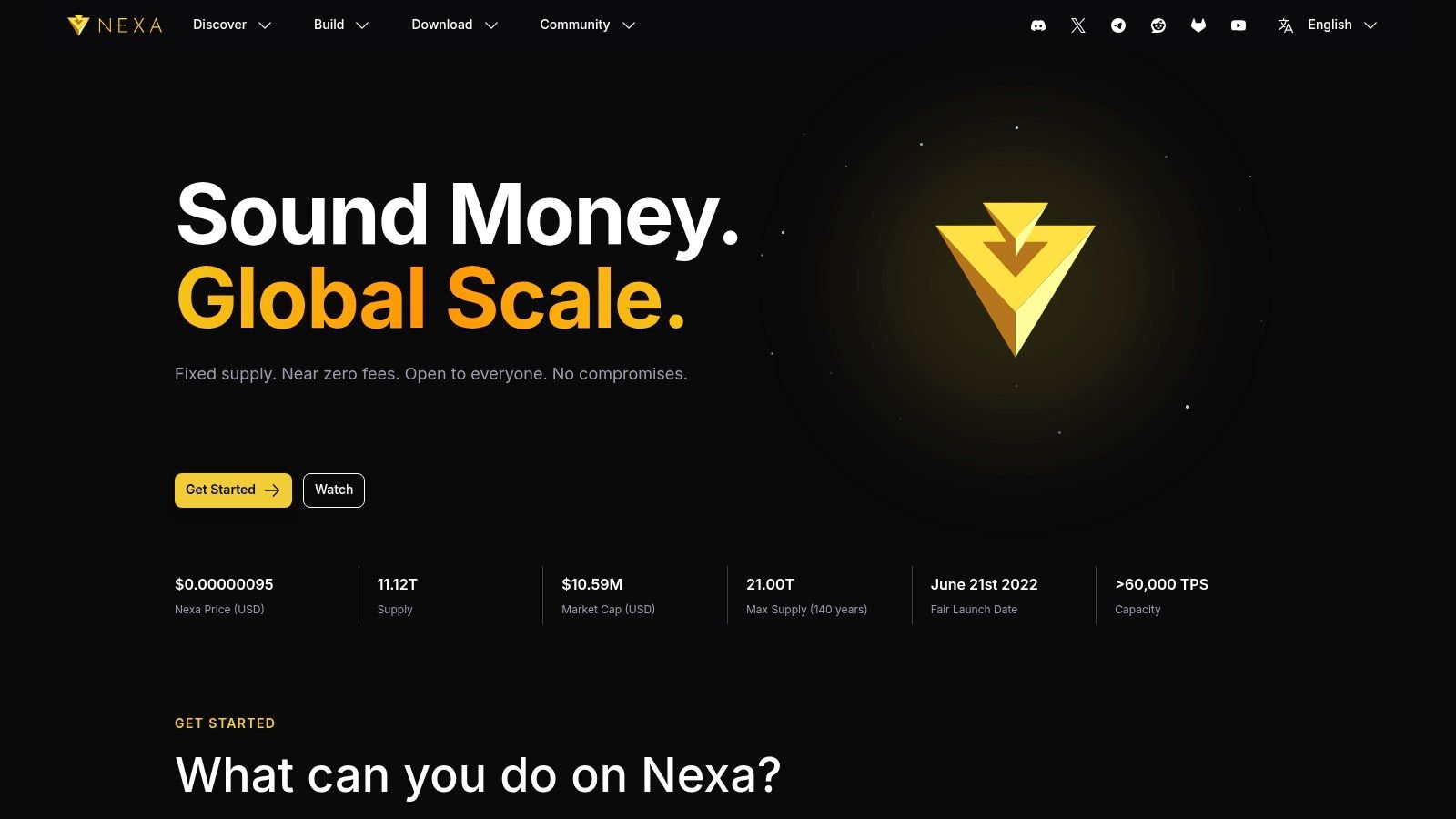
Nexa is a straightforward GPU decision. You mine with compatible AMD or NVIDIA GPUs through third-party mining software, following an official guide that lists supported miners and pools. The project advises mining to a wallet address rather than directly to an exchange, which is sound practice. It keeps payout control with you and avoids exchange deposit problems.
Its NexaPoW algorithm combines SHA-256 hashing with Schnorr signatures, giving the network a project-specific proof-of-work design rather than a plain copy of another chain. Mining rewards follow a halving schedule, so today's emission rate isn't permanent. Build that decline into any payback estimate.
The Efficiency Check That Matters
For GPU mining, raw hash rate is the wrong headline metric. A 2026 peer-reviewed study of SHA-256 mining efficiency and shutdown thresholds found block rewards have a long-run elasticity of approximately 0.773 to 1.009 with respect to both hash rate and energy consumption. The practical lesson applies across proof-of-work coins: benchmark coins per kilowatt-hour, recalculate after difficulty adjustments, and know the price and difficulty level where you'd shut the rig down.
Nexa's downsides follow from its hardware route. CPU mining isn't the current path, third-party miners may charge developer fees, and electricity plus hardware wear can exceed proceeds. If you already own a suitable GPU, Nexa is testable at low incremental cost. If you'd need to buy the card, the halving schedule makes a rushed purchase hard to justify.
4. Alephium (ALPH)
Alephium pairs proof of work with a sharded blockchain and smart-contract functionality. You're not just mining a standalone coin. You're contributing hash power to a broader platform, which gives the network utility beyond block rewards, though that utility doesn't guarantee mining returns.
Official documentation covers both pool and solo mining, with GPU and FPGA miner code references. Solo mining is the demanding route. It requires a synced full node and mining-wallet addresses for each network group, so setup errors are more likely than with a pool connection. Mining rewards are also locked for 500 minutes, a detail that affects how quickly you can move what you've earned.
Most beginners should start with a pool. Industry market research cited in analysis of pool mining revenue share estimated pool mining represented about 52.7% of cryptocurrency mining software revenue in 2025. Pools dominate because payouts are smoother, but that figure doesn't establish profitability for Alephium or any other coin.
Check a pool's fee, minimum payout, stale-share rate, server location, and uptime before you judge a coin by its calculator estimate.
Alephium doesn't prioritize ASIC resistance, so hardware competition can shift over time. Choose it if the sharded smart-contract design interests you and you're comfortable with either pool dependence or a more technical solo setup.
5. Radiant (RXD)
Radiant is a proof-of-work UTXO network using a SHA-512/256d mining algorithm. It supports GPU, FPGA, and ASIC routes, targets a five-minute block time, and follows a scheduled halving model. That hardware breadth sounds flexible, but each route has different software, efficiency, and cost profiles. Don't assume they're equally competitive.
Official resources cover mining setup and emphasize fair launch and open-source development. Those are useful transparency signals when you're comparing newer networks, because they let you verify how the chain started and inspect the code rather than trusting a marketing page.
Don't Confuse the Two Mining Activities
Radiant also has a Glyph protocol that supports mining certain on-chain tokens. That's a separate activity from earning RXD block rewards. Mixing the two up leads to bad expectations about what you'll receive, how liquid it is, and what hardware time is worth.
- RXD mining: Block rewards for securing the network through proof of work.
- Glyph mining: Participation in mineable on-chain assets within the ecosystem.
Before you start, confirm current pool availability, fees, and payout rules for your chosen hardware. Radiant fits miners who want a UTXO chain with multiple hardware paths and who'll take time to separate base-layer rewards from ecosystem experiments.
6. Ergo (ERG)
Ergo isn't newly launched, and that's precisely why it's useful here. It's the established control case. When a younger coin promises better returns, Ergo gives you a mature proof-of-work smart-contract platform to compare against, with documentation that states its requirements plainly.
Ergo uses the Autolykos algorithm and supports GPU mining through pool or solo participation. Its setup guide recommends a GPU with more than 6 GB of memory, so check your card before downloading anything. Official guides and mining tools are available, and the broader developer ecosystem means you're not relying entirely on mining interest to sustain the network. For a wider comparison set, see this overview of the best coins to mine across hardware types.
The energy warning applies here as much as anywhere. Industry analysis referenced in discussion of electricity as the dominant mining operating cost indicates electricity can represent roughly 60 to 80% of mining operating costs. ASIC resistance doesn't make GPU mining energy-free. Your card still draws power, produces heat, and may need cooling.
Solo mining adds high reward variance, so pools suit most home miners. Ergo works best as a measured choice for GPU owners who value clear documentation and an established platform over launch-stage upside.
7. Kaspa (KAS)
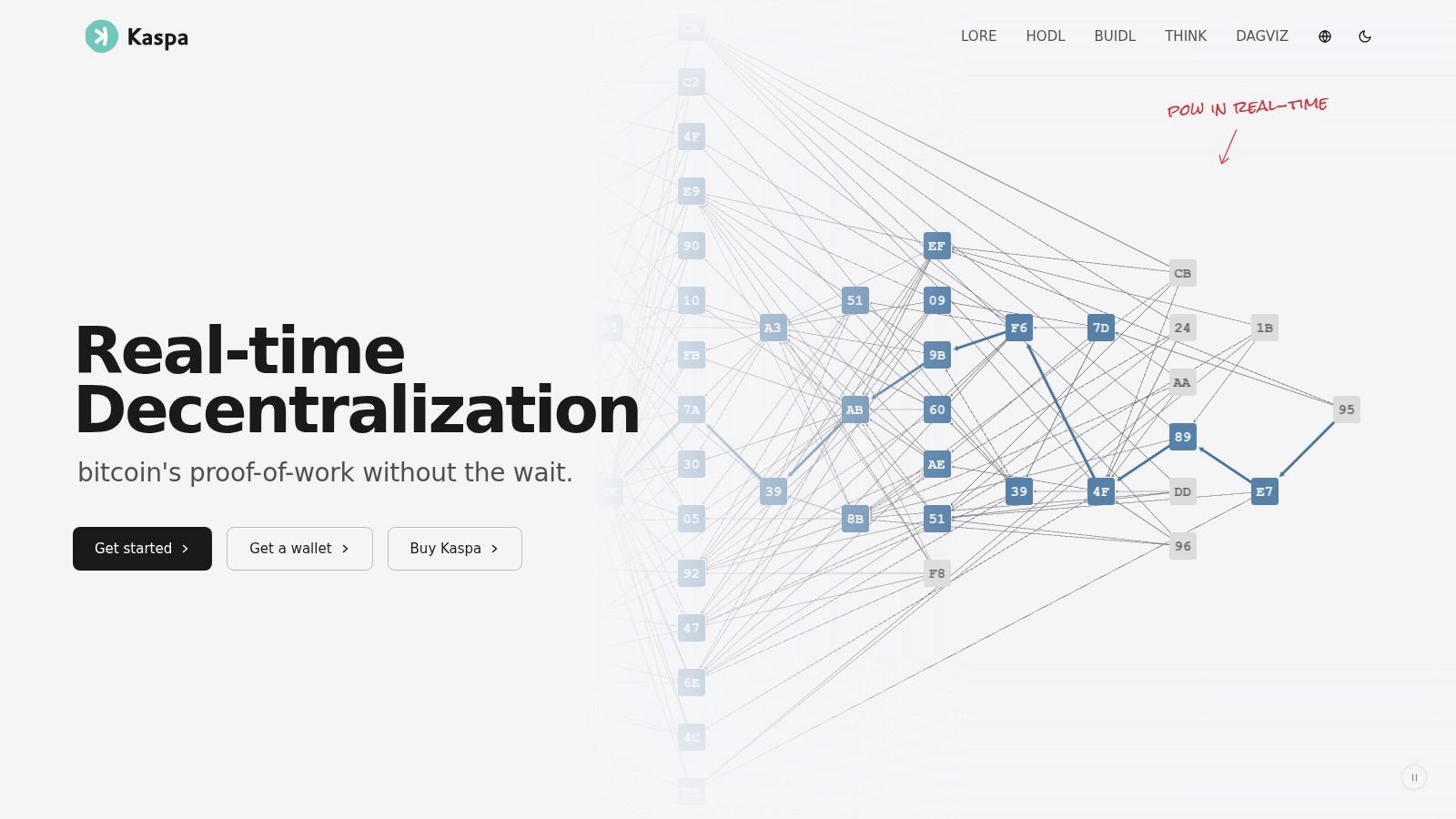
Kaspa is technically distinct. It's a proof-of-work blockDAG network with fast block generation where parallel blocks are ordered rather than discarded. The project describes a fair launch with no premine or presale, and public documentation covers pool and solo mining. If you want background on how these networks differ, this explainer on proof of work coins helps frame the comparison.
Now the constraint. Kaspa's own mining wiki says ASICs dominate current conditions and CPU or GPU mining is economically unjustified. That honesty should shape your decision. Kaspa is a comparison point for experienced ASIC operators, not a beginner entry point.
Bitcoin shows why that hardware arms race is unforgiving. An April 2025 report attributed to the Cambridge Centre for Alternative Finance, summarized in analysis of proof-of-work mining realities and energy mix, estimated Bitcoin consumption at approximately 138 terawatt-hours annually, with an approximate 43% decline in energy intensity per hash with each hardware generation. Older machines don't age gracefully in that environment.
ASIC purchases demand substantial upfront capital, and returns hinge on difficulty, coin price, power costs, and equipment efficiency. If you don't already operate ASICs with cheap electricity and a shutdown plan, Kaspa is one to watch rather than one to mine.
Comparison of 7 New Altcoins to Mine
| Item | Mining approach & hardware | 🔄 Implementation complexity | ⚡ Resource requirements | 📊 Expected outcomes | 💡 Ideal use case & key advantage |
|---|---|---|---|---|---|
| Cascoin | Labyrinth Mining, CPU-friendly MinotaurX, or SHA-256 for ASICs | Varies by method; wallets, documentation, and a public pool are available | CPU or ASIC, depending on method | Rewards and energy use are not guaranteed; up to 3× rewards is a project claim | Miners seeking multiple routes and open-source transparency; distinctive maze-based mining |
| Qubic (QUBIC) | Useful Proof of Work for AI-training tasks; CPU or GPU; pool or solo | Experimental model; participation rules may change | CPU or GPU; requirements depend on network setup | Compensation is not guaranteed; useful work does not establish lower energy use or better returns | Miners interested in experimental proof-of-work and CPU participation |
| Nexa (NEXA) | NexaPoW; compatible AMD or NVIDIA GPUs; third-party miners and pools | Moderate; requires compatible hardware, miner software, and a wallet | GPU, electricity, and possible miner fees | Rewards follow a halving schedule; proceeds may not cover costs | GPU miners seeking a proof-of-work network with official setup guidance |
| Alephium (ALPH) | Proof-of-work; GPU or FPGA; pool or solo | Pool mining is simpler; solo mining requires a synced node and multiple addresses | GPU or FPGA; solo mining adds node and storage demands | Mining rewards are locked for 500 minutes; returns are uncertain | Miners exploring a smart-contract ecosystem with pool and solo options |
| Radiant (RXD) | SHA-512/256-based proof-of-work; GPU, FPGA, or ASIC | Varies by hardware and mining route; check pool terms and availability | Hardware and power needs vary; ASICs may require substantial investment | Block rewards follow a halving model; Glyph mining is separate from RXD rewards | Miners comparing hardware options or exploring the Glyph ecosystem |
| Ergo (ERG) | Autolykos proof-of-work; GPU; pool or solo | Moderate; official setup guidance is available | GPU with more than 6 GB of memory recommended; electricity required | Solo mining has high reward variance; profitability is not assured | GPU miners seeking a broader smart-contract platform and mining ecosystem |
| Kaspa (KAS) | Proof-of-work blockDAG; pool or solo; ASICs dominate current conditions | High for competitive mining; requires ASIC setup and network configuration | Specialized ASIC equipment and substantial power | CPU/GPU mining is economically unjustified under current conditions; returns vary | Experienced ASIC operators; distinctive blockDAG design and public mining documentation |
Choose the Network Before You Buy the Hardware
Treat this roundup as a shortlist for further research, not a profitability forecast. Calculators describe a moment. Difficulty adjusts, prices move, pools change terms, and hardware generations erode the advantage you thought you'd bought. The miners who survive those shifts are the ones who measured their own conditions first.
Start with hardware you already own. Match the algorithm to that machine, then calculate expected coins against electricity and cooling at your actual rate. As you compare rigs and thermals, it helps to compare GPU monitoring software so you're tracking temperature, power draw, and throttling rather than guessing from miner output alone.
Then check launch survivability, not just headline yield. Is the code auditable? Are emissions and block rewards documented? Can you verify activity in a public explorer and payouts through independent pool data? Those questions matter because uncertainty is built into this sector. Research summarized in recent analysis of cryptocurrency electricity use and network efficiency notes the European Parliament's 2025 answer estimated EU cryptocurrency-related electricity use at about 11 TWh, mainly Bitcoin, while flagging substantial uncertainty from technological and regulatory change.
For a low-power, community-driven trial, Cascoin offers accessible Labyrinth and MinotaurX routes alongside SHA-256, so you can test without specialized equipment. Qubic suits experimenters, Nexa and Ergo suit existing GPU owners, Alephium and Radiant reward miners willing to learn platform-specific mechanics, and Kaspa belongs with committed ASIC operators.
Run a short test, record energy in and coins out, confirm you can sell the rewards, and only then consider spending more. That order sounds slow. It's how you avoid an expensive machine mining a coin that is no longer worth your time.
If you want a gentler first test among these new altcoins to mine, try Cascoin's Labyrinth Mining or CPU-friendly MinotaurX on hardware you already own, verify your activity in the Casplorer explorer, and check the results against your real power bill. Visit Cascoin to download a wallet, read the documentation, and join the miners and builders shaping the network.