Open Source Software Benefits That Actually Matter in 2026
You're staring at a renewal quote for a tool your team only half uses, and the price has gone up again. Someone suggests an open alternative. Someone else asks who'll maintain it, who'll secure it, and what happens if it breaks on a Friday night. Those are the right questions.
Table of Contents
- Why Open Source Software Benefits Deserve a Second Look
- What Open Source Software Actually Means
- Cost Transparency and the Real Price of Free Code
- Security Through Transparent Peer Review
- Community Power and the Scale of Modern Collaboration
- Real-World Flexibility in a Crypto Mining Project
- The Limits of Open Source and How to Spot Them
- Choosing Open Source With Eyes Open
Why Open Source Software Benefits Deserve a Second Look
People first meet open source through a price tag that says zero. That's a poor starting point. The open source software benefits show up later, in whether you can inspect the code, adapt it to your hardware, leave a vendor without rebuilding everything, and trust what the software claims to do.
A small team feels this tension quickly. A proprietary mining client, wallet, or project tool may be polished and supported, but you can't see how rewards are calculated or whether a change will strand your setup. An open project flips the trade. You gain visibility and control, and you take on more responsibility for setup, updates, and support.
Six benefit clusters worth testing
- Cost transparency: You save on licenses, but you budget openly for staffing, hosting, and review instead of hiding those costs inside a subscription.
- Security you can inspect: Public code lets outsiders challenge assumptions before a flaw ships, provided review is enforced.
- Community capacity: Fixes, documentation, and integrations don't have to wait for one vendor's roadmap.
- Flexibility: You can modify, fork, or extend the software when your needs diverge from the default.
- Auditability: Users can compare published code against observed behavior, which matters greatly when money or consensus rules are involved.
- Reuse at scale: One shared codebase spares many teams from rebuilding the same components.
That last point isn't abstract. A cross-country panel estimated that if no country contributed to open source development, the average country's long-run GDP would be 2.2% lower, because reusable libraries and standards let private work build on public knowledge instead of starting over, as detailed in the cross-country study of open source and GDP. The same logic applies at project scale, even for a young community cryptocurrency.
Open source doesn't remove hard choices. It moves them into the open, where you can see who's making them and why.
Throughout this guide, a community crypto mining project serves as the running example. Mining makes the trade-offs concrete because participants care about energy use, hardware access, reward logic, and whether network rules match the code they downloaded. If open source can't earn trust there, slogans won't save it.
What Open Source Software Actually Means
Think of open source as a shared cookbook rather than a free meal. A free meal feeds you once and tells you nothing. A cookbook shows you every ingredient and step, lets you adjust the seasoning, and allows you to pass your version to someone else.
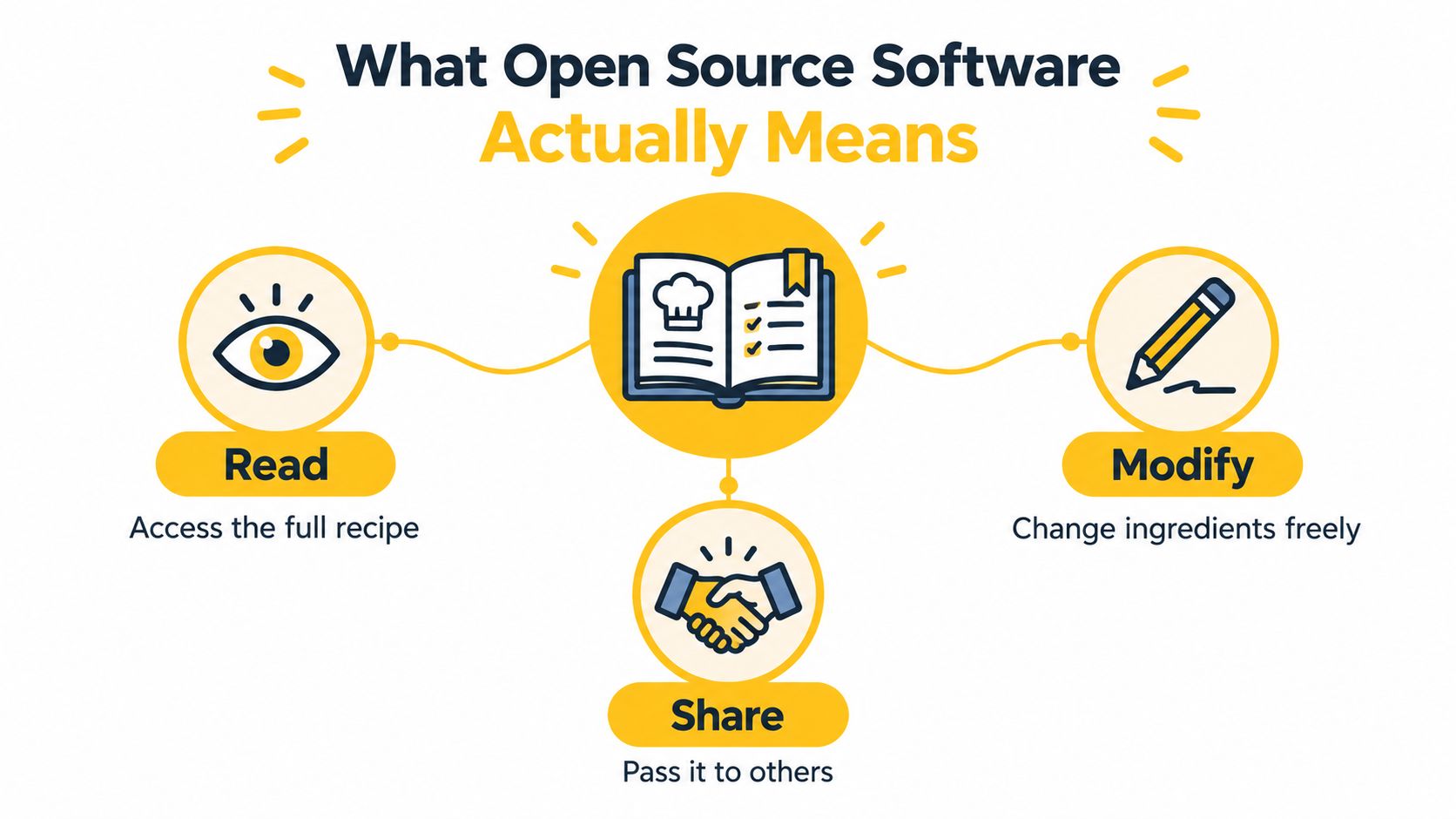
Software works the same way. Open source means the human-readable source code is published under a license that grants you defined permissions. You're not just allowed to run the program. Depending on the license, you can study it, change it, and redistribute your changes.
Licensing is the permission slip
Two families matter most for beginners:
- Permissive licenses: The MIT License is the common example. You can use, modify, and distribute the code, including in commercial products, as long as you keep the copyright and license notice. It's short, and that brevity lowers friction for contributors.
- Copyleft licenses: These also let you use and modify code, but they require distributed derivative work to stay under compatible open terms. The goal is to keep improvements in the commons.
Neither family is automatically better. Permissive licensing maximizes adoption and experimentation. Copyleft protects reciprocity. What matters is that you read the license before you build plans on top of the code.
Here's where newcomers often get confused. Open source doesn't mean the developers owe you support, hosting, or a roadmap vote. It means the code and its license don't lock you out. Governance, funding, and responsiveness are separate questions you still need to ask.
For an MIT-licensed crypto project, the practical effect is easy to picture. Anyone can read the wallet and node code, compile it themselves, propose a patch, or fork it if they disagree with the direction. That permission structure is the foundation underneath every benefit that follows. Without it, transparency is just a marketing word.
Cost Transparency and the Real Price of Free Code
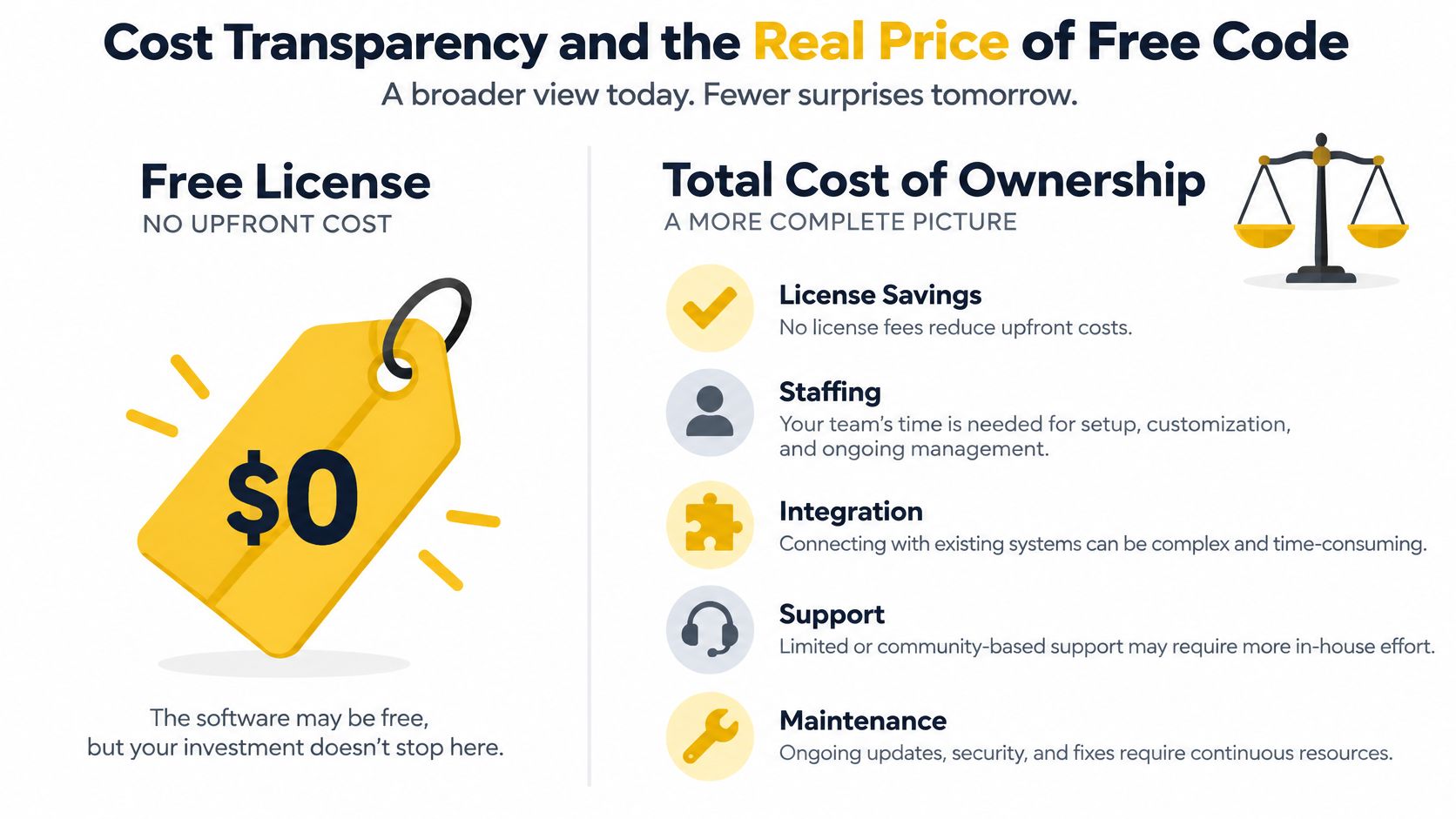
Free code isn't free software to operate. That sentence will save you from most bad open source decisions. You remove or reduce the license line, then you discover the work that a vendor used to bundle invisibly into your subscription.
At economy scale, reuse is where the money logic gets interesting. The European Commission estimated that EU companies invested approximately €1 billion in open source in 2018, generating an impact of €65 billion to €95 billion, an implied ratio above 65:1 at the lower end, according to the European Commission study on open source software impact. That doesn't mean your project gets that return. It shows why shared code can outperform duplicated private effort.
Where Open Source Costs Actually Show Up
| Cost Category | Typical Direction | What to Plan For |
|---|---|---|
| License fees | Usually down | Check license obligations and any paid add-ons |
| Staffing | Often up | Setup, upgrades, tuning, and troubleshooting time |
| Integration | Varies | Connecting wallets, pools, explorers, or internal tools |
| Support | Shifts to you | Community channels, docs, or paid help if available |
| Security review | Must be budgeted | Code review, dependency checks, and incident response |
Survey evidence backs up this more cautious view. Cost savings were the decisive advantage for only 26% of companies, source-code access ranked second at 19%, while broader research values productivity at 86%, reduced vendor lock-in at 84%, and lower ownership costs at 84%, all reported in the German Open Source Monitor 2025.
Planning rule: Ask whether open source is cheaper over three to five years under your staffing and support model, not whether the download costs nothing today.
Running community mining infrastructure makes this tangible. Public code and multiple client options can reduce dependence on a proprietary vendor. You still pay in hardware, electricity, uptime monitoring, documentation reading, and your own time when a node falls behind. Open source changes who pays and when. It doesn't repeal arithmetic.
Security Through Transparent Peer Review
A Cascoin-style mining network shows why visibility alone is weak protection. Say a contributor proposes a change to reward calculation. If that code is public but nobody inspects it, the repository works like an unsecured entrance in an empty building. If maintainers require a pull request, reviewers can read the diff, question edge cases, ask for tests, and stop the merge while the defect is still small.
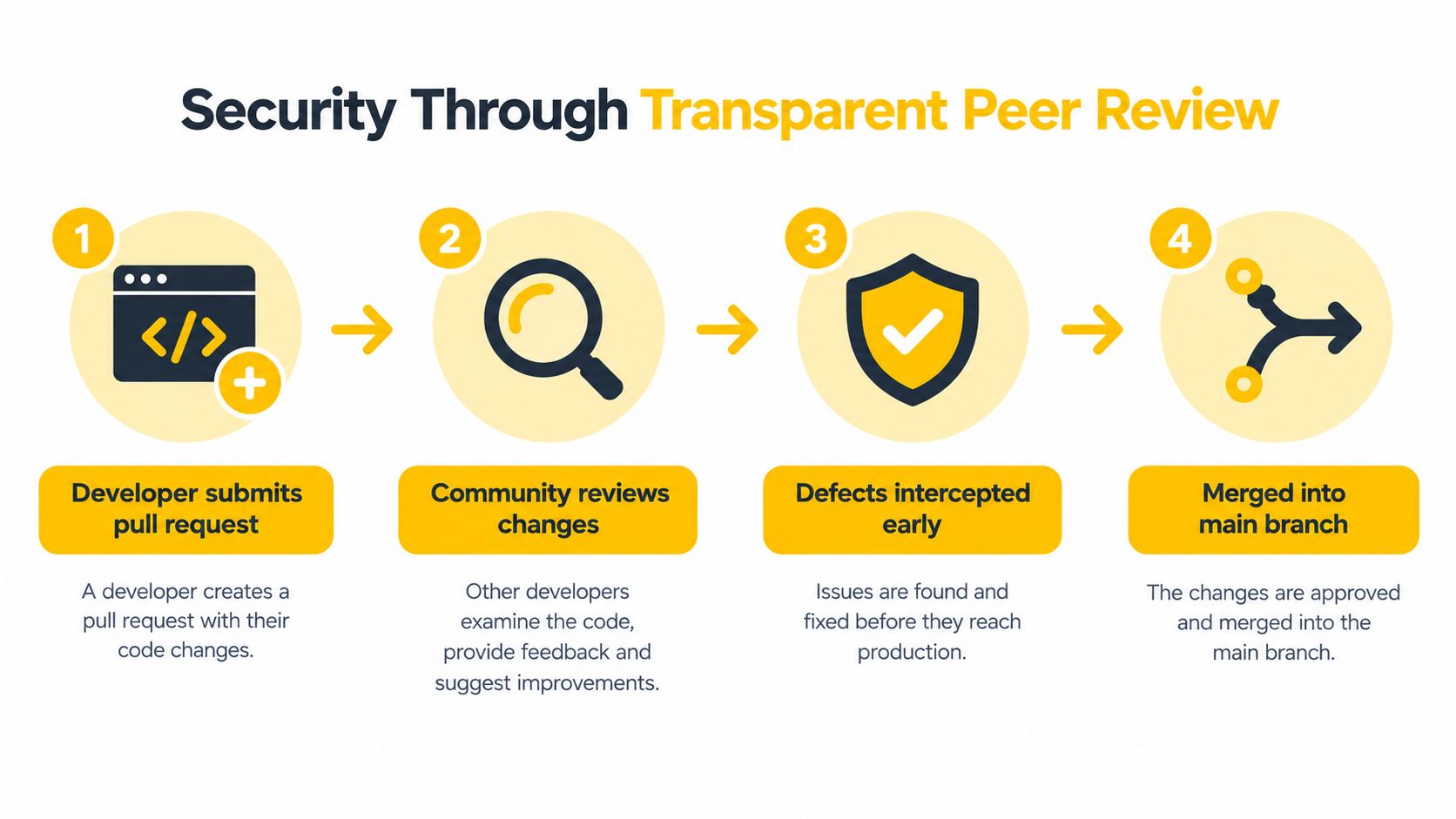
The useful unit is the review loop: proposal, scrutiny, revision, approval, release. Protected branches, mandatory approvals, and regression tests turn outside attention into a gate instead of a gallery.
Evidence supports that gate, with a sharp caveat. In the study of pull request review coverage and security outcomes, greater pull-request review coverage had a statistically significant negative relationship with total software issues and reported security bugs; the same review examined 135,560 review comments in OpenSSL and PHP and found developers fully addressed about 39 to 41% of raised security concerns, acknowledged 30 to 36%, and left 18 to 20% unresolved amid disagreements.
Review earns trust when concerns are tracked to closure. It disappoints when risky code collects polite comments and merges anyway.
For cryptographic or consensus changes, raise the bar: require at least one security-aware maintainer, use a threat-focused checklist, and treat review coverage as a standing metric rather than a release-day hope. If you want to practice that discipline yourself, auditing open source software step by step shows how a reader can inspect a codebase without mistaking a quick skim for an audit.
Mining makes the trade-off concrete. A flawed difficulty adjustment, wallet bug, or reward rule reaches every participant at once, so open review gives miners and developers a chance to challenge sensitive changes before release. That chance has value only when maintainers refuse to merge delicate code on trust alone.
Community Power and the Scale of Modern Collaboration
Community is often described as a vibe. It's better understood as distributed capacity. When code, issues, and discussion are public, work can spread across people who don't share an employer, a timezone, or a job title.
The scale of that capacity is now enormous, as the photo below suggests in human terms.

GitHub reported more than 5.2 billion contributions across over 518 million open-source, public, and private repositories in 2024, with nearly 1 billion contributions going specifically to open-source and public repositories, according to GitHub's Octoverse 2024 report. Organizations also invest substantial labor in this ecosystem, which is why open source now functions as strategic infrastructure rather than a hobbyist side channel.
Signals that community capacity is real
Don't count stars and stop there. Look for evidence that strangers can contribute successfully:
- Review activity: Pull requests receive timely, substantive comments instead of sitting untouched.
- Contributor diversity: Fixes and docs come from more than one person or one company.
- Governance clarity: Newcomers can find out who merges code, how releases happen, and where to ask questions.
- Lowered entry ramps: Good first issues and setup guides exist. A beginner-friendly route like making your first open source contributions helps turn curious users into useful contributors.
The short video below gives additional context on how collaborative development works in practice.
A small crypto project stewarded by one developer plus outside contributors sits at the fragile end of this spectrum. Public repositories and open chat create a credibility loop because users can verify behavior and propose fixes. The loop only holds if contributions are welcomed, reviewed, and merged visibly. Participation alone doesn't guarantee quality, but a closed project gives you no loop at all.
Real-World Flexibility in a Crypto Mining Project
A laptop owner, an ASIC operator, and a miner watching power costs can all reach the same Cascoin network through different doors. That is the concrete version of open source flexibility: the software is public enough that participation can be shaped around hardware, energy priorities, and risk tolerance.
Cascoin is an open-source cryptocurrency built around Labyrinth Mining, a gamified model in which lightweight client software simulates mice moving through a virtual maze to collect cheese. The project presents it as a more energy-conscious alternative to a pure hash race, and the public code lets a curious miner inspect how the client behaves instead of trusting a landing page.
The routes are easiest to read as trade-offs:
| Route | Practical fit | What public code changes |
|---|---|---|
| Labyrinth Mining | Recommended for participants who want the gamified, efficiency-focused route | Reward and client logic can be inspected before hardware is pointed at the network |
| MinotaurX | Beginners or ordinary CPUs seeking lower-power participation | Users excluded by specialized-machine designs still get a plausible path |
| SHA-256 | Experienced ASIC operators with existing hardware | Familiar work can be compared against power and cooling costs without abandoning prior investment |
A common confusion is to treat code review as the whole audit. It is only half. Public code says what the software should do; Casplorer, the public block explorer, shows what the network recorded. One without the other leaves room for a dishonest operator.
The cost is real. More paths mean more code to test, document, and secure, and a closed vendor could hide that complexity behind one polished download. The trade is that users give up the ability to verify reward logic or adapt the client. In a young crypto network, where trust has not had years to accumulate, that verification is what lets a stranger decide whether the network deserves their hardware at all.
The Limits of Open Source and How to Spot Them
A repository can look busy and still be fragile. Releases ship on time, issues get polite answers, the README inspires confidence; then the single maintainer takes a job, gets sick, or loses interest, and the review queue turns into a locked door. Open code makes the weakness visible only if you know where to look.
The visibility is the point. A University of California survey of 294 contributors across ten campuses found documentation time was the leading challenge and funding support the most desired intervention, while a European assessment reported six of ten maintainers worked without compensation, three received compensation insufficient for full-time work, and three worked alone, as summarized in the University of California open source contributor survey.
Read a project like an operations review rather than a homepage. Ask who can merge during an emergency, who holds release credentials under documented controls, whether security reports have a route and a clock, and whether new users can get from clone to build without private knowledge. Thin docs are not a cosmetic flaw; they push the learning cost onto every newcomer and slowly narrow the contributor pipeline.
Licensing sits in the same audit because legal permission and practical capacity often get blurred: what the MIT License actually permits explains the freedom to use and change code, while maintainers still decide whether your patch gets reviewed. When a tool claims its source or behavior is verifiable, AuricIDE source verification answers give a useful outside frame for testing that claim.
Public code shows intent. Sustained review, succession, and funding show whether intent can survive contact with time.
For Cascoin, the MIT license, public repositories, multiple mining clients, and explorer mark the first checkpoint of diligence. Solo-developer stewardship makes contributor growth, documentation depth, and contingency planning fair questions. Naming those limits can strengthen the earlier benefits by turning them into conditions you can check before hardware, budget, or reputation is committed.
Choosing Open Source With Eyes Open
You don't need a philosophical position on open source. You need a decision lens you can reuse. Start with the job the software must do, then test whether openness gives you a concrete advantage for that job.
A compact evaluation checklist
- Read the license first: Confirm you can use, modify, and redistribute the code in the way your project requires.
- Inspect the review trail: Look at recent pull requests. Are sensitive changes challenged, tested, and merged by more than one person?
- Price the whole system: Add staffing, integration, hardware, support, and security review to the zero license fee.
- Check community health: Review release cadence, maintainer concentration, documentation quality, and how newcomers are treated.
- Verify claims independently: Compile from source if you can, compare behavior against public data, and read unresolved issues before you commit.
- Plan your exit: Open formats, stable interfaces, and forkability protect you if governance changes.
The mining project discussed above passes some of these tests in ways you can observe directly. Its MIT licensing, public repositories, multiple mining clients, and public explorer make inspection possible. Its small stewardship base means you'd reasonably watch contributor growth and documentation before treating it as mature infrastructure. Both observations can be true at once, and holding both is exactly what evaluating open source software benefits with eyes open looks like.
Participate responsibly once you choose. Report bugs with reproduction steps. Improve one confusing paragraph in the docs. Review a small patch in your area of competence. Those contributions are how users stop shifting unpaid labor onto a handful of maintainers and start sharing the maintenance that the benefits depend on.
Open source earns its reputation when transparency changes behavior, yours included. Choose it for inspectability, control, and reuse. Budget for the work it reveals. Then help carry a small part of that work.
If you want to see these principles in a live, inspectable network, explore the public code, mining options, and block explorer offered by Cascoin, then decide for yourself whether its Labyrinth Mining, MinotaurX, or SHA-256 route fits your hardware. Read the documentation, verify activity on-chain, and join the community discussion before you point any machine at the network.