Crypto Mining Power Consumption: Cut Energy Costs in 2026
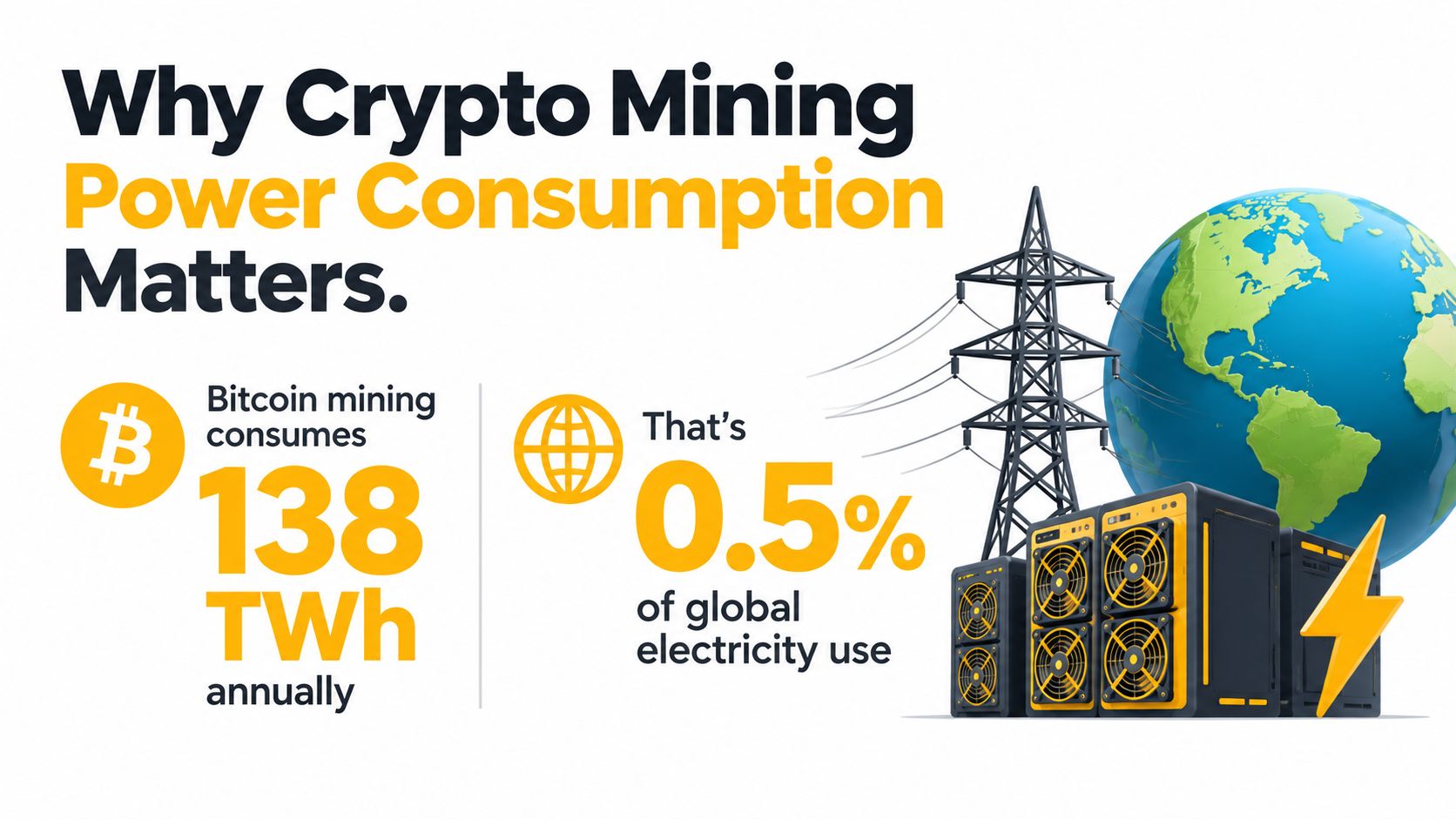
Bitcoin mining consumed approximately 138 TWh of electricity annually, about 0.5% of global electricity use. That scale makes crypto mining power consumption a practical operating concern, not just an environmental talking point.
A mining setup turns electricity into computational work, and the useful question isn't just how many watts a machine draws. The better question is: how much energy does it need to produce a valid contribution, a reward, or a dollar of mining output? A powerful ASIC can deliver huge hashrate while consuming more electricity than a CPU-based method. A low-power device can look efficient on paper but perform poorly if its reward probability is extremely low.
The difference matters for beginners, home miners, and industrial operators alike. Once you measure electricity at the wall, include cooling and idle loads, and compare reward per kilowatt-hour, mining choices become much easier to evaluate.
Table of Contents
- Why Crypto Mining Power Consumption Matters
- What Drives Mining Energy Use
- How to Measure and Estimate Your Energy Costs
- Comparing Mining Methods by Efficiency
- Practical Steps to Reduce Mining Power Consumption
- Cascoin Case Study in Low-Power Mining
- How to Get Started Responsibly with Low-Power Mining
Why Crypto Mining Power Consumption Matters
Bitcoin's electricity demand shows what proof-of-work security looks like at network scale. The Cambridge Centre for Alternative Finance estimated annual Bitcoin consumption at approximately 138 TWh, equivalent to about 0.5% of global electricity use, with associated emissions of roughly 39.8 million tonnes of CO₂-equivalent. Those figures describe Bitcoin, not every cryptocurrency, but Bitcoin remains the clearest reference point for understanding energy-intensive mining. Cambridge's assessment of Bitcoin mining energy use places the discussion in a useful context.
A network with that electricity demand behaves more like an industrial load than a conventional software service. Machines run continuously, operators compete against changing difficulty, and facilities need power delivery, ventilation, networking, and maintenance. The electricity bill therefore affects both the miner's economics and the surrounding grid.
The same wattage can produce different results
Suppose two miners each consume similar power. One performs a workload with a relatively strong chance of earning rewards, while the other contributes to a much more crowded network. Their devices may have similar readings on a power meter, yet their energy per useful outcome can differ sharply.
That distinction is why a total network number should be the starting point, not the ending point. Network-wide consumption tells us that the system has a material footprint. It doesn't tell a home miner whether a particular CPU, GPU, ASIC, or alternative algorithm makes sense.
Practical rule: Measure the electricity required for the result you care about, not just the electricity required to keep a machine switched on.
A responsible miner should track three things: wall-plug power, operating time, and useful output. Output might mean accepted shares, expected reward, or revenue at a stated market price. Each measure answers a different question, and none should be confused with raw hashrate.
For a broader discussion of how cryptocurrency activity affects energy systems, see this overview of cryptocurrency environmental impact. The central lesson is straightforward: understanding what drives consumption lets miners choose equipment and participation models with fewer surprises.
What Drives Mining Energy Use
A mining rig's electricity demand comes from more than the number printed on its product page. Four variables matter most: hardware efficiency, workload design, facility overhead, and electricity conditions.
Hardware efficiency sets the baseline
ASIC efficiency is commonly expressed in joules per terahash, or J/TH. The unit describes how much energy a machine needs to perform one trillion SHA-256 calculations. The Antminer S9 was reported at approximately 98 J/TH, while leading commercial machines were reported at roughly 13 to 15 J/TH by 2026. At a fixed hashrate, that improvement can reduce electrical demand by about 85%. This hardware efficiency comparison also explains why chip efficiency shouldn't be confused with total facility consumption.
A simple example makes the difference clear. Producing 100 TH/s would require approximately 9.8 kW at 98 J/TH, compared with about 1.35 to 1.5 kW at 13.5 to 15 J/TH, before cooling and auxiliary loads. Those values are theoretical device requirements, so a real installation must measure power at the wall.
The algorithm determines the kind of work
SHA-256 ASICs are designed for one narrow computational task. Their specialization creates enormous performance on compatible networks, but the machines draw substantial power and offer little flexibility outside that workload.
Other designs emphasize memory access, general-purpose computation, or lightweight participation. They may deliver less raw hashrate, yet that isn't automatically a disadvantage for someone comparing watts per accepted contribution. A CPU-friendly method can be more appropriate for a small home setup than an ASIC built for a large facility.
Cooling adds another layer. Fans, air conditioning, immersion equipment, power supplies, routers, and control systems all consume electricity. A miner that reports only chip draw can understate the energy needed to operate the complete installation.
Location changes the operating equation
Two identical machines can have different practical footprints because they run in different climates and on different grids. A cooler environment may reduce cooling work, while local electricity prices determine whether the equipment can operate economically. The generation mix also affects the emissions associated with each kilowatt-hour.
The right comparison therefore records wall-plug watts, temperature, uptime, cooling load, and local electricity price. A manufacturer's J/TH figure is useful for comparing chips, but it isn't a complete operating measurement.
How to Measure and Estimate Your Energy Costs
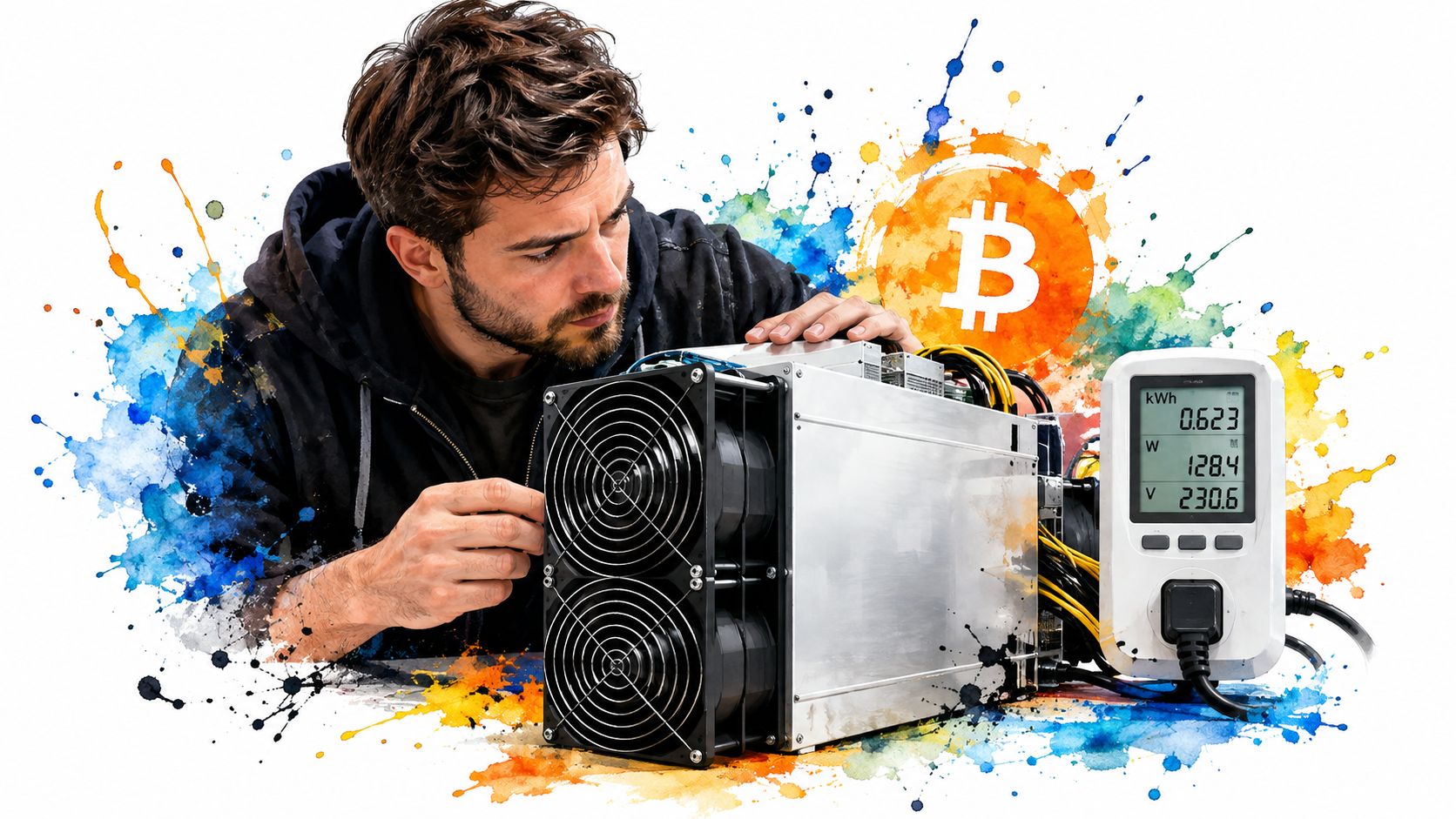
Start with a wall-plug measurement. A suitable power meter can show the actual draw of a miner, including the power supply and some connected equipment. For a larger installation, dedicated electrical monitoring or sub metering for property owners can separate mining loads from the rest of the building.
Record the reading after the machine has reached its normal operating state. Peak draw, startup draw, idle draw, and steady-state draw aren't the same. If cooling equipment sits on a separate circuit, measure it separately rather than assuming the miner's product label includes that load.
Use a simple calculation
The core formula is:
Daily energy in kWh = power in watts × operating hours ÷ 1,000
For example, a device drawing 500 watts for a full day uses 12 kWh. That example is a calculation method, not a claim about any particular mining machine.
To estimate electricity cost:
Daily electricity cost = daily kWh × local electricity price per kWh
Then add the loads that miners often overlook:
- Cooling: Include fans, air conditioning, pumps, or immersion equipment.
- Networking: Routers, switches, and monitoring computers may run continuously.
- Idle consumption: A device can draw power while producing little or no useful work.
- Pool fees: These affect net reward, although they aren't electricity costs.
- Downtime: Divide energy by actual productive operating time, not planned uptime.
Compare energy with useful output
A better efficiency record includes total energy and accepted work. You can calculate:
Energy per accepted result = total joules consumed ÷ accepted results
For reward-based comparisons, use:
Reward per kWh = expected reward ÷ total kWh
Keep the observation period long enough to capture ordinary variation. Short readings can mislead because mining rewards fluctuate and machines may change performance as temperature or network conditions change.
A profitability calculator can help organize electricity price, hardware power, hashrate, and reward assumptions. The mining profitability calculator should support your measurements, not replace them. Use measured wall-plug data whenever possible.
Comparing Mining Methods by Efficiency
Raw hashrate is easy to display and easy to misunderstand. It tells you how much computational work a machine performs, but not how much energy it uses for a useful result. A fair comparison starts with the workload, the reward mechanism, and the electricity required to participate.
| Method | Typical strength | Main energy question |
|---|---|---|
| ASIC mining | High performance on a specific algorithm | Does the reward justify continuous facility-scale power use? |
| GPU mining | Flexibility across compatible workloads | Can the hardware's broader use offset its energy demand? |
| CPU mining | Accessible and relatively modest power draw | Is the reward meaningful relative to low but continuous consumption? |
| Lightweight alternatives | Lower-power participation models | How many watts are needed per accepted contribution? |
SHA-256 ASICs suit operators who can manage specialized equipment, heat, noise, and electricity costs. Their efficiency should be judged at the wall, not only by the chip specification. GPU mining gives users more flexibility, but flexibility doesn't guarantee better reward per kilowatt-hour. The result depends on the network, hardware, difficulty, pool arrangement, and current reward conditions.
CPU mining has a different appeal. A desktop or modest server may be easier to run than an ASIC, and the lower draw can make experimentation less demanding. The trade-off is that lower energy use can come with lower reward probability or output, so the comparison must use a common measure.
Reward per dollar is an imperfect shortcut
A 2025 review reported approximate energy requirements of 5 kWh to generate USD 1 in Bitcoin mining, 2 kWh for Ethereum, 2 kWh for Litecoin, and 4 kWh for Monero. The review's comparison of cryptocurrency energy requirements should be treated as an estimate rather than a permanent benchmark, because prices, difficulty, hardware, pool fees, and issuance change over time.
Those figures illustrate a measurement problem. A method can consume less power per device but still require more energy per reward if its chance of receiving a reward is lower. Conversely, a higher-draw machine may deliver a better result per kilowatt-hour under specific network conditions.
The useful question is not “Which machine uses the fewest watts?” It's “Which method gives this operator the most useful output for each kilowatt-hour?” That answer can change with electricity prices, hardware age, network participation, and reward conditions.
Practical Steps to Reduce Mining Power Consumption
The fastest savings often come from removing wasted runtime rather than buying new equipment. Begin by measuring the complete setup for several ordinary operating periods. Look for idle machines, unnecessary display hardware, avoidable cooling loads, and power supplies that remain active when mining has stopped.
Make the hardware earn its electricity
- Replace inefficient equipment: Compare wall-plug watts per effective hashrate, not the machine's age or advertised speed alone.
- Tune conservatively: Reduce unnecessary clock speed or voltage when the resulting reward loss is smaller than the electricity saved.
- Schedule deliberately: If your tariff changes during the day, operate when electricity is cheaper, provided the change doesn't create excessive cycling or downtime.
- Remove idle loads: Shut down unused GPUs, fans, monitors, and controllers instead of leaving every component on continuously.
- Maintain airflow: Dust and blocked filters increase heat, which can push cooling systems to work harder.
Cooling deserves its own audit. Separate the miner's consumption from ventilation and temperature control, then test whether airflow improvements reduce the combined wall-plug reading. Don't assume a colder room is always more efficient if the cooling equipment consumes more power than it saves.
If your setup uses solar generation or another variable energy source, a practical solar power monitoring guide can help you compare production with mining demand. The useful goal is not to label energy “clean” without measurement, but to understand when supply is available and whether the miner can respond to it.
Choose the energy source with care
A favorable tariff can reduce operating costs, while a grid with lower-carbon generation can reduce associated emissions. Neither choice eliminates the need to measure consumption. A machine that runs longer because electricity is cheaper can still increase total energy use.
Use the guide to reducing power consumption as a checklist for equipment, cooling, scheduling, and monitoring decisions. Small changes matter most when they operate continuously, and they should be judged by measured kWh rather than by assumptions.
Cascoin Case Study in Low-Power Mining
Cascoin approaches mining through a different design idea. Its lightweight client software simulates mice navigating a virtual maze to collect cheese, rather than relying only on a conventional brute-force hash race. The project describes this Labyrinth Mining model as delivering up to 3x higher rewards compared with traditional approaches while consuming less power, and it also offers CPU-friendly MinotaurX options.
That description doesn't mean every user will receive the same outcome. Reward probability, network conditions, hardware, uptime, and electricity prices still matter. The useful point is that the design changes what a miner measures. Instead of asking only how many hashes a device produces, the operator can examine how much energy the client uses for useful maze participation and resulting rewards.

Three participation profiles
The practical contrast is between workload types:
- Labyrinth Mining: A lightweight, gamified model focused on low-power participation.
- MinotaurX: A CPU-friendly option for users who want accessible mining without dedicated ASIC hardware.
- SHA-256: An ASIC-oriented path for experienced operators with equipment and power infrastructure suited to that workload.
This gives users a choice based on constraints rather than a single performance target. Someone testing mining on an existing computer may care most about low additional power draw. An ASIC operator may prioritize specialized throughput and already have a facility designed for heat, noise, and electrical demand.
Transparency also affects responsible evaluation. Cascoin presents publicly available code, downloadable wallets, a public pool, and on-chain activity that can be checked through its block explorer. Those features let users inspect the software and verify activity instead of treating energy or reward claims as matters of trust alone.
A careful test would measure the client at the wall, note CPU utilization, record uptime, and compare accepted results with total kWh. That process makes Labyrinth Mining or MinotaurX comparable with other workloads without promising profitability. The method may suit people who want to explore a lower-power, community-oriented model, while SHA-256 remains relevant for miners who already operate compatible ASIC hardware.
How to Get Started Responsibly with Low-Power Mining
Start with your electricity facts. Check your tariff, identify the circuit you'll use, and measure the device at the wall. Decide whether your priority is learning, contributing to a network, experimenting with a CPU, or operating specialized hardware. That decision matters more than chasing a headline hashrate.
Then choose a method that matches your equipment and tolerance for power use:
- Set up a wallet using the project's documented download process.
- Choose a workload that fits your hardware, such as a CPU-friendly option or a specialized ASIC method.
- Join a public pool if pooled participation suits your goals.
- Record watts, uptime, accepted work, and rewards in a simple spreadsheet.
- Review the result regularly and stop or tune the setup if the energy use no longer makes sense.
Don't treat mining rewards as guaranteed income. Prices, difficulty, participation, fees, and reward conditions can change, so an energy-aware miner evaluates the setup using measured data rather than promises.
Open-source code, public documentation, community discussion, and verifiable on-chain activity can help you learn how a network works. The responsible path is small, measured, and reversible. Start with equipment you already understand, monitor its real consumption, and scale only when the results justify the additional electricity.
Cascoin offers Labyrinth Mining, CPU-friendly MinotaurX, and SHA-256 participation options with different hardware and energy profiles. Visit Cascoin to review the available tools, documentation, and community resources, then test your chosen method with a wall-plug meter and track reward per kilowatt-hour.