Safe Wallet Crypto: A Practical Guide to Real Security
You're halfway through a low-power Cascoin mining session when a browser pop-up offers a reward claim. It looks familiar, the wording is urgent, and the wallet asks you to approve a token permission. You click before checking the destination or the permission scope. The wallet hasn't been “hacked” in the usual sense, but you may have just authorized someone else to move assets.
That moment captures the meaning of safe wallet crypto. Security isn't only about choosing a hardware device or installing a reputable app. It's a daily operating discipline built around private-key handling, recovery, software verification, and careful transaction signing.
Table of Contents
- Why Most Crypto Losses Start Long Before a Hack
- What a Safe Crypto Wallet Actually Means
- Comparing Wallet Types Against Real Threat Models
- Seed Phrase Handling That Actually Works
- Reading What You Sign Before You Sign It
- Verifying Open-Source Wallets and On-Chain Reality
- Wallet Safety for Eco-Conscious and Low-Power Miners
- The Safety Checklist and the Real Trade-Off You Are Making
Why Most Crypto Losses Start Long Before a Hack
A miner often thinks about security after something goes wrong. The more useful question is what happens during ordinary work: downloading a wallet, connecting to a pool, checking a payout, opening a block explorer, or claiming a reward. Each action can expose a user to a fake download, a malicious website, a copied address, or a transaction that looks harmless but grants sweeping permission.
Personal wallets have become a much larger part of stolen crypto. Chainalysis reported that personal-wallet compromises represented 7.3% of stolen cryptocurrency value in 2022, rising to 44% in 2024. In its 2025 mid-year assessment, attacks on personal wallets accounted for 23.35% of stolen-fund activity, with approximately 80,000 unique victims affected during that year. Losses from individual-wallet attacks were estimated at $713 million in 2025, compared with $1.5 billion in 2024, suggesting that criminals were increasingly conducting many smaller attacks instead of relying only on spectacular breaches. These figures are reported in Chainalysis's assessment of crypto hacking and stolen funds.
For a Cascoin miner, the practical lesson is simple. The wallet can be based on sound cryptography, the code can be public, and the chain can operate as designed, yet a user can still lose funds by revealing a recovery phrase or approving the wrong contract. A public address may be visible without exposing private keys, but anyone who obtains the signing credentials can authorize an irreversible transfer.
Practical rule: Treat every unexpected wallet prompt as a security decision, not as a routine click.
A safer routine asks four questions before any approval:
- What am I authorizing? Is this a payment, a token approval, a message signature, or a contract interaction?
- Who receives control? Does the destination match the intended service, and does the permission make sense?
- Which wallet is connected? A daily interaction wallet shouldn't also hold long-term savings.
- Can I verify the action elsewhere? Use the signing device's display and a trusted block explorer instead of relying only on a browser tab.
The rest of the process follows from this idea. A safe wallet isn't a magical container. It's a controlled system for creating, storing, using, recovering, and eventually retiring private keys.
What a Safe Crypto Wallet Actually Means
A wallet doesn't store coins in the way a physical wallet stores cash. The blockchain records balances and transactions. The wallet manages the private keys that create valid signatures authorizing changes to those records.
That distinction matters because a wallet app can be deleted while the blockchain balance remains intact. The reverse is also true: if someone obtains the private key or recovery phrase, they may control the assets even when the original app, computer, or device is still in your possession.
The private-key lifecycle
NIST's key-management guidance explains that cryptographic protection can be defeated by poor key management. A complete process includes generation, storage, distribution, use, deactivation, and destruction, as described in the NIST guidance on cryptographic key management.
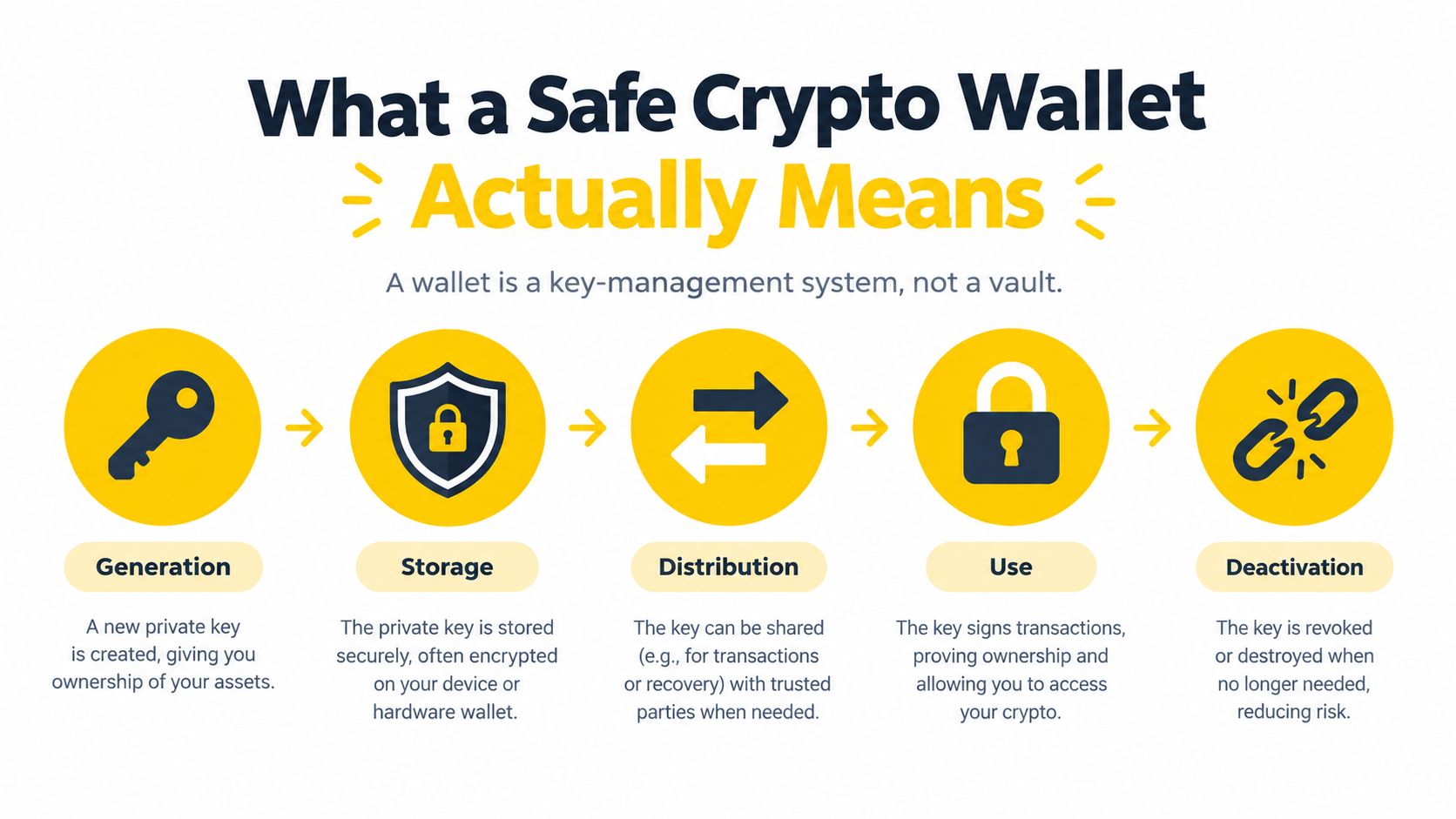
Think of the lifecycle as a set of doors:
- Generation: The wallet creates signing material using a trusted implementation and a cryptographically secure random source. If the source is weak or manipulated, later protection can't repair the original defect.
- Storage: Long-term keys should have as little exposure as possible. Offline or isolated storage reduces the opportunities for malware to copy them.
- Distribution: Every copy increases the number of places that need protection. Cloud notes, screenshots, email drafts, and unencrypted files turn a recovery backup into an attack surface.
- Use: Signing is an active event. A secure key can still authorize a harmful transfer if the user confirms the wrong address or contract.
- Deactivation and destruction: Retired keys, temporary exports, and obsolete backups shouldn't remain on connected computers or in forgotten folders.
A custodial wallet delegates private-key control to an exchange or other service. The provider manages account security, recovery processes, and often compliance controls. A self-custody wallet, also called an unhosted wallet in regulatory discussions, gives the individual direct control of the signing keys.
The Financial Action Task Force's 2019 guidance extended the wire-transfer travel rule to virtual assets and virtual-asset service providers. The rule primarily concerns regulated intermediaries that collect, transmit, retain, and make available identifying information about transfer originators and beneficiaries. Wallet-to-wallet activity outside a regulated intermediary generally falls outside the rule's direct scope, as explained in the Basel Institute's FATF resource.
That regulatory distinction doesn't decide which model is safer. Custody reduces some personal recovery burdens but introduces reliance on a third party. Self-custody removes that counterparty but makes you responsible for backups, devices, approvals, and continuity.
For a practical explanation of wallet protection and setup, Cascoin users can also consult this cryptocurrency wallet security guide. Teams handling user authentication may find a broader comparison useful too, especially when evaluating alternatives that replace Clerk and Cognito in adjacent application workflows. The common principle is the same: identify who controls secrets, where those secrets exist, and how access is recovered.
Comparing Wallet Types Against Real Threat Models
Wallet types make more sense when matched to a job. A miner receiving routine payouts has a different exposure pattern from someone protecting long-term savings. A developer testing software needs isolation from both, because experimental contracts and unfamiliar binaries deserve their own boundary.
A hardware wallet keeps signing keys in a dedicated device and usually shows transaction details on a trusted screen. It can reduce exposure to computer malware, but it can't protect a phrase that was photographed or a transfer approved to the wrong address. A software wallet is convenient for mining and regular payments, yet its keys interact more directly with an operating system, browser, or phone.
Custodial wallets simplify recovery through an account provider. That convenience comes with platform, account-access, and service-continuity risk. Non-custodial wallets provide direct control, but the user must maintain the recovery process. Paper backups can remove digital exposure, though they can burn, decay, be discovered, or become impossible for heirs to interpret. Multisig arrangements distribute approval across multiple signers, which can help organizations or families, but they also require careful coordination and documented recovery.
| Wallet Type | Best For | Primary Risk | Cascoin Fit |
|---|---|---|---|
| Hardware | Long-term holdings and deliberate signing | Device supply-chain issues, lost recovery material, or approval mistakes | Useful as an external signer where supported |
| Software | Mining payouts, testing, and routine activity | Malware, phishing, copied addresses, and browser exposure | Suitable for a low-balance mining wallet |
| Custodial | Users prioritizing provider-managed access | Counterparty failure, account restrictions, and platform dependence | Consider only when the custody trade-off is understood |
| Non-custodial | Direct ownership of keys | Irreversible loss through poor backups or careless signing | Fits users who can manage recovery procedures |
| Paper | Offline record of key material | Physical damage, theft, and difficult recovery | Better treated as a carefully protected backup, not a complete operating setup |
| Multisig | Shared treasury or multi-person control | Lost signers, coordination errors, and configuration mistakes | Appropriate for teams managing shared funds |
A low-power Cascoin setup may use lightweight wallet software for daily Labyrinth or MinotaurX activity, while accumulated funds remain in a more isolated arrangement. SHA-256 operators may have different hardware and payout workflows, but the separation principle still applies: the wallet that interacts frequently shouldn't automatically hold everything.
If you're considering paper-based storage, read a detailed guide to offline crypto storage before treating printed key material as a complete solution. The format is only one part of the design. You still need controlled generation, safe storage, recovery testing, and a plan for eventual access.
The right default is personal. Choose based on the threat you face most often, not on a feature checklist. Convenience is valuable for low-value activity. Isolation is valuable for long-term holdings. Shared control is valuable when one person shouldn't be able to move organizational funds alone.
Seed Phrase Handling That Actually Works
A recovery phrase is often the most important object in a self-custody setup. It can reconstruct the wallet's private keys, so anyone who obtains it may gain signing authority. Anyone who loses it, along with the relevant device and other recovery options, may lose access permanently.
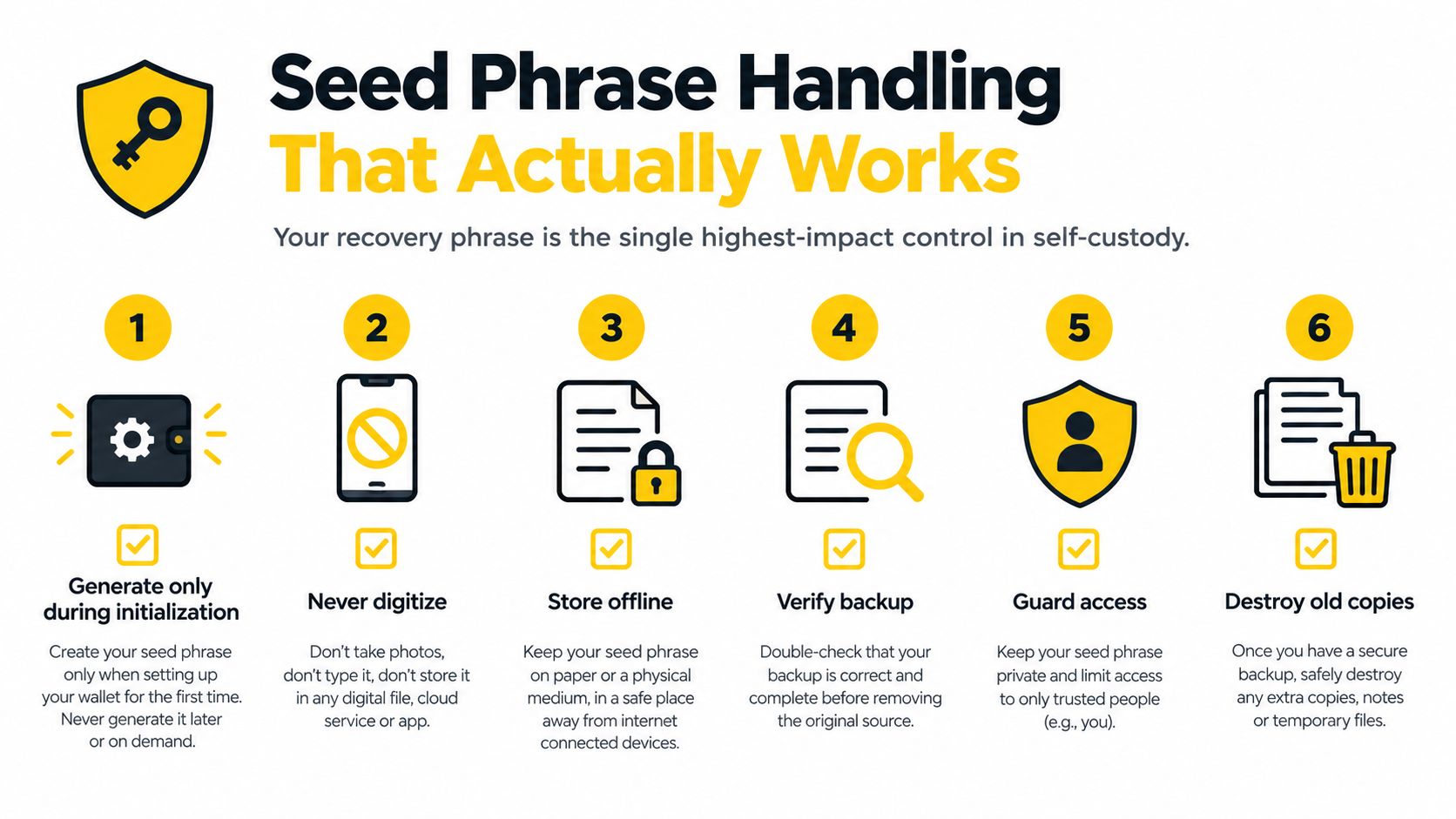
Generate the phrase only during wallet initialization. A legitimate wallet shouldn't arrive with a recovery phrase already written out for you. If a device or seller supplies one, assume someone else may know it and create a fresh wallet from trusted entropy instead.
A recovery procedure you can test
- Initialize privately. Create the phrase in a controlled environment, following the wallet's official instructions.
- Verify on a trusted display. If the wallet provides a hardware screen, compare the phrase there rather than trusting a possibly compromised computer.
- Record it offline. Write it on a durable medium. Don't photograph it, type it into a computer, store it in cloud notes, or send it through messages.
- Test restoration. Before depositing meaningful funds, restore the wallet on a second trusted device or a separate test setup. Confirm that the expected address appears.
- Separate backups. Keep durable copies in geographically separate, access-controlled locations so one incident doesn't destroy every copy.
- Destroy obsolete material. Remove temporary exports, discarded drafts, and old recovery records that could reveal the same signing authority.
Testing restoration doesn't mean repeatedly exposing the phrase. Perform a controlled verification, then return the phrase to secure offline storage. The purpose is to confirm that your written record is legible and complete, not to create another digital copy.
Backup planning also needs a human continuity plan. Ask who could access the funds if you were unavailable, what instructions they would need, and how to avoid placing the phrase beside an internet-connected device. Practical guidance on why regular backups matter can help frame backups as an ongoing responsibility rather than a one-time task.
If you suspect exposure, don't wait for a visible theft. Treat the wallet as compromised, create a new wallet from fresh entropy, and move assets after verifying the destination carefully. The Cascoin wallet setup guide can help users review the basic initialization process, but recovery decisions should always follow the official software and device documentation.
Reading What You Sign Before You Sign It
Storage protects keys at rest. Signing protects, or endangers, funds during action.
A token approval may allow a contract to spend tokens on your behalf. A malicious signature may authorize an operation that isn't obvious from the page's headline. Address-substitution malware may replace an address copied from a trusted source with one controlled by an attacker. In each case, the cryptography can work exactly as designed while the user authorizes the wrong outcome.
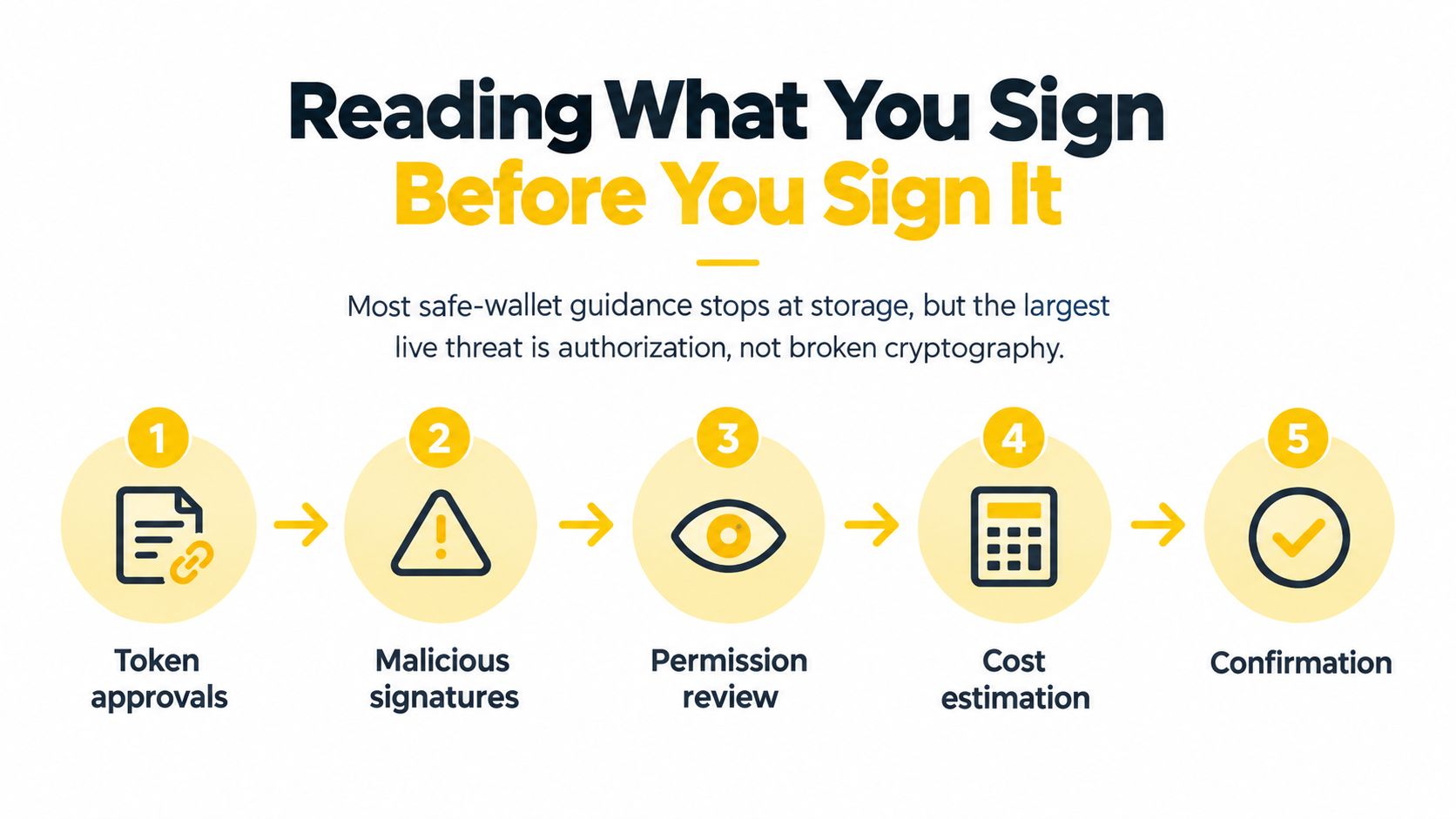
Before confirming, pause and inspect:
- The action type: Is it sending funds, approving spending, signing a message, or interacting with a contract?
- The destination: Compare the full address on the trusted signing device, not only the shortened version in a browser.
- The amount and asset: Check the exact asset, amount, network, and fee. A familiar website can still prepare an unfamiliar transaction.
- The permission: For an approval, determine what can spend your tokens and whether the scope is necessary.
- The context: If the prompt appeared after an unsolicited message, pop-up, giveaway, or reward claim, close it and verify the service through an independently opened official channel.
The signing device's screen matters because a compromised browser can display one address while passing another address to the wallet. A hardware signer won't make a bad decision for you, but it gives you a separate place to inspect the transaction.
Before you approve: If you can't explain the transaction in plain language, don't sign it.
Scam Sniffer data reported that wallet-drainer phishing losses fell 83% year over year, from nearly $494 million in 2024 to $83.85 million in 2025, yet 106,106 victims still lost funds globally and the reported average loss per victim was about $790, according to CoinCentral's report on the data. Lower aggregate losses don't make an individual approval safe by default.
Use separate wallets for separate jobs. A low-balance interaction wallet can connect to unfamiliar applications. A holding wallet can remain disconnected except when funds are deliberately moved. A testing wallet can absorb mistakes without exposing mining proceeds or long-term savings.
If you've already interacted with a suspicious site, review and revoke dangerous approvals where the relevant network supports that function. Then move assets to a fresh wallet if the recovery phrase or signing authority may have been exposed. A secure wallet is only one component. The operating procedure around it determines what gets authorized.
Verifying Open-Source Wallets and On-Chain Reality
Open source helps users inspect software, but public code doesn't remove the need to verify what they download. An attacker can imitate a project website, package a modified installer, or place a convincing link in a search result. Download wallet software through the project's verified channels, then compare checksums or signatures when maintainers provide them.
Start with the release itself:
- Confirm the project identity. Check that the repository and download page belong to the expected project.
- Match the release version. Compare the installer name and version with the project's release notes.
- Validate integrity. Use published checksums or signatures according to the project's documentation.
- Review changes. Look for dependency updates, new permissions, and changes affecting wallet storage or transaction signing.
- Test with limited value. Open the software with a low-balance wallet before using it for significant holdings.
- Confirm the chain record. Use Casplorer to compare addresses, transactions, confirmations, and payout destinations with what the wallet reports.
A block explorer doesn't reveal private keys. It lets you inspect public on-chain facts, such as whether a transaction exists and which address received it. That makes it useful for separating a wallet display problem from a network or payout problem.
Cascoin's open-source approach gives users and contributors a basis for reviewing implementation details through public Codeberg and GitHub repositories. The downloadable Core Wallet supports Windows, macOS, and Linux, while the project's public materials describe wallet security, mining, and network use. Readers interested in the broader principles can also review this open-source software audit discussion.
Verification should remain proportional to the action. A routine balance check doesn't require the same scrutiny as installing a new signer or importing recovery material. For every high-impact change, preserve the release information, verify the source, and use a test wallet first.
Wallet Safety for Eco-Conscious and Low-Power Miners
Mining creates a repeated cycle of payouts, wallet access, and public address reuse. That routine can tempt users to keep their main holdings in the same wallet that runs continuously beside mining software. Separation reduces the consequences of a compromised mining environment.
A practical arrangement has three layers:
- Interaction wallet: Holds a limited balance for pool payouts, routine transfers, and low-value activity.
- Holding wallet: Receives accumulated funds and stays offline or disconnected except during deliberate transfers.
- Testing wallet: Handles new software, unfamiliar tools, and experiments without touching either operational balance.
For Labyrinth Mining and MinotaurX users, the mining device can remain focused on lightweight participation while a separate device handles larger transfers. SHA-256 operators can apply the same pattern even when their mining hardware and payout frequency differ. The important boundary is between a machine exposed to regular activity and a signer used for long-term funds.
Use a fresh receiving address when your wallet supports that workflow and your accounting process can track it. Don't publish recovery material to troubleshoot a payout. Instead, check the transaction and destination through Casplorer, compare the address carefully, and contact the relevant pool through an independently verified channel if something doesn't match.
Low-power mining makes disciplined custody practical because the workflow can remain simple: mine with one wallet, sweep accumulated rewards to a more isolated wallet, and inspect every large transfer on the signing device. The chain's ecological or gamified design doesn't change the private-key rules. A lightweight client still needs verified software, controlled backups, and a clear separation between earning and storing.
The Safety Checklist and the Real Trade-Off You Are Making
A safe wallet routine should leave you with five clear answers:
- Wallet model: Do you know who controls the private keys?
- Recovery: Is the phrase generated privately, stored offline, and tested without digitizing it?
- Signing: Can you verify the full destination, amount, asset, and permission on a trusted display?
- Software: Did you download from a verified channel and check the release integrity?
- Separation: Are mining, experimentation, daily interaction, and long-term holdings kept apart?
Self-custody removes a major counterparty risk, but it adds an irreversible personal-administration risk. No developer or support team can reset access when both the device and recovery material are gone.
Cascoin offers an open-source Core Wallet, low-power mining options including Labyrinth Mining and MinotaurX, and public on-chain verification through Casplorer. Visit Cascoin to review the wallet resources, verify the project channels, and build a mining setup that treats key management and transaction signing as part of the workflow.