Sustainable Cryptocurrency: A Guide for 2026
A sustainable cryptocurrency minimizes absolute energy use, prioritizes verifiable clean-energy provenance, and limits environmental harm beyond simple power-consumption claims. Ethereum's transition to proof-of-stake reduced its estimated energy consumption by approximately 99.95%, while Bitcoin's 2018 network activity was estimated to consume 31.29 TWh and produce approximately 17.29 million tonnes of carbon-dioxide equivalent emissions.
Those figures reveal why the subject needs more than a list of “green” coins. A network can use less electricity per participant and still draw power from a carbon-intensive grid, create local air pollution, discard short-lived hardware, or publish claims that nobody can independently check. Conversely, a network using more electricity may still improve its profile if it reports its energy sources clearly, operates during periods of surplus generation, and accounts for equipment and local effects.
Sustainability is therefore a systems question. Consensus design, mining hardware, validator requirements, electricity provenance, geographic concentration, governance, and community behavior all shape the final impact. This guide explains how those pieces fit together, then applies a practical scorecard to real participation choices.
Table of Contents
- What Is Sustainable Cryptocurrency
- Consensus Mechanisms and Environmental Trade-offs
- Why Low Energy Use Is Not the Same as Low Environmental Impact
- Building a Transparent Sustainability Scorecard
- Technical Approaches and Real-World Case Studies
- How to Evaluate and Join Sustainable Projects
- Community, Policy, and the Future of Green Crypto
What Is Sustainable Cryptocurrency
Sustainable cryptocurrency is a digital currency network designed and operated to reduce its total environmental impact while preserving useful security, participation, and governance. That definition includes three connected questions: how the network reaches agreement, what resources participants consume, and whether the project can prove its environmental claims.
Consider two miners using the same amount of electricity. One operates where additional demand is supplied by renewable generation that would otherwise be curtailed. The other operates beside a fossil-fuel plant that increases output to meet mining demand. Their electricity totals may look identical, but their marginal emissions, local air quality effects, and pressure on the grid can differ sharply.
The equipment matters too. A low-power algorithm may reduce operational demand, but a short hardware lifespan can create electronic waste and shift environmental costs into manufacturing and disposal. A fair assessment must examine the whole operating model, not just the wattage shown by a mining application.
A practical definition
A project deserves serious sustainability analysis when it can explain:
- Consensus design: Whether security depends on continuous computation, staked assets, or another mechanism.
- Energy provenance: Where electricity comes from, when participants use it, and whether the reported supply is independently verifiable.
- Hardware lifecycle: How long devices remain useful, how specialized they are, and what happens when operators replace them.
- Participation access: Whether ordinary computers can contribute or whether security concentrates in specialized facilities.
- Governance transparency: Whether code, emissions methodology, and operational data are open to review.
This approach helps separate lower energy use from lower overall impact. It also gives newcomers a way to compare an established blockchain with a small experimental network without accepting labels such as “eco-friendly” at face value.
Why the label matters
Bitcoin's historical footprint shows why total network demand matters more than the energy use of one device. A life-cycle assessment found that the network's operational or use phase represented 99.043% of the assessed carbon footprint in its analysis of 2018 activity, connecting environmental impact primarily to ongoing mining electricity rather than peripheral life-cycle stages. The study's estimate of 27.14 MWh per terahash mined also linked security to the aggregate computational race, not to the efficiency of an individual machine. The peer-reviewed Bitcoin life-cycle assessment provides the relevant historical context.
For users exploring wallets, mining, and participation, sustainability also includes personal behavior. A wallet that supports self-custody and clear transaction verification can help users understand the system, but it doesn't automatically make the underlying network sustainable. A useful introduction to that distinction appears in this guide to a green wallet and Bitcoin.
Practical rule: Treat “green” as a claim to investigate, not as a technical category.
Consensus Mechanisms and Environmental Trade-offs
Consensus determines how a decentralized network agrees on valid activity without relying on one central operator. It also determines what participants must do to earn the right to help secure the network.
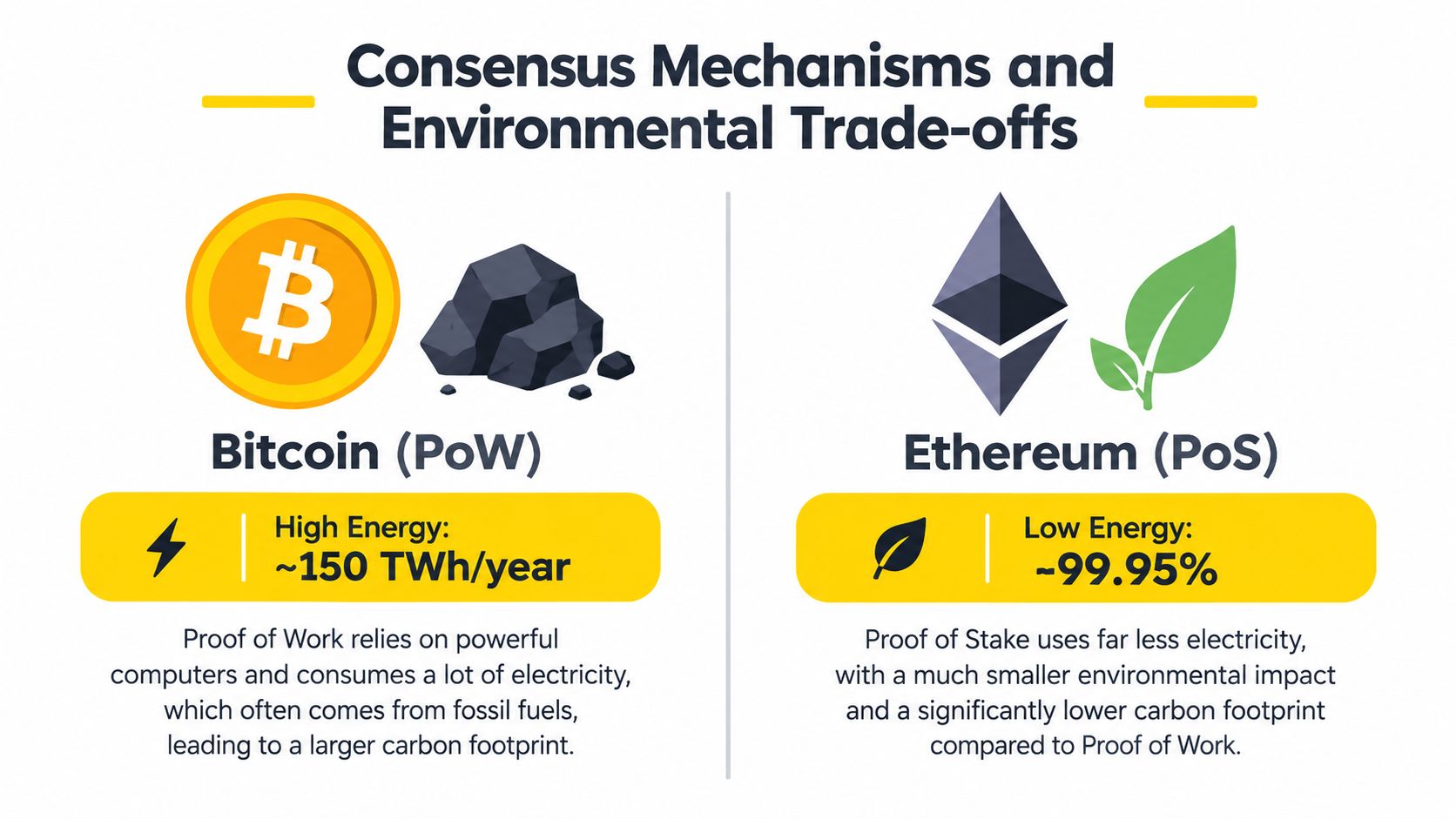
In proof-of-work, miners compete by performing computational work. Bitcoin is the clearest example. The network's security depends on a continuing race in which miners deploy hardware and electricity to find valid results. More efficient chips can reduce energy per unit of computation, but the overall network may still consume substantial electricity when competition, hardware deployment, and market incentives expand.
In proof-of-stake, validators participate by committing cryptocurrency as economic collateral. Ethereum's Merge replaced proof-of-work mining with a validator system based on staked assets. Validators still need hardware, connectivity, and reliable operations, but they aren't required to perform a comparable hashing race.
Why architecture matters
Ethereum completed its transition on September 15, 2022. Ethereum.org estimates that the change reduced the network's energy consumption by approximately 99.95%, a protocol-scale result rather than a small equipment upgrade. Ethereum's explanation of the Merge describes how the network moved from computational mining to validator participation.
That historical shift matters because it shows the difference between improving a machine and changing the task the machine must perform. Replacing older mining hardware with more efficient equipment can reduce energy intensity, but proof-of-work still asks participants to compete continuously. Proof-of-stake removes that specific computational race and changes the resource requirements of validation.
The trade-off is not merely “proof-of-stake good, proof-of-work bad.” Each architecture has different security assumptions, participation requirements, concentration risks, and governance dynamics. A project may use a lower-power mechanism but still require specialized validators, create barriers to entry, or fail to explain how participants are selected and penalized.
Compare the mechanism, not the slogan
When reviewing a project, ask:
- What activity consumes energy, continuous hashing or validator operation?
- What resources secure the network, electricity, staked assets, hardware, or a combination?
- Can the project publish participation requirements and security assumptions?
- Does lower operational demand create new environmental costs elsewhere?
- Can independent users verify the project's claims from code and network data?
A broader overview of blockchain consensus mechanisms can help readers build the vocabulary needed for that comparison. The central lesson is straightforward: consensus architecture usually has more influence than incremental hardware efficiency, but architecture alone doesn't complete a sustainability assessment.
Why Low Energy Use Is Not the Same as Low Environmental Impact
A lower electricity figure can be encouraging without being conclusive. Environmental impact depends partly on which electricity responds to new demand, where that electricity is generated, and what pollutants those facilities release.
A 2025 peer-reviewed study examined 34 large U.S. Bitcoin mines and estimated 32.3 TWh of electricity consumption. It found that fossil-fuel plants supplied 85% of the additional electricity demand, including 138 coal-fired and 497 natural-gas-fired plants. The study of Bitcoin mining and local pollution also found that electricity use, carbon dioxide, and fine-particle pollution were only loosely correlated.
That last point is easy to miss. Two regions can supply the same amount of electricity while producing different combinations of greenhouse gases and local pollutants. One plant may respond to mining demand with relatively lower carbon intensity, while another may increase coal generation and expose nearby communities to more fine particles.
Marginal demand changes the question
A project shouldn't report only its average electricity mix. It should explain the marginal source, meaning the generation that responds when miners or validators add demand. It should also show whether that demand occurs during high-pressure grid periods or when renewable power would otherwise go unused.
Useful questions include:
- Where does additional power come from? Average regional renewable percentages may hide the actual plants responding to demand.
- When does the network operate? Hourly patterns can affect grid stress and emissions.
- Where are facilities concentrated? Local communities may experience effects that a global average conceals.
- What pollutants are measured? Carbon dioxide alone doesn't describe fine-particle exposure or other local impacts.
- What happens to hardware? Lower electricity use doesn't eliminate manufacturing impacts or electronic waste.
A network can be light on electricity and heavy on unverifiable assumptions.
This distinction is especially important for small networks. A lightweight client may make participation accessible, but the project still needs to disclose how rewards, hardware, energy sourcing, and network growth affect total impact. A responsible review should read the technical documentation, inspect public activity, and look for a methodology that others can reproduce.
The practical conclusion is not that low-power designs are unhelpful. They can reduce barriers and operational demand. The conclusion is that low power is one input into an environmental assessment, not the assessment itself. For a wider discussion of the factors involved, see this overview of cryptocurrency environmental impact.
Building a Transparent Sustainability Scorecard
A credible sustainability claim needs comparable measurements, clear boundaries, and an audit trail. A single renewable-energy percentage can be informative, but it can't answer whether the energy is additional, whether it displaces other users, or how much hardware the network consumes.
Cambridge's 2025 mining report estimated that Bitcoin used 138 TWh annually, about 0.5% of global electricity consumption, and produced 39.8 million metric tons of CO2-equivalent emissions. It estimated that 52.4% of surveyed mining electricity came from sustainable sources, including 42.6% renewables and 9.8% nuclear, compared with 37.6% in 2022. Cambridge's 2025 mining report shows why energy-mix reporting is useful, while also leaving important questions open about provenance, timing, hardware, and local effects.
The scorecard
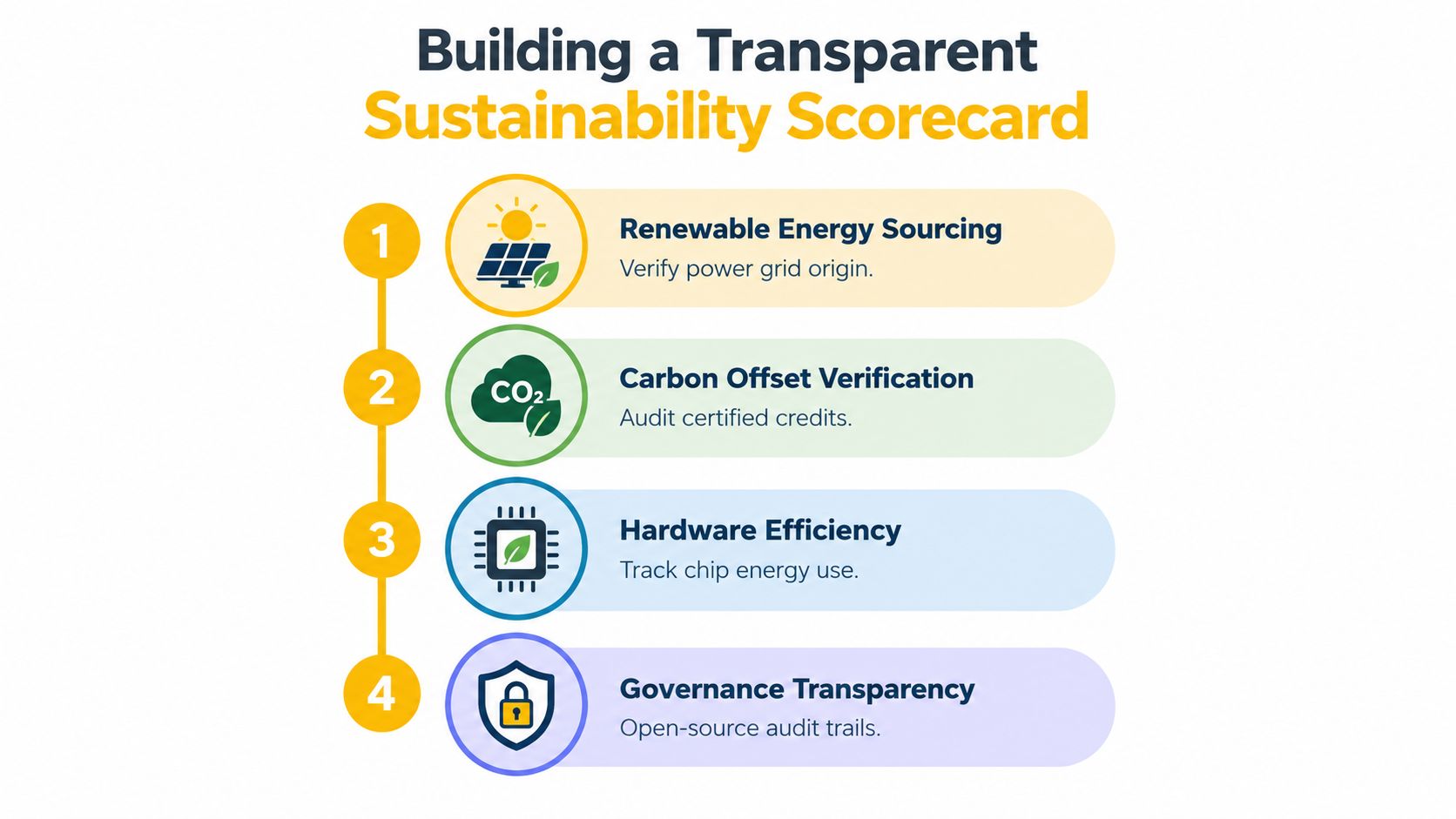
Use these categories for any network, whether it uses mining, staking, or a hybrid approach:
- Operational electricity: Report energy per successful block, reward unit, transaction, or active participant. The unit must be defined clearly so readers can compare like with like.
- Carbon intensity: Publish the method, geography, time period, and emissions factors. Separate average grid intensity from marginal demand where possible.
- Energy provenance: Identify power sources and provide evidence for renewable or nuclear claims. Explain whether certificates represent additional generation or only a contractual attribute.
- Water and local effects: Disclose water use, cooling requirements, noise, air pollution, and community exposure where those effects are relevant.
- Hardware lifecycle: Track device types, expected service life, repairability, reuse, and end-of-life treatment.
- Geographic concentration: Show where infrastructure operates and whether a small number of regions carry most of the burden.
- Independent verification: Make raw methodology, assumptions, and supporting records available for review.
How to judge the result
A strong scorecard doesn't need every answer to be perfect. It needs honest boundaries and enough detail for another person to challenge the conclusions. Be cautious when a project presents a polished renewable claim but omits energy per reward, hardware turnover, geographic distribution, or the identity of the reviewer.
Auditability matters more than a reassuring adjective.
Readers can also compare disclosures over time. A project that revises its methodology openly may be more credible than one that repeats an unchanged slogan while its participation model expands. Developers should publish uncertainty instead of hiding it, because environmental measurement always depends on assumptions about grids, equipment, and user behavior.
Technical Approaches and Real-World Case Studies
Sustainable participation can take several technical forms, and each one solves a different problem. Proof-of-stake reduces the need for continuous computational competition. Off-chain and layer-two systems can reduce activity on a base layer, although their own infrastructure still needs assessment. Green proof-of-work variants try to retain mining participation while lowering the hardware and energy burden.
The key comparison is not which label sounds cleanest. It is what participants run, how rewards are calculated, whether the code is open, and whether outsiders can verify network activity.
Three design directions
Proof-of-stake networks shift security from hashing competition to economic commitment. Their environmental profile depends on validator hardware, uptime, participation concentration, and the rules governing stake and penalties.
Alternative proof-of-work designs can reduce reliance on specialized ASIC hardware by using algorithms that run on more accessible equipment. That may widen participation and lower individual power demand, but the project still needs to measure total network activity and hardware turnover.
Off-chain scaling systems move some transactions or computation away from a base layer. They can reduce pressure on the main chain, but operators should account for the servers, bridges, sequencers, and settlement activity that support the scaled system.
Cascoin as an open-source example
Cascoin presents Labyrinth Mining, an ecological, gamified mining model in which lightweight client software simulates mice navigating a virtual maze to collect cheese. It also supports MinotaurX, a CPU-friendly option for lower-power participation, and SHA-256 for experienced ASIC operators. The important evaluation point isn't the theme. It is whether users can inspect the code, verify activity through a block explorer, review documentation, and understand how each mining path affects resource use.
The project's open workflow includes public code, on-chain verification, downloadable wallets, a public mining pool, and community discussion. Those features don't prove a complete environmental benefit by themselves, but they make the project easier to examine than a network that publishes only promotional claims.
| Mining Option | Target User | Hardware Requirement | Sustainability Rationale |
|---|---|---|---|
| Labyrinth Mining | Beginners and users seeking accessible participation | A regular computer running lightweight client software | Designed to avoid dependence on power-intensive ASIC competition |
| MinotaurX | CPU miners and low-power participants | A general-purpose CPU | Supports participation without requiring specialized mining hardware |
| SHA-256 | Experienced ASIC operators | SHA-256-compatible ASIC equipment | Provides a familiar path for operators who already use ASIC infrastructure |
No design removes every trade-off. A CPU-friendly algorithm can still consume meaningful electricity if participation grows, while an ASIC pathway can concentrate hardware and power use. The responsible standard is to publish actual operating assumptions and allow researchers to test them.
How to Evaluate and Join Sustainable Projects
Participation should begin with verification, not installation. An attractive mining interface can hide unclear binaries, weak governance, or unsupported environmental claims. Open-source projects give users more material to inspect, but openness only helps when participants know what to look for.
Start with the evidence
Use this sequence before committing hardware or funds:
- Read the consensus documentation. Identify the security mechanism, reward process, validator or miner requirements, and failure conditions. If the project can't explain what participants do, you can't assess its environmental profile.
- Inspect the code repository. Look for source code, license terms, release history, issue discussions, and reproducible build guidance. Don't assume that a public repository means every downloadable file has been independently reviewed.
- Verify on-chain activity. Use the project's block explorer to inspect blocks, rewards, transaction activity, and network continuity. Public data should support the project's description of how the network operates.
- Review sustainability measurements. Ask whether the project reports energy per reward or transaction, equipment assumptions, electricity provenance, and hardware lifecycle effects.
- Test governance. Read developer discussions and community decisions. A solo developer or small team can move quickly, but users should understand how changes are proposed, reviewed, and released.
Join carefully
Download wallets only from the project's documented channels and verify release information before importing keys. Start with a limited test of the software, confirm that the wallet communicates with the network, and observe whether mining behavior matches the documentation.
For pool mining, read the pool's fee, payout, server, and privacy information before connecting equipment. For solo mining, understand the difference between contributing to the network and receiving a reward. Neither route guarantees income, and cryptocurrency prices remain volatile.
Responsible participation means measuring your own setup, not borrowing the project's headline claim.
Record power use, operating hours, hardware temperature, and local electricity conditions. Then compare the result with the project's published methodology. Developers and researchers can contribute by opening issues, improving measurement tools, reviewing code, and challenging unclear assumptions respectfully.
Community, Policy, and the Future of Green Crypto
Technical design sets the boundaries of environmental performance, but people decide how those designs operate. Miners choose locations and schedules. Developers choose what to measure. Communities decide whether a project rewards transparent reporting or tolerates vague claims.

Open-source licensing can make that work more collaborative. Researchers can inspect algorithms, operators can report real-world performance, and users can propose changes without depending entirely on private disclosures. Community governance doesn't automatically produce good environmental outcomes, but it creates a path for evidence to influence decisions.
Policy will shape operating incentives
Regulators and grid operators may ask networks and mining facilities to report energy use, source electricity responsibly, respond to grid conditions, and manage electronic waste. Those requirements could improve comparability, especially if reporting standards define the same boundaries across projects.
Policy also needs to distinguish between contractual renewable claims and physical grid effects. A certificate can describe an energy attribute, but it may not show what generation responded to demand at a specific location and time. Better rules would encourage hourly provenance, marginal-emissions analysis, local pollution reporting, and independently reviewable methods.
The social question is just as important. A network that lowers individual participation costs may broaden access, while a network that depends on specialized infrastructure may concentrate control among a smaller group. Communities should ask who receives rewards, who bears infrastructure costs, and whether governance gives affected participants a meaningful voice.
A useful future standard would combine:
- Protocol metrics, including consensus requirements and energy per useful unit.
- Operational metrics, including power source, timing, location, and hardware.
- Environmental metrics, including carbon, water, air pollution, and electronic waste.
- Governance metrics, including open code, review procedures, and disclosure quality.
- Participation metrics, including accessibility, reward distribution, and community oversight.
The future of green crypto won't be decided by a single consensus label. It will depend on whether projects make trade-offs visible and whether users reward evidence over branding.
Sustainable cryptocurrency is best understood as an ongoing practice of measurement and accountability. Users can choose lower-power participation, developers can publish verifiable methods, operators can respond to grid conditions, and communities can reject claims that can't withstand scrutiny. Those choices won't eliminate every environmental cost, but they can make the network's impact more visible and its direction more responsible.
Cascoin offers Labyrinth Mining, a lightweight, gamified participation model, along with CPU-friendly MinotaurX and SHA-256 support for different mining setups. Review its open-source documentation and community resources, then visit Cascoin to explore the project and decide whether its transparent, community-driven approach fits your sustainability goals.